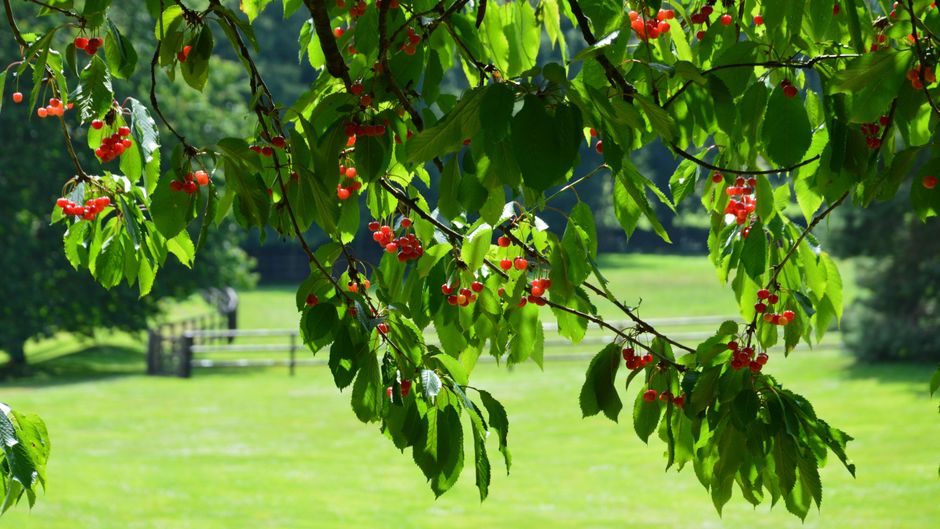
Cherry trees are essentially the drama queens of the backyard orchard. They fruit magnificently, bloom like something out of a tourism ad, and then respond to a badly timed pruning cut with the kind of quiet devastation that takes two seasons to become obvious. So when do you prune cherry trees?
The answer is shorter than you think. Fruiting cherries in July or August. Ornamental and flowering cherries right after bloom — May or June in Langley/Aldergrove. The why is what fills the rest of this post.
Quick answer: Pruning cherry trees correctly means knowing which type you have. Fruiting varieties — Bing, Lapins, Stella, Morello — prune in July or August, immediately after harvest. Ornamental and flowering cherries — Kwanzan, Yoshino, Prunus serrulata and its relatives — prune in May or June, right after the blooms drop. Both types share one absolute rule: never prune in autumn. That is the window where silver leaf disease does its best work.
Nine out of ten homeowners who call us about a struggling cherry tree mention they pruned in autumn. It looked fine for a season. Then it didn't.
Which cherry tree is actually in your yard
Langley/Aldergrove has two distinct populations of cherry trees. The first is the fruiting variety — Bing, Lapins, Stella, and Montmorency are the most common — planted in older established yards, often by previous owners who wanted fruit. The second is the ornamental cherry: Kwanzan, Yoshino, and various Prunus serrulata cultivars, planted by landscapers and developers across the Fraser Valley for their spring display.
The pruning rules differ enough that getting this identification right is step one.
How to tell them apart: Check in late spring. Fruiting varieties produce small, glossy fruit — red, yellow, or near-black depending on the variety — that is edible and plentiful. Most ornamental cherries produce no meaningful fruit, or very small, bitter drupes that birds eat before you get a chance to look closely. Ornamental varieties like Kwanzan also have noticeably doubled flowers — multiple petals per bloom rather than the simpler five-petal blooms on fruiting trees.
If you are still not sure, look at the leaf shape after the flowers drop. Fruiting cherry leaves tend to be longer and more pointed; ornamental leaves are slightly more rounded with serrated edges. If you genuinely cannot tell, a ten-minute site visit from an ISA Certified Arborist will settle it.
Why does it matter so much? Because the pruning windows are different. Get them confused, and you are either pruning at the wrong time — which invites disease — or skipping a pruning window that the tree actually needed.
When to prune — the rule that differs by type
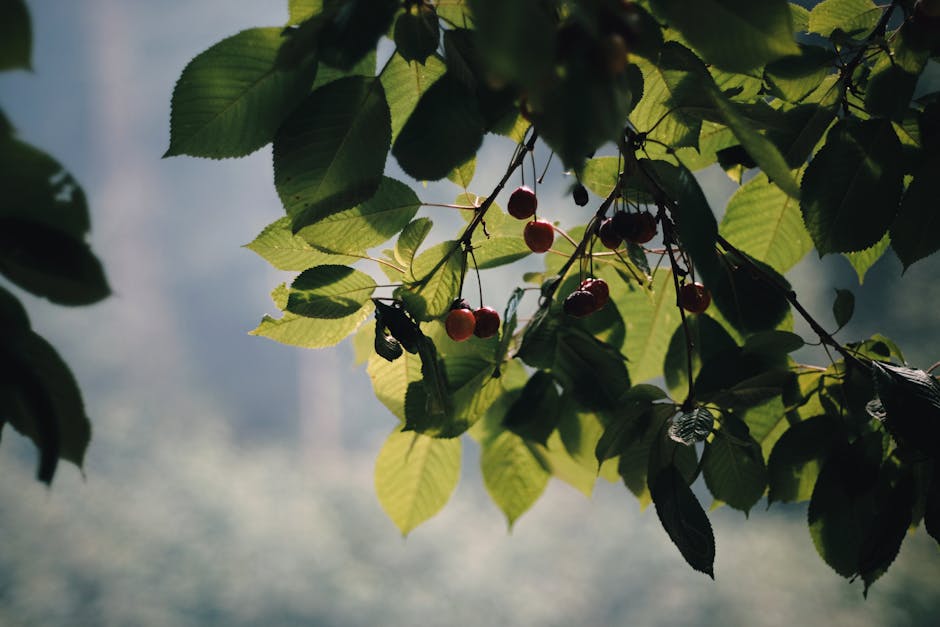
Fruiting cherry trees: July and August, right after the last fruit is picked. The tree is still in active growth, wounds close quickly in warm dry weather, and the vascular system is moving fast enough to compartmentalise fresh cuts before disease can establish. This is not a soft preference — the BC Tree Fruit Production Guide identifies summer as the recommended window specifically because silver leaf disease and bacterial canker are least active in warm, dry conditions.
Sour cherries (Montmorency, Morello) follow the same summer rule. They are slightly more forgiving than sweet varieties, but BC's wet autumns and winters make summer pruning the correct call regardless of variety.
Late February as a backup: If summer pruning was genuinely missed, late February — after the worst frost, before bud break — is a distant second option. Do it only in a dry spell. It is not equivalent to summer pruning; disease risk is meaningfully higher in the dormant season in the Pacific Northwest.
Ornamental and flowering cherry trees: Prune immediately after blooming ends — May or June in Langley/Aldergrove, depending on the variety and the year. These trees do not produce fruit to time the pruning around, so the bloom is your marker. Wait until the blossoms have dropped, then prune within the following four to six weeks while the tree is in active leaf growth.
I reckon the most common mistake I see with ornamental cherries in Langley/Aldergrove is pruning them in late February before bloom. It seems logical — the tree is dormant, the branches are bare, you can see what you are doing. The problem is that timing removes the flower buds and the cuts sit open through weeks of wet Pacific weather before the tree has any real wound response. For a detailed breakdown of fruiting cherry technique, see our fruiting cherry tree pruning guide.
How to prune a cherry tree: cuts, angles, and the 20% rule
The order matters as much as the technique.
Step one: dead, diseased, and damaged wood. This comes out first, regardless of anything else. Dead branches harbour pest and disease entry points. Remove them cleanly back to healthy tissue. Do not leave stubs.
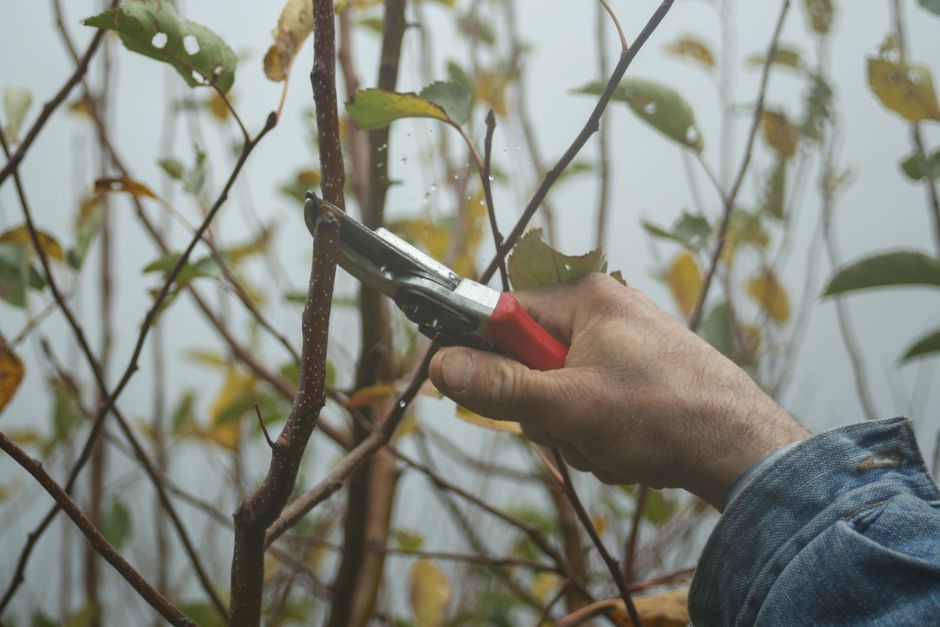
Step two: crossing branches and water sprouts. Crossing branches create wounds where they rub. Water sprouts — those vigorous vertical shoots that rocket up from scaffold limbs — produce almost no fruit and shade the interior wood that does. Both come out entirely, cut flush to the parent branch without leaving a stub, and without cutting into the branch collar (the slightly swollen ring of tissue where the branch meets the trunk).
Step three: shape and light. For fruiting cherries, the goal is an open-centre vase: three to five scaffold branches fanning outward with the interior open to light. For ornamental cherries, the goal is usually maintaining the natural arching habit and keeping the canopy from becoming too dense. Prune back to a lateral branch pointing in the direction you want the tree to grow.
The 20% rule. Remove no more than 20% of the total canopy in a single season. This is not an arbitrary number — exceed it and the tree's stress response produces water sprouts at an accelerated rate, and you end up doing more work to undo what the rule would have prevented. For a broader look at pruning technique across species, see our general tree pruning guide for Langley/Aldergrove.
Cut angle:45° slope, just above an outward-facing bud. The slope allows water to run off. Sharp, clean tools. No wound sealant — research from the last twenty years consistently shows it does more harm than good by trapping moisture and interfering with the tree's own compartmentalisation.
Silver leaf disease and why summer is non-negotiable
Silver leaf (Chondrostereum purpureum) is the reason the pruning timing for cherry trees in BC is stricter than almost any other species. The fungus produces spores on dead and decaying wood through autumn and winter. Those spores land on fresh pruning cuts. In cold, wet conditions — October through February in Langley/Aldergrove — a wound stays open and vulnerable long enough for the fungus to establish inside the wood.
By the time the silvery metallic sheen appears on the leaves — which is how the disease gets its name — the fungus has been colonising the wood for months, sometimes an entire season. At that point there is no treatment. Management means removing all affected tissue well below the visible stain line, sterilising tools between every cut to avoid spreading spores, and hoping the rest of the scaffold can recover. Agriculture Canada's guide on silver leaf disease describes the full progression and confirms there is no chemical cure once infection is established.
Severe cases require removing the tree entirely. That is a $600–$1,200 removal job, depending on size. The prevention is free: prune in summer with clean tools. (The tools need to be actually clean. Sterilise with 70% isopropyl alcohol or a diluted bleach solution — one part bleach to nine parts water — between trees and between cuts when removing infected wood.)
Bacterial canker (Pseudomonas syringae) follows a similar pattern. It enters through wounds during wet weather, causes sunken lesions and amber gum on the bark, and is most damaging on young trees. The same summer pruning window that protects against silver leaf also keeps bacterial canker risk low.
When not to call an arborist
I will happily tell you when you don't need us, because it happens regularly.
Skip the arborist call if: Your cherry tree is under four metres tall. You have clean, sharp secateurs or loppers. You know what type it is and what the timing is. You are removing less than 20% of the canopy, targeting dead wood, water sprouts, and crossing branches. That is a legitimate DIY job. Give us a call to confirm your timing if you are unsure, but the call itself is free.
Call us when:The tree is tall enough that you need a ladder to reach more than a third of the work. There are already signs of silver leaf — silvery or dull metallic leaves on any branch — because cutting infected wood without proper tool hygiene spreads the fungus. The tree is within fall distance of a structure, or branches are over a roof or near power lines. You've never pruned a cherry tree and this one has been neglected for more than three years, because restoring an overgrown scaffold is different from annual maintenance.
The rule of thumb: if you could do the whole job standing on the ground with a step stool for the highest cuts, you probably don't need us. If you need a ladder for more than a few cuts, or if anything about the tree's structure looks concerning, that is when a professional assessment is worth the cost — because cherry trees are genuinely worth protecting.
What cherry tree pruning costs in Langley/Aldergrove
Nobody lists honest numbers. We think they should.
| Tree size | Typical range (CAD) |
|---|---|
| Small cherry under 4m, straightforward access | $150–$300 |
| Medium cherry 5–8m, established scaffold | $300–$600 |
| Large mature cherry over 8m | $600–$1,200 |
| Overgrown or neglected tree requiring restoration | From $400 |
Pricing is flat and confirmed before work starts. If scope changes on the day — a second damaged scaffold branch becomes apparent once we're up in the tree — work stops, you get a revised number, and you decide. You will not find out the price after the fact.
For more on what affects tree pruning pricing across species, see our tree trimming cost guide for Langley/Aldergrove.