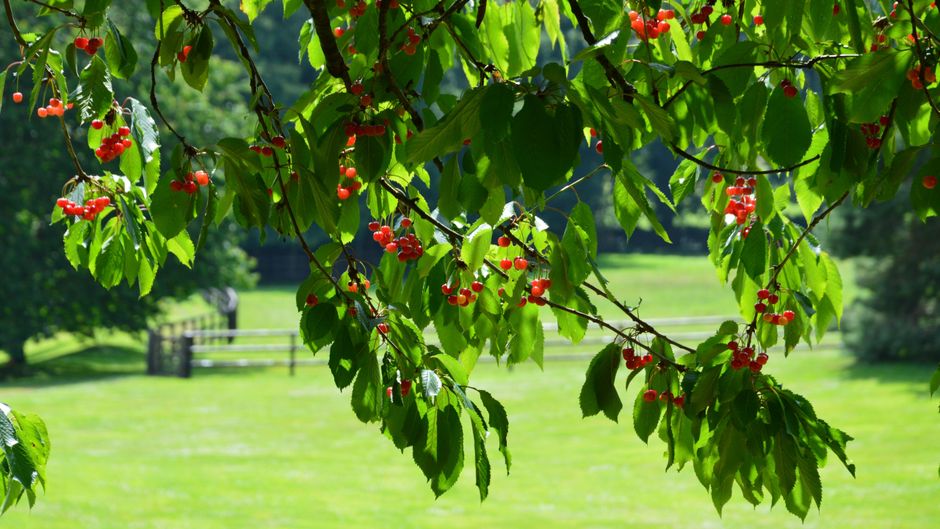
Pruning fruiting cherry trees in Langley/Aldergrove should happen in July or August, right after harvest. That is the direct answer, and everything else in this guide is the reason it matters as much as it does.
The cherry on top of getting this timing right is a tree that stays healthy for decades. Get it wrong — prune in autumn, or worse, leave it until the wet February window that works fine for other fruit trees — and you are handing silver leaf disease an open invitation through every fresh cut. (It never declines.)
Short answer: Prune sweet cherries in July–August, after harvest and before September. Remove no more than 25–30% of the canopy in a single season. Aim for an open-centre vase with three to five scaffold branches. Do not prune in autumn. If you missed summer, late February is a distant second option — only if the weather has been dry.
Nine out of ten homeowners who call us about a struggling cherry tree pruned it at the wrong time of year. The tree looked fine for a season or two, then the leaves started silvering. By then the fungus had been working inside the wood for months.
When to prune fruiting cherry trees in Langley/Aldergrove
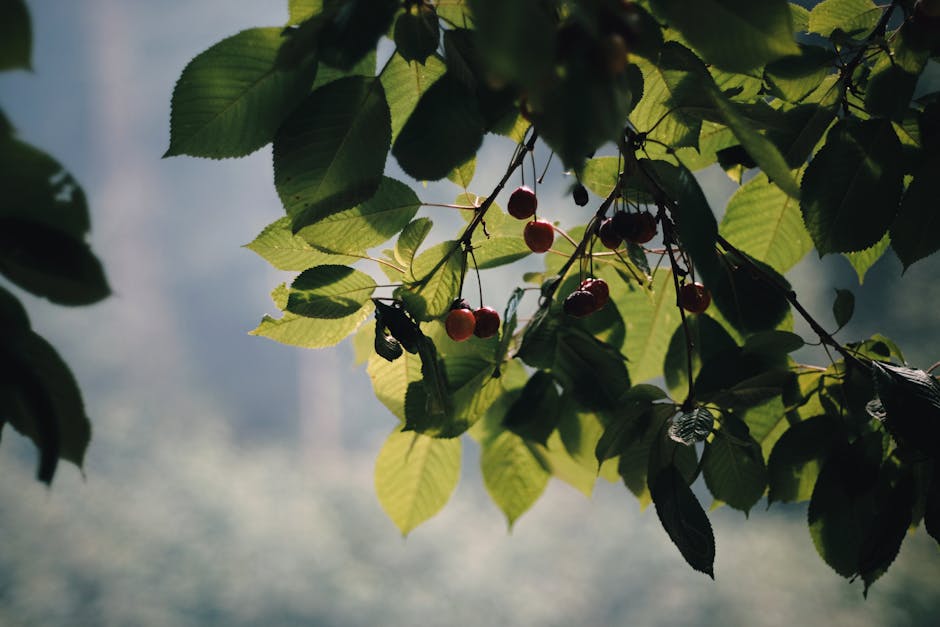
The correct window for pruning fruiting cherry trees in Langley/Aldergrove is July through August, immediately after the last fruit is picked. The tree is still in active growth — wounds close quickly, the vascular system is moving, and the dry summer weather keeps disease pressure low.
Sour cherries (Montmorency, Morello) follow the same rule. They are slightly more forgiving than sweet varieties, but in BC's climate the summer window is still the safest.
The second option: late February, after the worst frost but before bud break. This is acceptable only in a dry year and only for trees that genuinely could not be reached in summer. It is not equivalent to summer pruning — disease risk is meaningfully higher in the dormant season in the Pacific Northwest.
Never: October, November, December, January. These are the months when silver leaf disease is most active, wounds heal slowest, and your pruning cuts will be open to infection for the longest period. The BC Ministry of Agriculture consistently identifies late summer as the recommended window for cherry pruning in this climate zone.
Silver leaf disease — why timing is everything
Silver leaf (Chondrostereum purpureum) is a fungal pathogen that colonises cherry trees through fresh cuts in the bark. The name comes from a metallic sheen that appears on the leaves of affected branches — by the time you see it, the fungus has been growing inside the wood for months, sometimes an entire season.
The mechanism is straightforward. The fungus produces spores on old, dead wood throughout autumn and winter. Those spores land on pruning wounds. In warm, dry summer weather, the tree's wound response is fast enough to seal the cut before the fungus can establish. In cold, wet conditions — October through February in Langley/Aldergrove — the same wound stays open long enough for infection to take hold.
There is no effective chemical treatment once a tree is infected. Management means removing affected branches well below the stain line and sterilizing tools between cuts. Severe cases require removing the tree entirely. The prevention is free: prune in summer, use clean tools, make sharp cuts that the tree can seal quickly.
Sterilize pruning tools with 70% isopropyl alcohol or a diluted bleach solution — one part bleach to nine parts water. Do it between trees and between cuts when you are removing visibly diseased wood. US Forest Service research confirms that sterilized tools reduce transmission of wood pathogens significantly across all fruit tree species.
The open-centre shape and how to build it
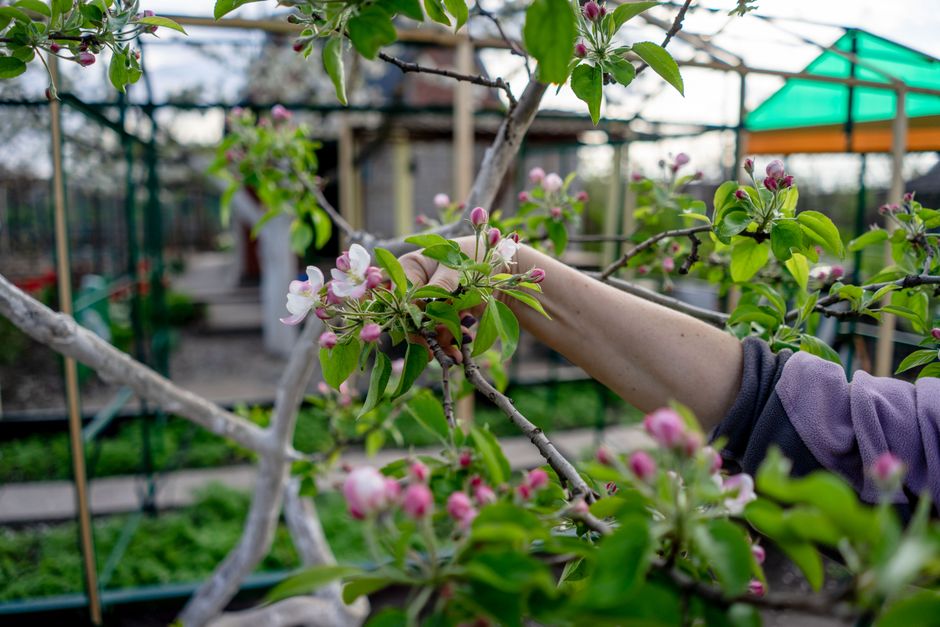
The standard form for a backyard fruiting cherry is the open-centre vase: a short central trunk, then three to five main scaffold branches fanning upward and outward, with no dominant central leader above them. The result looks a bit like a wine glass, which I reckon is appropriate given what you are going to do with the fruit.
The practical reasons for this shape: light reaches the interior fruiting wood, air moves freely through the canopy (reducing the damp conditions that brown rot and silver leaf prefer), and the fruit stays at a height you can actually reach.
For young trees in years one through three: choose your scaffold branches early. Remove competing leaders, anything pointing back toward the centre, and any branch that crosses another. You are not trying to produce heavy fruit yet — you are building the structure that will produce for the next thirty years.
For established trees: the annual goal is maintaining that open shape. Remove water sprouts (vigorous vertical shoots from the scaffold branches), any branches that have grown to block light from the interior, and wood that is crowding fruiting spurs.
Fruiting spurs — the short, stubby side branches that carry the cherries — should largely be left intact. They produce well for eight to ten years before needing replacement. Do not confuse them with water sprouts, which are long and straight and fruit poorly. For a full picture of our approach to fruit tree structure, see our tree pruning service in Langley/Aldergrove.
What to remove — the right sequence
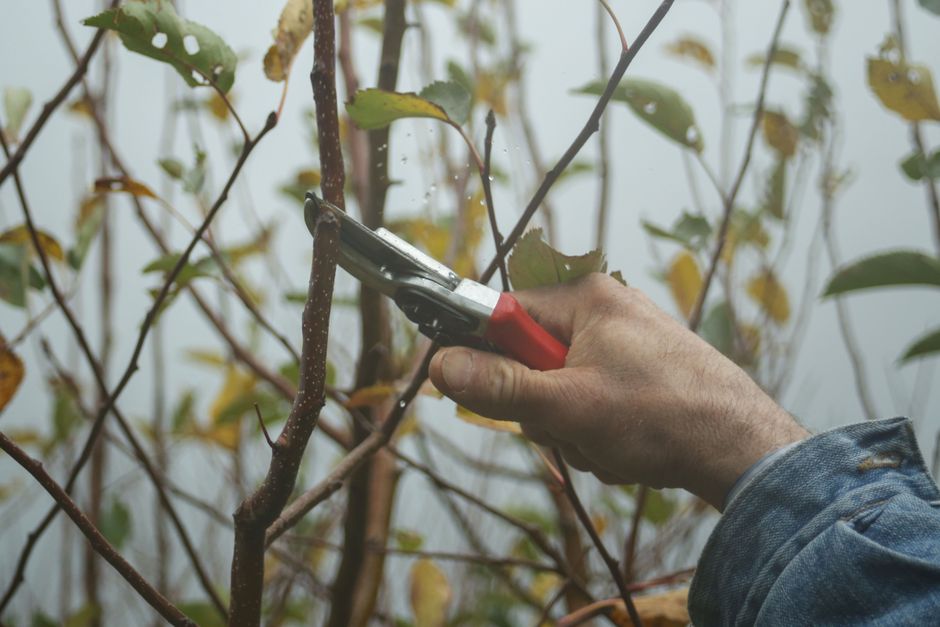
Work through cherry trees in this order. Each step makes the next easier to assess.
Step 1 — Dead, diseased, damaged wood. This comes out regardless of season or circumstance. Dead branches are entry points for pests and disease. Remove them cleanly back to healthy wood.
Step 2 — Suckers and water sprouts. Any growth shooting straight up from scaffold branches, or emerging from below the graft union at the base, should come out entirely. These are vigorous but they fruit poorly, they shade the interior, and they divert energy from productive wood.
Step 3 — Crossing and rubbing branches. Where two branches rub against each other, one or both will eventually have bark damage. Pick the branch that better serves the overall shape and remove the other.
Step 4 — Centre-crowding growth. Any branch that has grown inward and is starting to fill the centre of the vase should be shortened or removed. The goal is light penetration, not density.
Rule of thumb: do not remove more than 25–30% of the live canopy in a single season. Harder pruning triggers a flush of water sprouts as the tree compensates — which means more work next year, not less.
Make cuts just outside the branch collar — the slight ridge where the branch joins the trunk. Do not cut flush with the trunk (removes the callus tissue) and do not leave a long stub (dies back and invites disease). Sharp tools only. Ragged cuts on cherry wood are an invitation the fungus will accept.
Restoring a neglected cherry tree
A cherry tree that has not been pruned in three or four years is a project, not a one-afternoon job. The fruiting zone has moved upward. The interior is crowded and damp. There is probably dead wood throughout and water sprouts competing everywhere for light.
The right approach: spread the work over two seasons. In year one, remove all dead and diseased wood, cut out the worst crossing branches, and open the centre as much as you can without exceeding the 25–30% removal limit. In year two, do the structural work — reducing scaffold height, thinning spurs, establishing the vase shape properly.
Attempting a full restoration in a single session triggers a wall of water sprouts the following spring. You will end up doing more total work, not less. Patience here is not a virtue — it is just efficiency with an extra year attached.
When not to prune it yourself
I will tell you this even though it costs us call-outs. If your cherry tree is under 3m, structurally sound, and within easy reach from the ground or a stable stepladder — prune it yourself. You have the guide above. It is not complicated once you understand the timing and the sequence.
Give us a call when:
- The tree is over 4–5 metres and the structural work requires working at height with a chainsaw
- There is visible dead wood or a suspicious silvery sheen on the leaves — that needs a professional assessment before any cutting starts
- The tree is overhanging a structure, a fence line, or power infrastructure — the rigging and drop zone planning matters
- You are unsure whether what you are looking at is a water sprout, a fruiting spur, or a scaffold branch — one wrong cut on the wrong branch costs you years of production
For a standard maintenance prune on a healthy, accessible tree, hiring a certified arborist is not strictly necessary. For structural restoration, a tree with suspected disease, or anything at height — it is.
What cherry tree pruning costs in Aldergrove, Langley/Aldergrove, Langley, and the Fraser Valley, BC
Nobody puts prices on these pages. I reckon they should.
| Tree size / scope | Typical range (CAD) |
|---|---|
| Small tree under 4m, standard maintenance prune | $160–$280 |
| Medium tree 4–7m, maintenance prune | $280–$450 |
| Large mature tree over 7m | $450–$700+ |
| Neglected tree, staged restoration (year one) | $350–$600 |
| Multiple trees, same property (per tree) | Reduced rate — ask |
Price is confirmed before any work starts. If we get up the tree and find silver leaf staining or structural issues that change the scope, we come down, explain what we found, give you the revised number, and wait for yes. Nobody starts cutting and figures out the bill afterward.
Most maintenance prunes on a healthy 4–5m cherry take about 90 minutes. The cleanup is included. The quote covers the whole job, not just the climbing part. For tree removal costs if a cherry tree has reached the end of its life, we have a separate guide with honest numbers on that too.