
Before we go any further, I should tell you that pruning trees is, by definition, a cut above most weekend garden projects. I had to get that out of the way early.
Here’s the direct answer: prune most deciduous trees in late fall through early spring, while they’re dormant and leafless. That window gives you the best wound closure, the clearest view of what needs to come out, and the lowest risk of spreading disease. For dead, damaged, or dangerous branches — take them off any time of year, no waiting required.
Nine out of ten pruning questions I get come down to timing and technique. This guide covers both, along with the mistakes that turn a healthy tree into an expensive problem.
Why prune trees at all
Pruning isn’t just about making a tree look tidy. It serves four real purposes.
Health.Removing dead, diseased, or crossing branches stops decay and fungal problems from spreading into healthy tissue. A diseased limb left in place doesn’t stay put — it works its way toward the trunk over time.
Structure. Young trees pruned early develop stronger central leaders and better branch angles. A tree with good structure at age 10 is dramatically less likely to fail at age 40. Early formative pruning is the highest-return investment you can make in a tree.
Safety. Branches over rooflines, driveways, and power lines are risk factors, not just inconveniences. A limb that fails in a windstorm over your car is a different problem than one that falls in the garden. Regular pruning keeps clearances where they should be.
Aesthetics and function. For fruit trees, pruning improves light penetration and air circulation, which directly affects yield. For shade trees, it shapes the canopy. For cedars and hedges, it keeps form. These are valid reasons to prune — just lower on the priority list than the first three.
A useful shorthand is the Four D’s: remove anything that’s Dead, Diseased, Damaged, or Deranged (crossing or rubbing another branch). Work through that checklist on any tree and you’ve covered most of what genuinely needs doing.
When to prune trees in Langley/Aldergrove BC
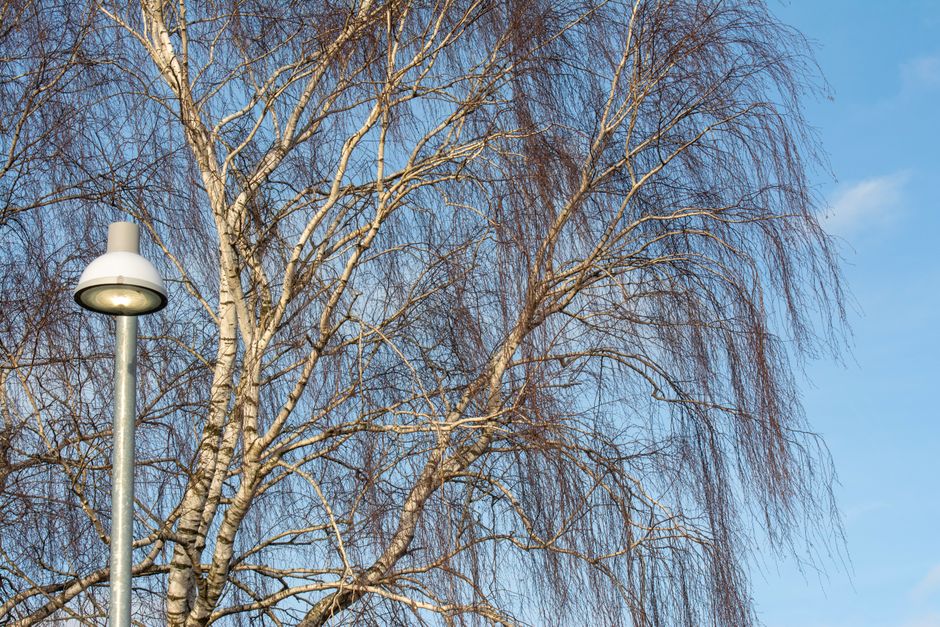
The general rule for deciduous trees is the dormant season: roughly late October through late February in the Fraser Valley. That’s when trees have dropped their leaves, sap flow is minimal, insects aren’t active, and the branch structure is clearly visible. Cuts made in this window close faster when the growing season returns.
Langley/Aldergrove’s mild winters complicate this slightly. We don’t always get hard frosts to confirm full dormancy. Watch for leaf drop as your signal — once a tree has shed its leaves and isn’t showing any bud swell, you’re in the window.
Species that need different timing:
- Oaks and elms — avoid pruning between April and July. Oak wilt and Dutch elm disease spread via sap-feeding beetles attracted to fresh cuts. Prune in deep winter (December–January) or wait until August when beetle populations are lower.
- Bleeders (maple, birch, cherry, walnut)— these produce heavy sap flow from late-winter cuts. You have two options: prune in December when fully dormant, or wait until late May or June when the tree is fully leafed out and sap pressure has dropped. Both work well. Avoid the in-between window of February through April if you don’t want a tree that looks like it’s crying.
- Evergreens (cedar, spruce, pine) — prune just before new growth in late February to early March. For pines specifically, remove candles (new growth spurs) in late spring before they harden off to control shape.
- Spring-flowering trees (cherry blossom, magnolia, lilac)— prune immediately after flowering, not before. Pruning before means cutting off next year’s buds.
Dead and dangerous branches come off any time of year — season doesn’t override safety. If you’re not sure whether a branch is dead or just dormant, our guide on how to tell if a tree is dead walks through the scratch test and other checks you can do from the ground.
How to prune trees properly
Choose the right tool for the branch diameter:
- Bypass pruners — up to 2 cm. The bypass blade makes a cleaner cut than anvil types and is less likely to crush soft tissue.
- Loppers — 2–5 cm. Longer handles give you leverage and reach.
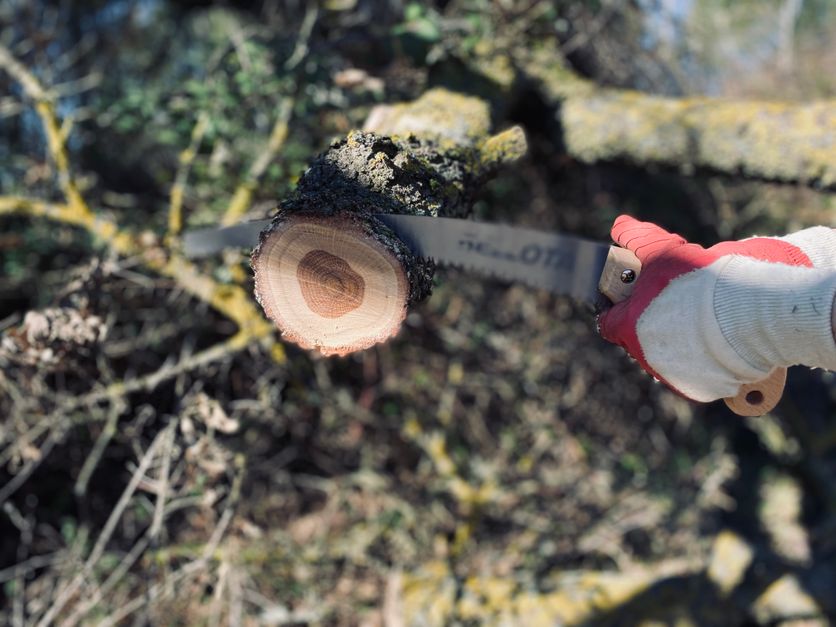
- Folding hand saw or pruning saw — 5–10 cm. Most residential pruning that actually matters falls here.
- Chainsaw — 10 cm and above, or overhead work. Requires proper training, PPE, and usually a second person on-site.
The branch collar is the key reference point.It’s the slightly swollen ring of tissue where a branch meets the trunk or a larger limb. You can usually see it as a wrinkled or raised band. Your cut goes just outside it — not through it, and not leaving a long stub beyond it.
Cutting through the collar removes the tissue the tree uses to close the wound. Leaving a long stub creates a dead zone that rots inward. The collar is the target; cutting just outside it is how you leave the tree in the best possible position to heal itself.
For small branches (under 5 cm), one clean cut just outside the collar is all you need. Angle it slightly if you want, to allow water to run off the cut surface, but the location matters far more than the angle.
The 25% rule:never remove more than a quarter of the tree’s live canopy in a single season. Going beyond that puts the tree into stress response — energy reserves drop, the immune system weakens, and you often trigger a burst of weak, fast-growing epicormic shoots that create future problems. If there’s a lot to do, plan it over two or three seasons.
According to the Morton Arboretum, the two fundamental pruning cuts are thinning (removing a branch at its origin) and heading back (cutting to a lateral branch). Thinning is almost always the better choice — it preserves natural structure, reduces wind resistance, and doesn’t create the regrowth problems that heading cuts can.
The three-cut method for large branches
Any branch heavy enough to tear bark as it falls needs the three-cut method. The risk with a single cut on a large limb is that the weight peels a strip of bark down the trunk before the branch fully separates — leaving a long wound that takes years to close and invites disease in the meantime.
Cut 1 — the undercut. About 30 cm out from the trunk, saw upward about a third of the way through the branch from below. This creates a stop point for any bark tear.
Cut 2 — the top cut.About 2 cm further out from the trunk than your undercut (so you’re leaving a short stub), saw down from above until the branch drops. The undercut stops any tear in its tracks.
Cut 3 — the collar cut. Remove the remaining stub by cutting just outside the branch collar. This is your final, clean cut that the tree will seal over.
This sequence works because each step removes the weight and the tear risk before you make the cut that actually matters. The International Society of Arboriculture recommends it as standard practice for any limb that can’t be safely supported during cutting.
Common pruning mistakes to avoid
Flush cuts. Cutting right against the trunk, removing the branch collar, is the most common mistake I see on DIY pruning jobs. It destroys the tissue the tree uses to close wounds and creates a flat scar that rots inward rather than healing over.
Leaving stubs.The opposite problem — cutting mid-branch and leaving a long stub. The stub dies back, rots, and becomes an entry point for decay fungi. Rule of thumb: if the stub is longer than 5 cm, it’s too long.
Pruning oaks in late spring or summer. This one bears repeating because the consequences are severe. Oak wilt has killed mature trees in BC within a single season. If you have oak trees on your property, prune them in December or January — not in the window when beetles are active.
Lion’s tailing. Stripping all the inner branches and foliage from a limb, leaving a clump only at the tip. It looks dramatic but destabilises the tree — long branches with all the weight at the end are prone to failure, especially in wind.
Tree topping.I reckon tree topping is the single most destructive thing you can do to a mature tree while technically still leaving it alive. Topping cuts the main branches back to flat stubs, which triggers an explosion of epicormic regrowth — dozens of structurally weak shoots growing faster than the original canopy, poorly attached at the base, and far more likely to fail in a storm than the branches they replaced. ISA research consistently shows topped trees die 10 to 20 years earlier than trees managed with proper pruning. If a contractor quotes you a topping job and can’t explain why it’s necessary, ask to see their arborist certification. Or just call someone else.
When to call a professional arborist
A lot of pruning is perfectly safe to do yourself. Small branches under about 10 cm diameter that you can reach from the ground or a stable step ladder — go for it. Young trees needing formative pruning, basic deadwood removal in reach: that’s homeowner territory.
The line to stop at:
- Anything requiring a ladder more than 2 metres high
- Branches over structures, vehicles, or fencing
- Anything near power lines — not negotiable, not ever a DIY job
- Large branches over 15 cm diameter where a chainsaw is required overhead
- Any tree you suspect has structural issues at the trunk or major branches
The honest version of this advice: if you’re considering renting a chainsaw and climbing a ladder to remove something, call first. A phone call costs nothing. A hospital visit and a damaged roof cost considerably more.
We’re also happy to come for an assessment and tell you what’s safe to DIY and what isn’t. That’s sometimes more useful than just booking the whole job. For the work that genuinely needs professional equipment, our tree pruning services in Langley/Aldergrove cover the full range, from formative pruning on young trees to crown reduction and structural work on established ones. For branches that look like they might fail before you can book something in, the dangerous tree assessment page explains what that process looks like.
I’ll leave you with a thought I’ve shared at more than a few client assessments over the years: the trees you prune well in the first decade are the ones that never cause problems in the next three. The ones that get ignored, topped, or badly cut are the ones we get called about at midnight in November. Give us a call — ideally before that happens.