
Weeping willows got their name for a reason. They also — if you trim them wrong — have a reliable way of making the homeowner do the same. (Too on the nose? It stays.)
How to trim a weeping willow tree: late winter to early spring is your window, late February through early April in the Surrey and Fraser Valley area. Take out the deadwood, the crossing branches, and the upright water sprouts. Leave the long sweeping fronds alone unless they are dragging on something they should not be. Do not remove more than 25–30% of the canopy in a single season. That covers most of what you need to know.
The rest of this is why those rules exist, and what to do when the situation gets more complicated.

Why weeping willows need a different approach
Weeping willows — Salix babylonica, Salix alba Tristis, and their close relatives — are fast. Three to eight feet of new growth per year in good conditions is normal. They push hard toward water sources, which in a residential yard often means your downspouts, your irrigation lines, and — eventually, if you let it go — your foundation drain. (Weeping willows have an almost supernatural ability to find drainage pipes. It is not a feature.)
That growth rate means they need regular management. Ignore one for three or four years and you have a tree that has doubled in size, with scaffold limbs crossing each other and roots starting a conversation with your neighbour's yard.
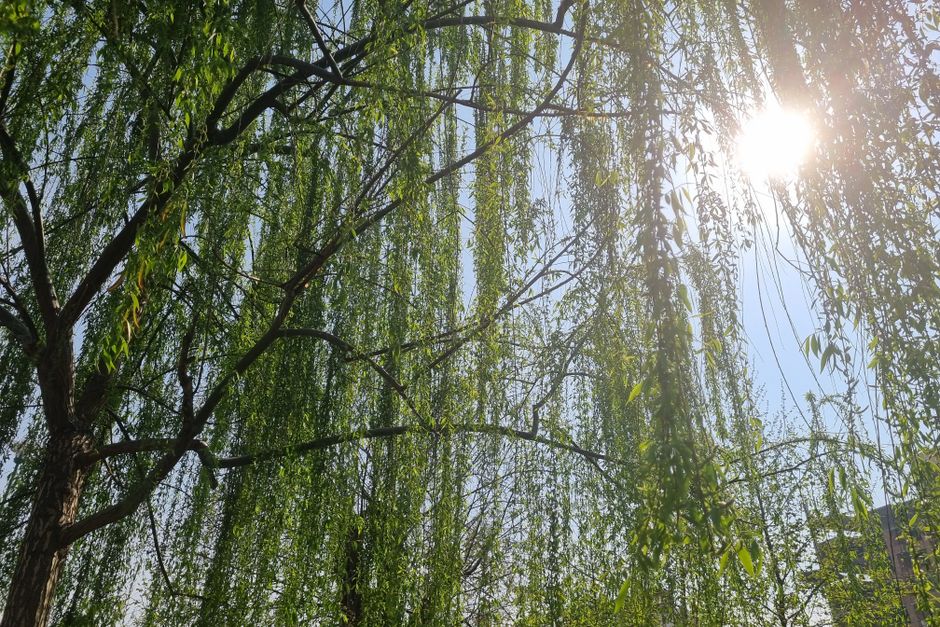
The other thing that sets them apart is their architecture. The signature look comes from the long cascading branches — what arborists call the scaffold limbs — and the long flexible branchlets that hang from them. Most trimming mistakes on weeping willows happen when someone treats those hanging fronds like hedging material and cuts them back hard. That is not how they work. The fronds are not what you are managing. The underlying structure is.
This is also worth saying clearly: weeping willow pruning is different from dappled willow pruning. Dappled willow (Salix integra Hakuro Nishiki) is a compact shrub you cut hard every year or two to refresh the foliage colour. Same genus, completely different plant, completely different approach.
The right time to trim a weeping willow
Late winter to early spring: late February through early April in Surrey and the Fraser Valley. That is your window.
Trim when the tree is dormant or just breaking bud — before new growth has pushed out. The cuts trigger fresh growth, and you want that growth to have a full growing season to harden off before October. This is standard timing for most deciduous trees in our climate, and willows follow it the same way.
The time to avoid is late summer through fall — August through October specifically. Trim then and you trigger a flush of tender new growth that will not harden before the first frost. That new growth is what fails first in a wet, cold coastal winter. You will be left with dead shoot tips all over the canopy and more work to do in spring.
Minor deadwood removal is the exception. If you have a branch that is clearly dead — dry, brittle, no bud swell even mid-summer — remove it whenever you notice it. The timing rules apply to living wood.
Rule of thumb for BC: have any major structural work done by late September. The storm season runs October through March here, and a well-maintained willow sheds wind considerably better than one that has not been touched in three years.

What to trim — and what to leave alone
This is where most DIY trimming goes wrong. Two clear lists.
What to remove:
Deadwood. Dry, brittle branches with no leaf buds or bark pulling away from the wood. Easy calls. Remove them at any time of year, cutting back to the nearest living branch union.
Crossing and rubbing branches. Where two branches press against each other, bark gets damaged and disease gets in. Remove the weaker of the two — usually the one growing inward toward the canopy or the one with the smaller diameter.
Upright water sprouts. Fast-growing, straight-up shoots that emerge from horizontal scaffold limbs. They are not part of the weeping structure. Remove them at the base. They will come back, and you will remove them again. That is normal.
Low-hanging fronds touching ground, house, fence, or vehicles. These can be shortened — but cut to a healthy side-bud or branch, not a bare stub. There needs to be living wood at the cut point.
What to leave alone:
The cascading fronds themselves. Do not head these back hard. If you cut the hanging branchlets to stubs all over the tree, you get a burst of bushy regrowth that looks nothing like a weeping willow and everything like a bad haircut. The fronds grow back, but the structure takes years to re-establish.
Healthy scaffold limbs. The main branches off the trunk. Do not remove these unless there is a specific structural reason. They are the architecture of the tree.
Nine times out of ten, when I arrive to sort out a willow that has been trimmed badly, the problem is the same: someone took loppers to the hanging fronds and cut them back uniformly. The tree looks tidy for about six weeks. Then it comes back bushy, with multiple competing shoots from every cut point, and the homeowner cannot figure out what went wrong.
How to make a clean cut
The cuts matter as much as what you cut.
An angled cut — roughly 45 degrees — made about a quarter of an inch above a healthy bud. The angle faces away from the bud so water runs off rather than sitting on the wound. This is standard for most pruning work and willows are no exception.
No stubs. A stub is a section of branch left projecting past the last healthy bud or branch union. It dies back and becomes an entry point for disease and decay. Cut to the branch union or just above a bud. Nothing left hanging in the air.
Clean tools. Wipe pruning saws and loppers with isopropyl alcohol before you start. If you are working through visibly diseased sections — sunken, discoloured bark patches are the tell for cytospora canker — clean between each cut. Fungal problems travel easily on cutting tools and you can spread them through the tree without realising it.
No wound sealant. The research on this is consistent: it does not help and can trap moisture against the wound, creating conditions that favour decay. The ISA's pruning guidance dropped this recommendation years ago. Trees compartmentalise their own wounds better than any sealant does.
How much can you safely take off a weeping willow
Twenty-five to thirty percent of live canopy per season is the rule of thumb. Willows can handle a harder cut than most species because of their vigour — they push back fast. But that is not an argument for going further. Removing more than a third in one pass stresses the root system and triggers excessive water sprout production. The tree responds by growing back harder, which is the opposite of the result you wanted.
I had a call a couple of years back from a homeowner in Surrey whose willow had not been touched in five years and was overhanging the house roof. A well-meaning relative had taken it upon himself to deal with it: he removed close to 60% of the canopy, straight across the top like a hedge. The tree survived — willows generally do. But it threw up dozens of water sprouts from every cut point, grew back denser than before, and the structure took three seasons of corrective work to sort out. The logic had been that a smaller tree was a tidier tree. Short-term, that was true. Long-term, it created considerably more work.
If the tree is severely overgrown and needs significant reduction, phase it. Take 25–30% this season. Assess again next year. The results are cleaner, the tree handles it better, and you end up with a properly shaped specimen rather than a recovery project.

When to stop doing it yourself
Honestly, for a young willow under 15 feet on flat ground with nothing overhead, a careful homeowner with proper hand tools can manage the basics. I would rather tell you that straight than pretend you always need to hire someone.
When you can reasonably do it yourself: the tree is under 15 feet, you are working from the ground or a stable step ladder, the branches you are targeting are under 2 inches in diameter, and there are no power lines or overhead cables above the work area.
When to call an arborist:
When the work is above 20 feet. This is the line. Work above 20 feet requires proper climbing equipment or an elevated work platform. The injury risk goes up sharply, and cut quality suffers — it is very hard to make a correct pruning cut with a pole saw at full extension, and a bad cut on a willow creates exactly the kind of stub problems described above. Our guide to pruning tall trees safely covers this in more detail.
When the tree is near power lines. Always call. In the Surrey area, this means BC Hydro coordination in addition to arborist work. The two happen in sequence, not at the same time. BC Hydro handles the line isolation before any cutting happens near live wires.
When you are removing major scaffold limbs — anything over 4 inches in diameter. These require rigging to control where they land. Dropping a heavy limb from height without rigging is how properties get damaged and people get hurt.
When the tree has been topped or badly cut before. Regrowth patterns after a topping cut are unpredictable and structurally weak. A professional assessment before any further cuts is worth the $150 consultation fee — it tells you what you are actually working with before a saw goes near the tree.
What professional weeping willow trimming costs in Surrey BC
Specific numbers, because vague ranges are not useful when you are planning a job.
| Service | Range (all-in) |
|---|---|
| Crown thinning / light pruning | $300–$800 |
| Crown reduction (overgrown specimen) | $500–$1,200 |
| Deadwood removal only | $250–$600 |
| Tree assessment / consultation | $150 (credited toward work) |
For a mature weeping willow that has been left for several years, crown reduction is usually the right scope — not removal. The tree has value and the work costs considerably less than replacing it. A $700 crown reduction on a willow that has gotten away from you is a better outcome than a $1,200 removal and the landscaping cost of the gap it leaves behind.
The full breakdown of tree trimming costs in Surrey covers the variables in more detail — species, access, proximity to structures, and what actually drives the final number.