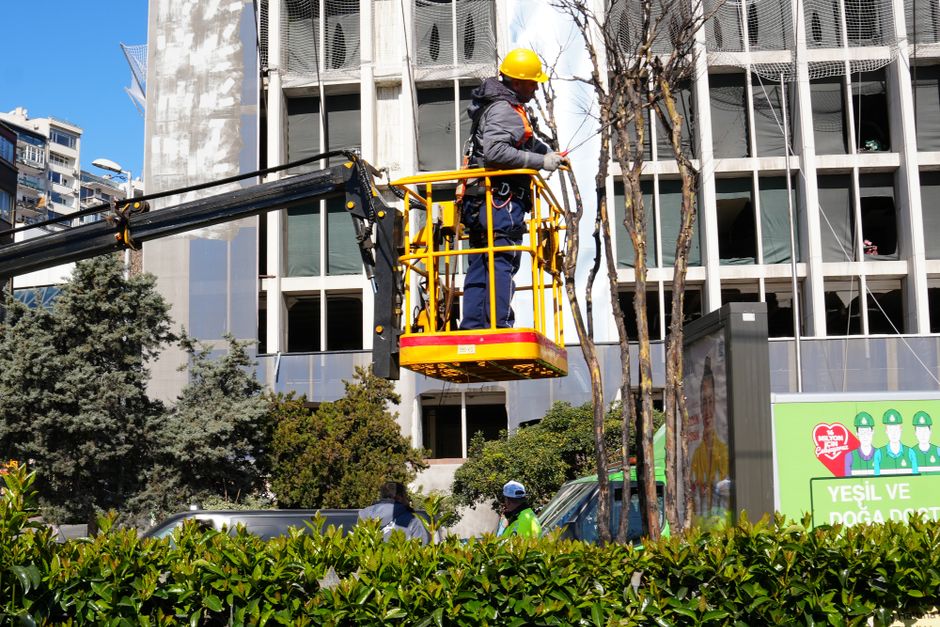
Let's get the obvious one out of the way: no, you cannot prune a 40-foot Douglas fir from a regular ladder. (The trees find this amusing. You would not.)
For anything over 20 feet, call an ISA certified arborist. Here is everything you need to know before you do.
Quick answer: Tall tree pruning in Surrey requires rope climbing or elevated platform equipment, rigging skills, and a certified crew. Crown reduction removes height safely. Deadwood removal eliminates fall hazards. Do not top a tall tree — ever. Costs run $450–$1,800 depending on tree size and access. The longer the backlog, the higher the bill.
Why tall trees in Surrey need regular pruning
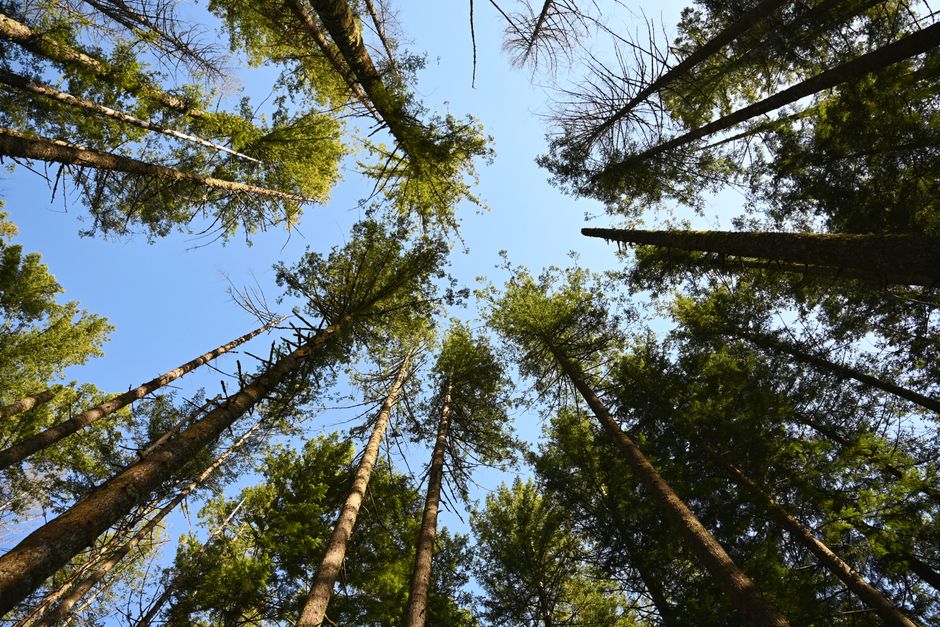
The Douglas firs, western red cedars, and bigleaf maples common to the Lower Mainland regularly hit 60 to 100 feet at maturity. They grow fast, they grow tall, and gravity does not negotiate.
A dead branch in a tall tree does not stay in the tree. A 50-pound limb falling from 40 feet carries significant force. The height multiplies the consequence of every structural problem in the canopy.
The main reasons tall trees need regular attention:
Dead and dying branches. Dead wood breaks faster and less predictably than live wood. In a Lower Mainland windstorm — October through March is when the real weather arrives — a dead limb at 30 feet is a hazard, not just an eyesore.
Crossing and competing branches. Two branches rubbing against each other create wound entry points for disease and fungus. In a dense canopy, this is easy to miss from the ground.
Structural imbalance. A tree growing heavily to one side develops uneven weight distribution. Left long enough, it develops lean. Address it with crown reduction while it is manageable — not with a removal quote when it is not.
Crown thinning for wind resistance.A dense canopy in a windstorm acts like a sail. Removing 15–20% of interior growth allows wind through and reduces load on the branch structure without changing the tree's shape noticeably from the street.
I reckon nine out of ten calls we get about tall trees could have been handled for half the price if someone had looked at them two years earlier. Regular pruning every three to five years is maintenance. Waiting ten years is a restoration project, and it costs more.
Techniques an arborist uses on tall trees
The question is not just what gets cut. It is how someone gets there to cut it safely.
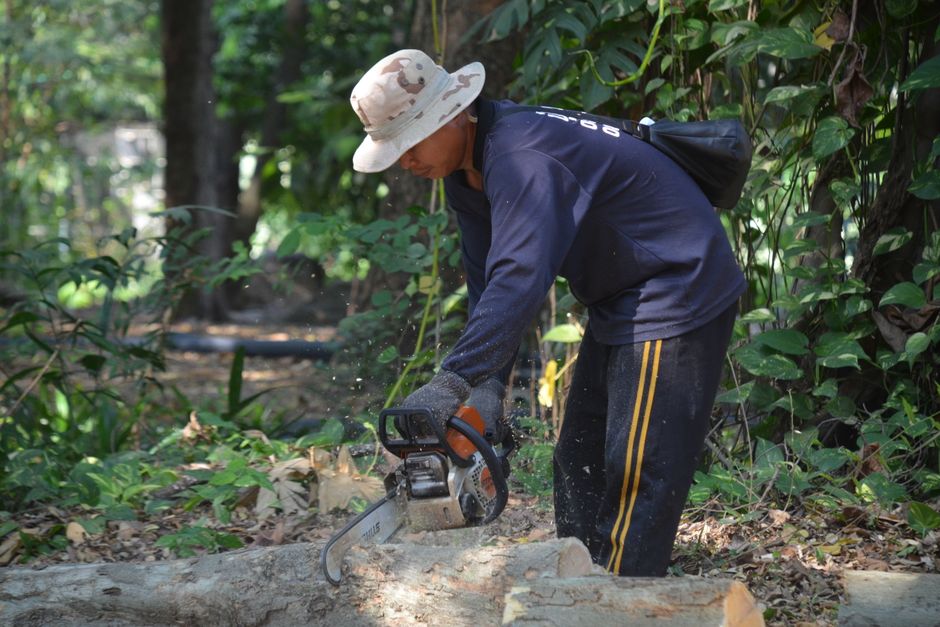
For most residential tall trees, a certified arborist climbs with rope-and-saddle equipment. They work in sections from the outer canopy inward, making cuts and rigging branches down with ropes so nothing falls freely. Every cut is deliberate. Nothing gets dropped.
Crown reductionreduces overall height and spread by cutting branches back to lateral growth points. A 20–25% reduction takes significant mass off the canopy without destroying the tree's natural form. This is nearly always preferable to removal for a tree that otherwise has years of life ahead of it. We did this for a homeowner in Surrey a few years back — a large bigleaf maple quoted at $1,400 for removal ended up needing a $650 crown reduction. The tree is still there. They saved the money, they kept the tree. The removal quote was wrong.
Never top a tall tree. Topping — cutting straight across the top — creates large wound openings, triggers weak water-sprout regrowth, and sets the tree up for structural failure within a few years. Any company suggesting it as a routine height-reduction method should be questioned. It is not pruning. It is damage with an invoice attached.
Deadwood removal is systematic removal of dead, dying, or broken branches. Straightforward on a short tree. On a 50-foot cedar, it requires the same technical climbing access as any other canopy work. The ISA has published guidance on tree risk assessment that any certified arborist should be working from.
Directional pruning removes growth heading toward structures, power lines, or neighbouring trees. This is often the most cost-effective preventive work we do — a few targeted cuts now versus a reactive job in eighteen months.
For a full picture of what our tree pruning services cover, including crown thinning, structural work, and deadwood removal across Surrey and the Fraser Valley, see the services page.
Why pruning tall trees is not a DIY job
The rule of thumb is straightforward: if the tree is over 20 feet or within fall distance of your house, do not DIY it. That covers most of the tall trees in Surrey.
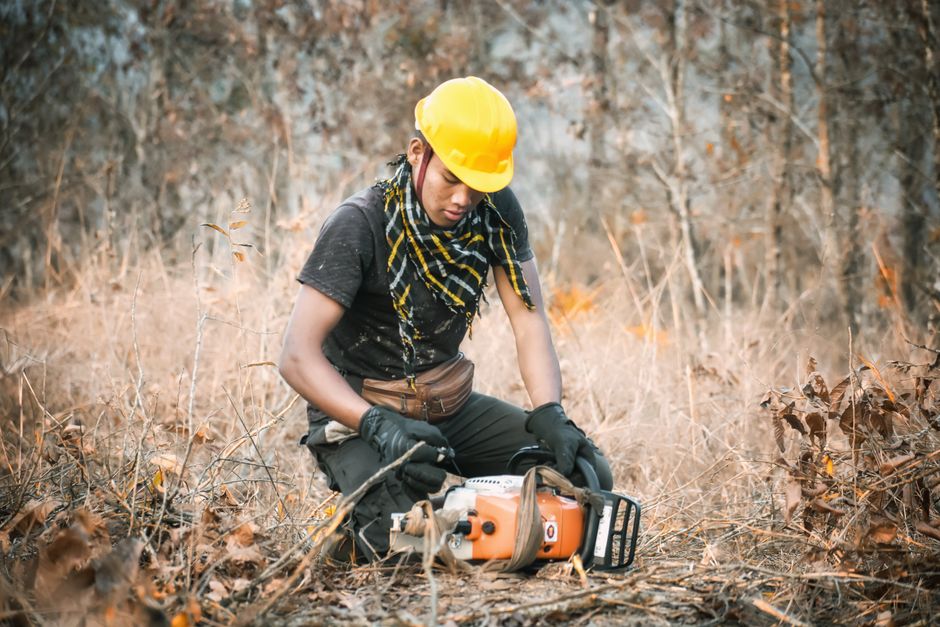
Height compounds everything. Working at 30 feet on rope requires specific equipment, fall-arrest training, and the ability to control a running chainsaw while maintaining balance on a harness. None of these come naturally. Most cannot be safely improvised.
The three-cut method becomes critical on large branches. Large limbs need to be removed in three cuts to prevent bark tearing and stripping back to the trunk. This is technique acquired through training, not through reading about it. Miss it on a large limb and you create a wound that can spread disease or kill the branch entirely.
A homeowner in Surrey came to us after attempting to prune his own maple. He cut it severely, left stubs, and created four competing leaders in the canopy. Two years later the tree was worse — multiple hazard attachment points, each one a structural risk. The crown-reduction work to correct it cost $800. If he had called in the first place, it would have been $350 and a cleaner result. He paid more for the mistake than for the job done right.
Working around power lines requires line clearance credentials. If any branch is near BC Hydro lines, neither a homeowner nor a general landscaper can touch it legally. WorkSafeBC sets out the requirements for tree work near energised lines — this is not a guideline, it is a regulatory requirement.
Use a certified arborist. The ISA Canada certification means training, an exam, and continuing education requirements. Anyone can call themselves an arborist. Not everyone has passed the test.
Best time to prune tall trees in the Lower Mainland
Tall trees need pruning when they need pruning. Dead branches do not have a season — if a limb is dead today, it is a hazard today.
That said, the Lower Mainland does have better and worse windows for structural work:
Late fall through early spring (November–February) is the ideal window for most species. Trees are dormant, sap flow is reduced, and disease vectors like fungal spores are largely inactive. For maples, this avoids excessive sap bleed. For conifers, it avoids the peak window for bark beetle activity.
Avoid major structural pruning during early spring bud-burst unless you are removing hazards. A tree in active growth mode allocates significant energy to new foliage. Large cuts during this period create competition between wound response and bud development.
Douglas fir and cedar: any time except the warmest months. The smell of fresh resin in summer attracts bark beetles to wounded wood. Urgent work can still be done in summer — we take precautions — but winter timing is cleaner.
For storm preparedness: if you have tall trees within fall distance of your house, get an assessment done before September. The October-to-March wind season in the Fraser Valley is when the real damage happens. A tree health assessment is $150 and is credited toward any work booked. What it finds could easily save you ten times that in reactive work after a storm.
What pruning tall trees costs in Surrey, BC — honest numbers
Nobody lists prices. We do.
| Scope | Rough range (CAD) |
|---|---|
| Deadwood removal, small–medium tree (under 30 ft) | $350–$650 |
| Deadwood removal, large tree (30–60 ft) | $650–$1,200 |
| Crown thinning or reduction, medium tree | $500–$950 |
| Crown thinning or reduction, large tree (40 ft+) | $950–$1,800 |
| Elevated work platform required (boom truck) | Add $400–$800 |
A few things that move the price up: difficult site access, trees that have gone more than five years without attention, and work near power lines that requires coordination with BC Hydro.
A few things that will not change the price: cleanup. We chip the brush and haul what leaves with us. No homeowner should be picking up after a tree crew.
Rule of thumb:get the tree looked at in person before accepting a phone quote. A tree described as "about 30 feet" is often 45 feet once someone is standing next to it. The price changes with that information, and you want to know before anyone starts climbing.
When you should not call us
This is the part we mean when we say we are honest.
Trees under 15 feet with stable access and no structural concerns: a sharp pair of loppers and a stable stepladder will handle deadwood removal and light shaping. Good loppers cost $60. We cost $250 minimum. Do the math.
Before you have a second opinion on removal.If another company has quoted removal on a significant tall tree, get a second assessment first. A lot of tall trees get removed that did not need to be. Crown reduction at $700 solves the same problem as removal at $1,400 more often than anyone in this industry likes to admit. A second opinion costs $150. We'll tell you honestly which way it should go.
If removal is actually the right call. Sometimes a tall tree is past the point where pruning makes sense. If the structure is compromised, the species does not belong in that location, or the risk profile is not worth managing through ongoing maintenance — we will say so. Pruning a genuinely dangerous tree to avoid a harder conversation is not a service. It is just a delay.
Give us a call if you are unsure which category you are in. That call costs nothing. Guessing wrong costs considerably more.