
The dappled willow is the Swiss Army knife of the Langley/Aldergrove garden: ornamental, water-loving, and perfectly happy to be cut back hard. (It counts as knife work. I'll stand by that.)
Pruning a dappled willow tree is best done in late January through mid-March, before new growth begins. Take back up to one-third of the canopy. Remove any shoots coming from below the graft point immediately. That is the whole job, most years.
Quick answer: Prune in late winter — the Langley/Aldergrove window is late January to mid-March. Cut each stem back by roughly one-third. Remove dead and crossing branches. Deal with reversion shoots the moment you spot them. If you have the right tools and a couple of hours, this is a job most homeowners can handle without calling anyone.
Nine out of ten dappled willows I see in Langley/Aldergrove gardens have not been pruned properly — or at all. The signs are not subtle: plain green leaves taking over, congested stems, a plant that looks like it gave up on being ornamental. Usually, one good prune sorts it out.
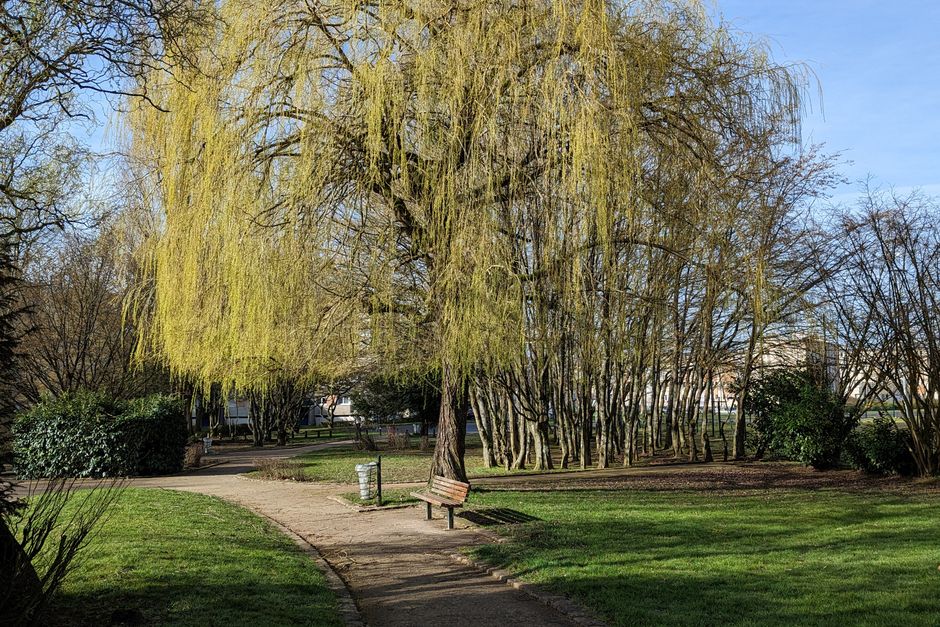
What a dappled willow actually is
Dappled willow — Salix integra‘Hakuro-nishiki’ — is a Japanese willow cultivar known for its variegated spring foliage: fresh shoots emerge pink, then lighten to white-and-green as the season progresses.
In Langley/Aldergrove gardens you will encounter it in two forms. The shrub form grows multi-stemmed from the ground, reaching two to three metres. The tree form — sometimes called a standard or lollipop willow — is the same plant grafted onto a trunk of a different willow species, creating a clear stem of one to one and a half metres before the canopy begins.
The distinction matters for pruning, because the tree form is technically two plants in one. Everything below the graft union belongs to the rootstock. Everything above is the dappled willow. That boundary changes how you handle certain problems — which I will get to shortly.
The Toronto Master Gardeners have a useful breakdown on pruning young dappled willows — worth reading if your plant is under two years old and you are not sure how hard to go.

When to prune a dappled willow in Langley/Aldergrove
Late January through mid-March. That is the window for Langley/Aldergrove and the Fraser Valley. The plant is still dormant, the branch structure is easy to read, and cuts close cleanly before new growth starts.
There is a second reason to prune in late winter: the freshest, most intensely variegated foliage appears on new growth. Cut the plant back in February and it pushes a full flush of pink-tipped growth by April. Leave it unpruned and the older stems produce progressively less colour each season.
Do not prune in fall.Fall pruning stimulates tender new growth that has no time to harden before Langley/Aldergrove's first frosts — typically late November. That growth gets killed, and you end up removing the dead tips in late winter anyway. The job gets done twice, and the plant is stressed in between. Rule of thumb: if the leaves are still on, leave the pruners in the shed.
Summer pruning is fine for a lighter touch. A quick trim of the longest stems in June or July keeps the plant tidy and encourages another flush of variegated colour through late summer. This is not a substitute for the main structural prune — it is more of a haircut than a proper pruning.

What to cut — and how much
Start with the obvious. Remove anything dead, diseased, or damaged — those come out entirely, not just trimmed back. Then look for branches that are crossing and rubbing against each other. One of each pair goes.
Next, shorten the remaining live stems. The rule of thumb: take back by about one-third of the stem's length, cutting just above an outward-facing bud. For a stem that is 60 centimetres long, remove around 20 centimetres. The bud below the cut becomes the new leader for that stem.
On a shrub-form dappled willow, also thin out the interior. Remove older, congested stems at the base to open up the centre of the plant. Good air circulation reduces the risk of fungal problems, which willows can be prone to in Langley/Aldergrove's wetter winters.
For the tree-form (grafted standard), the approach to the canopy is the same — one-third back, above an outward bud. Do not cut into the trunk below the graft union, and do not take the canopy below the point where it meets the trunk.
I reckon most homeowners underestimate how much willow can handle. They trim a little, feel worried, and stop. The plant responds to assertive pruning far better than to timid snipping. Cut a third back confidently. It will thank you.
Reversion shoots: the one thing you must not ignore
If you have a tree-form dappled willow and you notice some branches bearing plain, solid-green leaves — not the variegated pink-and-white ones — those are reversion shoots from the rootstock.
They grow from the trunk below the graft union, or from the roots at ground level. Left alone, they grow faster than the grafted top and will eventually take over the whole plant. You will end up with an entirely plain green willow and a significant amount of regret.
The fix: remove them immediately. The technique matters here. Pull them off rather than cutting them. Cutting leaves a stub with dormant buds that will re-sprout within weeks. Pulling removes the bud at the base, slowing regrowth considerably.
I got called to a property in Cloverdale last spring to check a dappled willow that the homeowner described as “turning completely green and dying.” It was not dying. A reversion shoot had taken over roughly two-thirds of the canopy while the homeowner was watching it happen and assuming it was natural. We removed it, and the variegated top was recovering well by late summer. The diagnosis took about fifteen seconds. I still had to charge for the call-out. That is fifteen seconds I am genuinely happy to hand back to you for free.
How to make the cuts
Use bypass pruning shears for stems up to about half an inch thick. Loppers for anything bigger. A pruning saw for old, thick wood.
Cut at a slight angle — roughly 45 degrees — just above a bud, slanting away from it. The angle allows water to run off rather than pooling above the bud and causing rot. Cut too close to the bud and you damage it. Cut too far above and you leave a stub that dies back and provides an entry point for disease.
Do not use wound sealant on the cuts. It was standard practice for decades and is now known to trap moisture and encourage fungal growth. Make a clean cut, let the plant seal itself. That is what it is built to do.
The ISA Canada guidance on pruning cuts is worth a read if you want the technical detail behind why this matters.
Hard pruning when the plant gets out of hand
If your dappled willow has not been pruned in several years and is now a congested mass of old stems with poor colour, one-third-back will not fix it in a single season. You have two options.
Option one is renovation pruning over two or three seasons — taking out the oldest, worst stems each winter while the plant gradually rebuilds.
Option two is coppicing: cutting a shrub-form dappled willow down to near ground level in late winter. The plant re-sprouts from the base with vigorous new growth, and within a season you have a completely rejuvenated plant with excellent colour. Willows are among the most tolerant plants in the garden for hard pruning — this technique works reliably.
Coppicing applies to shrub-form willows only. Do not cut a tree-form standard down to the ground — you will remove the grafted top and be left with the rootstock. For a neglected tree-form, renovation pruning over two seasons is the right approach, or give us a call and we can assess whether the structure is salvageable and what the best approach is.
For a broader look at how we approach tree and shrub care in Langley/Aldergrove, the services page covers what we offer and what to expect.

When not to call us
A dappled willow is one of the most DIY-friendly pruning jobs in a Langley/Aldergrove garden. I will say that clearly, because most tree companies will not.
Handle it yourself if:
- Your plant is small enough to reach from the ground with standard loppers
- You are doing the annual maintenance prune — one-third back, remove dead wood, deal with reversion shoots
- Your shrub-form plant needs coppicing — it is a straightforward job with a sharp pruning saw
Call an arborist if:
- The tree-form canopy is significantly above head height and you would need a ladder to reach it
- The plant has been badly neglected for multiple seasons and you are not sure what can be salvaged
- You suspect a disease or structural problem — discolouration, canker, cracked bark at the graft union
- You want someone to do the first prune to show you what the correct shape looks like, so you can maintain it yourself in future
That last one is worth saying again. We are happy to do a single prune and walk you through the reasoning, so you understand what to do yourself next year. One visit can save you the cost of calling us every winter. That is genuinely our preference for this plant.
What dappled willow pruning costs in Langley/Aldergrove
Nobody posts prices. I reckon they should.
| Scope | Typical range (CAD) |
|---|---|
| Annual maintenance prune, standard tree-form | $150–$300 |
| Annual maintenance prune, large shrub form | $175–$350 |
| Renovation pruning, neglected plant | $250–$450 |
| Coppicing, shrub-form plant | $200–$400 |
| First prune + walkthrough to show technique | $200–$350 |
These assume reasonable access and no special equipment requirements. If the plant is in a tight corner, elevated, or near a structure, that changes things. The price is always confirmed before any work starts.
For context on how dappled willow pruning fits into overall tree trimming costs in Langley/Aldergrove, that post breaks down the factors that move the price across different species and situations.