
An apple blossom tree is just an apple tree with good timing. (The apples are the real product — the blossoms are just showing off first.) In Surrey, BC, most apple trees flower somewhere between late March and early May. If yours isn’t blooming, the problem is almost certainly one of six things, and five of them are fixable without spending a dollar on an arborist.
What is an apple blossom tree
“Apple blossom tree” isn’t a separate species. It’s what people call a standard apple tree (Malus domestica) when it’s doing what it does in spring. The blossoms — pink or white, depending on variety — appear before the leaves fully open. Bees pollinate them. Then, where a flower was successfully pollinated, a fruit develops. That’s the sequence.
Ornamental crabapple trees (Malus sylvestris and related cultivars) also produce gorgeous blossoms and are common in Surrey yards. Worth knowing about, because crabapples can act as pollinators for regular apple trees — which becomes relevant later.
Both types are deciduous. Both bloom in spring. Both need full sun and decent soil to perform well. The main difference is that a crabapple produces small, tart fruit not really worth eating, while a regular apple tree is there to produce actual apples.
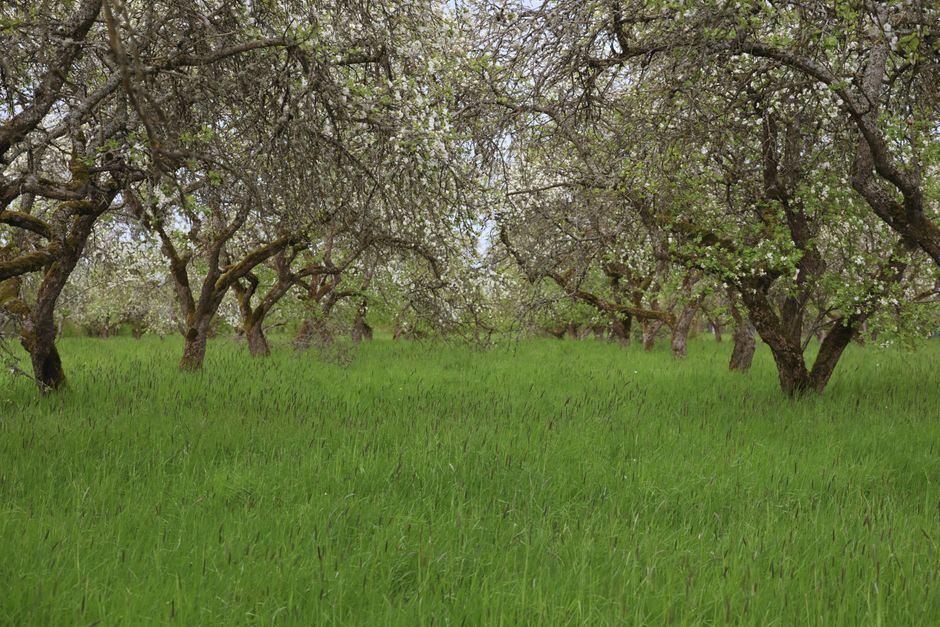
When do apple blossom trees bloom in Surrey, BC
In Surrey and the broader Fraser Valley, apple trees typically bloom from late March through early May. The exact timing depends on variety.
Early varieties — Lodi, Zestar, Akane — can open blossoms by late March in a mild year. Late-season varieties like Fuji, Granny Smith, and Honeycrisp often hold off until May. Most backyard apple trees in Surrey (the ones that came with the property and nobody remembers planting) are mid-season varieties that bloom through April.
The Lower Mainland’s mild winters are generally helpful. The risk here isn’t winter kill — it’s a late frost after the buds have already opened. A single night below about −2°C when the blossoms are open kills those flowers. The tree survives fine. That year’s fruit crop does not.
I reckon most Surrey homeowners underestimate how often a late-March frost explains a sparse fruit set. The blossoms opened, the frost came through, and by summer there was nothing to show for it. You can’t do much about a frost that already happened — but it’s useful to know it’s the cause, rather than wondering whether the tree is broken.
Why your apple tree isn't blossoming
There are six main reasons an established apple tree won’t flower. At least one of these applies to most non-blooming apple trees in Surrey.
1. The tree is too young
Standard rootstock apple trees take 4–8 years before flowering reliably. Dwarf rootstock trees get there in 2–3 years. If the tree is under five years old and hasn’t bloomed, that’s not a problem — it’s just not ready. Give it time.
2. Not enough sun
Apple trees need at least 6–8 hours of direct sun per day to produce a full flush of blossoms. A tree shaded out by a neighbouring cedar hedge or a new house addition will produce fewer flowers each year, and sometimes none. Rule of thumb: if you wouldn’t grow vegetables in that spot, an apple tree won’t bloom well there either.
3. Over-fertilizing with nitrogen
High-nitrogen fertilizer — including lawn fertilizer applied near the tree’s drip line — pushes apple trees into leafy vegetative growth. The tree goes green, lush, and impressive. It also skips the flowers. This is the most common fixable mistake I see on residential properties. Back off the nitrogen and give it a season.
4. Frost damage at bloom time
As above — a single hard frost after the buds open kills the flowers. The tree looks perfectly healthy all summer. You only realize what happened when there’s no fruit. According to University of Minnesota Extension, even a brief dip to −2°C at full bloom can kill a significant portion of open flowers. There’s nothing to do about a frost that already happened. Wait for next year.
5. No pollinator nearby
This is a fruiting problem, not strictly a bloom problem. The tree will blossom regardless. But without a compatible pollinator variety within range, those blossoms won’t set fruit. There’s a full section on this below.
6. Improper pruning
This one gets its own section, because it’s the issue I see most on Surrey properties, and it’s the one most homeowners don’t know they’re causing.
The pruning mistake that kills next year's blossoms
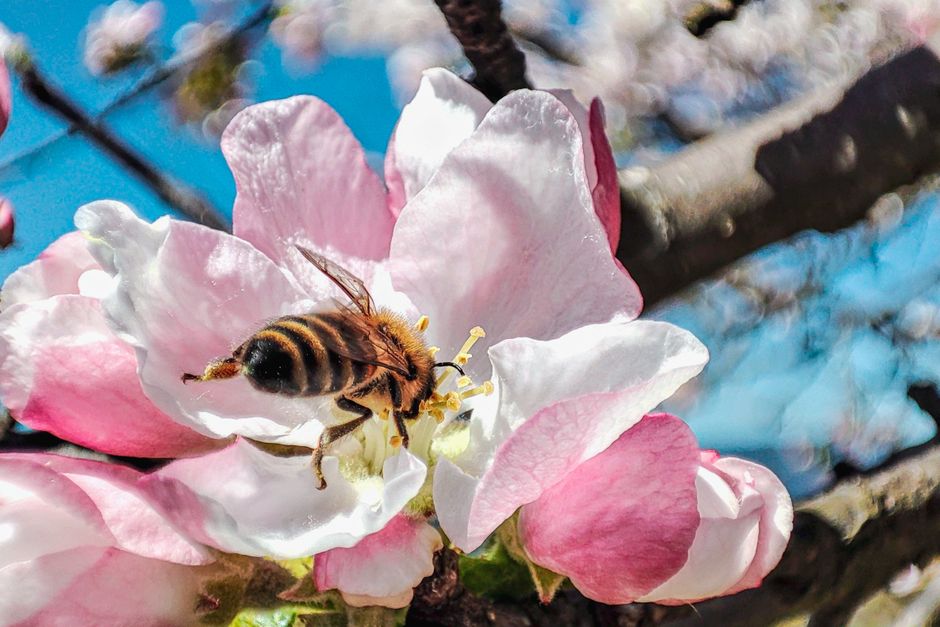
Apple trees bloom on two-year-old wood and on short, stubby growth called fruiting spurs. Those spurs take years to develop. If you prune the wrong wood at the wrong time, you remove the flowering potential for the following season — and sometimes the season after that.
The mistake I see most often: pruning in late spring or summer, right after the blossoms drop. It makes sense intuitively. The tree just finished blooming, it looks like it needs a tidy, you have a free Saturday afternoon. So you go in and cut back the new growth.
That new growth is already forming next year’s flower buds. By July, the buds that will become next spring’s blossoms are differentiating inside the developing wood. You can’t see them yet, but they’re there. Cut that wood off and you’ve removed next year’s show before it ever started.
The right time to prune an apple tree is during dormancy — late winter, before the buds break. In Surrey, that window runs roughly February into early March, depending on the season. The tree is bare, you can see the structure clearly, and you won’t accidentally remove the wood that matters.
A few years back I assessed a tree in Cloverdale that hadn’t bloomed properly in three seasons. The owner had been pruning it in July every year — right after the blossoms dropped, which felt logical. One properly-timed dormant prune in February, and by April the tree was covered. Three silent years fixed with one correctly-timed session. For more on the timing specifics, our guide on when to trim apple trees covers what to cut and what to leave.
Why your apple tree needs a neighbour

Nine times out of ten, a Surrey homeowner with a blossoming apple tree but no fruit has a pollination problem.
Most apple varieties are self-incompatible. They produce pollen, but their own pollen can’t fertilize their own flowers. They need pollen from a genetically different variety — ideally one blooming at the same time, within 50–100 feet, with bees actively moving between them.
A single apple tree in a yard with no other apple or crabapple nearby will blossom beautifully, drop all those blossoms without setting fruit, and do it again next year. Without complaint. It’s not broken. It just needs company.
The fix is planting a second compatible variety. Most local nurseries can match varieties for you — you want something that blooms at the same time as your existing tree. Golden Delicious and Grimes Golden are reliable cross-pollinators for most common mid-season types.
Before you buy anything, check one thing: does a neighbour have a crabapple in bloom at the same time? Crabapples are excellent pollinators for most apple varieties. If there’s one within a hundred feet and it’s flowering when your tree is, that might already be doing the job — and your actual problem is one of the other five reasons. The Penn State Extension has a solid breakdown of pollination compatibility if you want to match varieties properly.
When not to call us
Honestly — call us last, not first.
If your apple blossom tree isn’t flowering, go through the list above before spending money on an assessment. Is the tree young? Check. Too much shade? Walk around it at noon on a clear day. Heavy nitrogen fertilizer nearby? Look at the lawn care routine. Late frost last spring? Think back to the weather in March.
Most non-blooming apple trees in Surrey have a fixable, diagnosable problem. A homeowner who spends an afternoon researching their specific variety and soil conditions will often solve it without professional help. That’s not false modesty — I’d rather you spend that money on something that actually needs an arborist.
Where we’re actually useful: structural problems. Major dead sections in the canopy. Cracks at the main scaffold limbs. A lean that’s been getting more pronounced over recent seasons. Signs of fire blight — blackened, burnt-looking branch tips that spread from the tips inward. If you’re seeing any of those, that’s a call worth making.
Our tree health assessment guide covers what a proper assessment looks for and what different findings mean in practice. And if you’re managing multiple fruit tree species, our post on when to trim fruit trees is worth reading before you pick up the loppers.
Apple blossom trees are honest. They tell you exactly what they need — sun, dormant pruning, a compatible neighbour, a bit of patience. Get those four things right, and they’ll do the rest themselves.