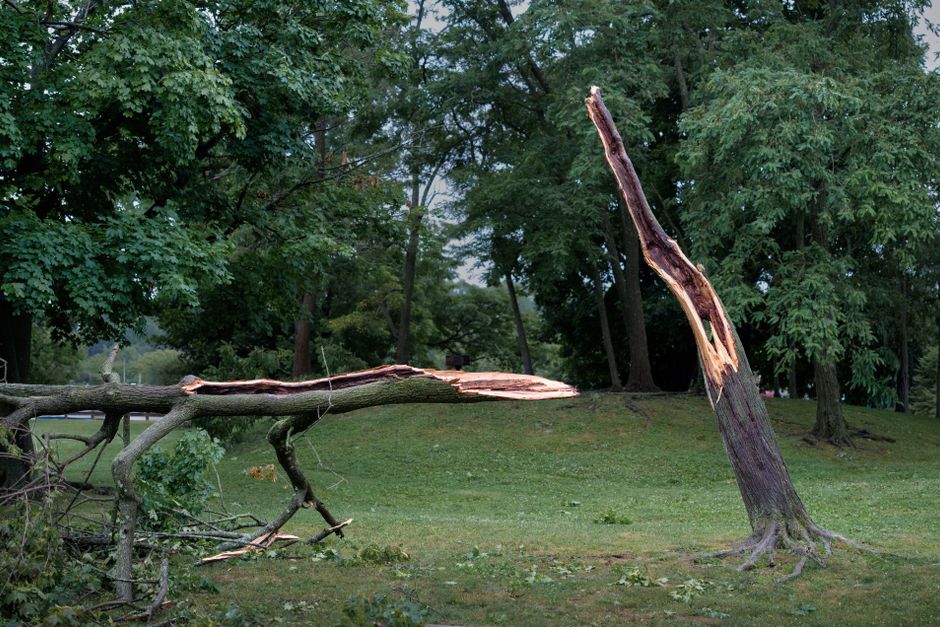
Your tree is splitting. The pun writes itself, but I'll leave it there.
A splitting trunk usually means one of two things. The tree grew two leaders instead of one — what arborists call codominant stems — or something stressed the bark enough to crack it. Nine out of ten cases I see, it's the first one.
Quick answer:Two trunks competing for space from the same base, with bark trapped between them, is the structural reason most trees split. It's not a disease. It's not a pest. It's a defect from how the tree grew — often something that could have been corrected early with a single pruning cut. Now it needs either cabling to hold it together or removal if the split has gone too far.
Here's what you're actually dealing with and what to do about it.

The most common reason: codominant stems
Most trees grow with one dominant leader. A central trunk, one main stem, with branches coming off the sides. When a tree develops two equally strong stems from the same base, neither one backs down.
Both stems grow outward. Both get thicker each year. And the bark between them — instead of merging into proper wood-to-wood contact — gets compressed. Trapped. This compressed bark is called included bark, and it's the crux of the problem.
Where a normal branch union has solid wood connecting stem to stem, included bark gives you a weak seam. Under wind load. Under the weight of wet snow. Under the mechanical stress of a good Fraser Valley windstorm. That seam is what fails.
Look at the crotch where your two stems meet. If you see a ridge or a V-shaped groove, that's included bark. If the groove is widening into an actual gap, the split has already begun.
The frustrating part: this is preventable. A single pruning cut to remove the competing leader when the tree was young — say, 10 to 15 years old — costs maybe $200. By the time the split is visible at a mature tree, the same problem costs $400–$800 to cable or $1,000–$1,400 to remove. I've seen it too many times.
Other causes: frost cracks, sunscald, and storm damage
Codominant stems are the most common cause, but not the only one.
Frost cracksrun vertically up the trunk and appear almost overnight in cold weather. They happen when the outer wood cools and contracts faster than the inner wood. You'll often see them on the south-facing side of the trunk — the side that gets the most solar radiation and experiences the biggest temperature swings. Most frost cracks are superficial. They look alarming. Many close again in summer.
Sunscald is similar in appearance. Direct winter sun on exposed bark — particularly on recently planted trees or on trunks that have lost upper canopy — can damage the cambium (the living layer just beneath the bark). The dead section dries and cracks. Young trees benefit from trunk wraps in their first few winters. Established trees are generally past the risk stage.
Storm damage.A single high-stress event — a limb falling on the trunk, a vehicle impact, or a wind gust loading one side unevenly — can crack bark and sometimes split wood. These are usually obvious from context. If the crack appeared after a storm, it's not codominant stems; it's mechanical damage. The tree may still need assessment, but the approach is different.
Disease and rot. A less common cause, but worth mentioning. Fungal decay at the core makes wood brittle. The split you're seeing might be structural failure where rot has weakened the timber from inside. If you see bracket fungi (shelf-shaped growths on the bark), mushrooms at the base, or soft wood when you probe the split — this is a different problem and potentially a faster-moving one. See our guide to tree fungus for more.

How dangerous is a split tree, really
It depends. That's not a dodge — the risk genuinely varies based on a few specific factors.
What's underneath.A split codominant stem on a tree in an open field — no structures, no paths, nothing but grass — is a low-urgency situation. The same split over a driveway, a deck, or a fence is a different conversation. The risk isn't just the probability of failure. It's probability multiplied by consequences.
How far the split has progressed.A V-shaped crotch with visible included bark but no actual gap — monitor it, assess it annually. A gap you can fit your hand into, particularly if it's widening — that's urgent. The time between a visible structural gap and full stem failure is not predictable. Sometimes it's years. Sometimes it's the next windstorm.
The species. Some species are more prone to codominant failure than others. Silver maple, Norway maple, and ornamental cherries are common offenders in the Lower Mainland. Western red cedar and Douglas fir are generally stronger at their branch unions — but no tree is immune with a severe enough codominant stem.
The angle of the split. Two stems growing at a narrow angle (less than 30 degrees from vertical) with tight included bark are higher risk than two stems growing at a wider angle. Narrow-angle codominants leave almost no room for wood-to-wood union; wide-angle ones have more structural surface area.
Rule of thumb: if the tree is large (over 30 feet), the split has visible included bark, and there's anything worth protecting underneath — get an assessment. The cost of a consultation ($150, credited toward the work) is a lot less than the cost of finding out the hard way.
The ISA Tree Risk Assessment Qualification framework gives arborists a structured way to quantify this. I reckon most homeowners don't need the full report — they just need someone experienced to look at the tree and give them an honest read.

Can a split tree be saved
Often. Here are the realistic options.
Tree cabling.The most common intervention for a codominant split. A high-tensile cable is installed between the two stems, high up in the canopy, limiting how far apart they can move under wind load. It doesn't fix the structural defect — the included bark is still there — but it prevents the gap from widening further and reduces the chance of sudden failure. For high-value trees where removal would be the alternative, it's usually worth doing.
Cabling costs $400–$800 at Little Tree Care, all-in. It needs inspection every few years to check cable tension and hardware condition. That's the full ongoing commitment.
Crown reduction. Reducing the upper canopy by 20–30% removes weight from the two stems and lowers the wind load on the split point. Sometimes done in combination with cabling. It costs $500–$1,200 depending on tree size. And it keeps the tree.
Removal. When the split has progressed to the root flare, when the included bark has fully failed, or when the stem is already partially down — cabling isn't the answer anymore. Removal is. I try not to recommend removal when cabling will do the job. The full guide to tree cabling has more detail on what the installation involves.
I had a family in Langley a few years back — 40-foot cedar, two codominant leaders, a gap you could see from the street. They'd been quoted removal at $2,200. We proposed cabling instead. That was $600. The tree is still standing. They're $1,600 ahead of where they would have been, and they still have their windbreak.
Cabling a valuable tree is worth the cost when the alternative is removal. That's not always the case — if the split is too far advanced, or the tree is in poor health overall, removal is the honest answer. But the conversation about whether cabling is possible should happen before anyone starts up a saw. Most tree services skip that conversation because removal pays better. We don't.
When you don't need to call anyone
I'll say this even though it costs us a call.
A natural lean with no splitting.Trees lean. It's normal. A tree that leans away from your house, has no visible crack or included bark at a stem junction, and has been leaning the same amount for years — that's just how it grew. It doesn't need work.
A hairline frost crack on the trunk.Single vertical crack, no included bark at a stem junction, no soft wood. Watch it over one season. If it closes in summer and shows no signs of widening, it's cosmetic. A coat of tree wound sealant is not needed either — that's also outdated advice.
A recently planted young tree settling.Young trees move in wind more than established ones. Some bark cracking at the soil line in the first couple of years is normal. As long as the trunk isn't split at a crotch or visibly delaminating, it's doing fine.
Surface bark plates lifting.Some species — western red cedar in particular — naturally shed outer bark. It peels in strips or plates. This is not a split. It's just cedar being cedar.
If you're genuinely unsure, that's what a certified arborist assessment is for. We charge $150, credited toward any work we end up doing. Half the time I'm telling people their tree is fine and they don't need to spend anything else. That's also the job.