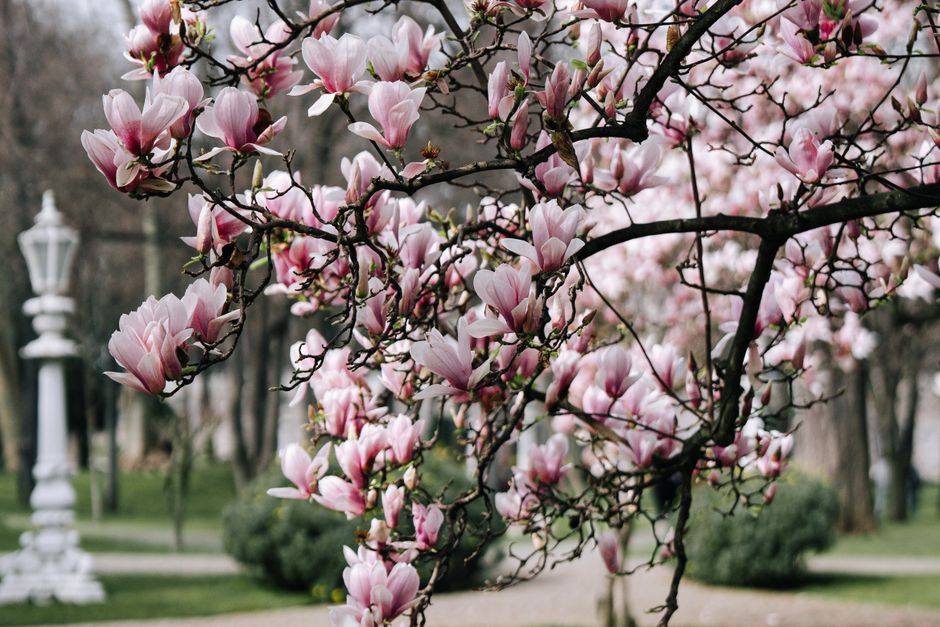
A magnolia in full bloom has a kind of confidence that basically dares you to touch it. Picking up the loppers anyway is, technically, a blossoming career in bad decisions. (Sorry. That's the only pun in here. I promise.) The short answer: most magnolia trees in Langley/Aldergrove don't need pruning, and the most common mistake I see is pruning them when they didn't ask for it.
Nine out of ten calls I get about magnolia pruning are from homeowners who want to keep the tree smaller, tidy up its shape, or just feel like they should be doing something. Fair enough. But with magnolias, "doing something" is more likely to cause a problem than solve one.
Short answer:Prune magnolia trees after flowering, in late summer (July–August for most Langley/Aldergrove varieties). Remove only dead, diseased, or crossing branches. Don't prune in late winter — magnolias bleed sap and the wounds are slow to heal in BC's wet climate. Most healthy magnolias need pruning every few years at most, not every season.

Do magnolia trees actually need pruning?
Mostly, no. Magnolias develop their shape naturally and do it well. Unlike fruit trees, which need annual attention to stay productive, or fast-growing species that need structural management, a healthy magnolia in a good location tends to sort itself out.
Pruning is genuinely warranted when:
- There are dead, diseased, or storm-damaged branches
- Two branches are crossing and rubbing, causing bark damage
- A branch is growing directly toward the house or a structure
- The tree has developed multiple competing leaders and you want to establish one
If none of those apply, the correct answer is usually to put the loppers away and walk back inside. Magnolias do not need annual pruning the way roses or hedges do. Every cut is a wound, and magnolias are slow healers. They are worth treating accordingly.
If you are not certain whether your magnolia has a structural problem or just looks a bit full, a quick tree health assessment will give you a clear answer before you make any cuts.
When to prune magnolia trees in Aldergrove, Langley/Aldergrove, Langley, and the Fraser Valley, BC
Timing is the thing that most guides cover but few cover well for our specific climate. The Pacific Northwest — and Langley/Aldergrove in particular — adds a layer of complexity that general UK or US gardening advice does not account for.
Deciduous magnolias (saucer magnolia, star magnolia, loebner magnolia — the common flowering types in Langley/Aldergrove front yards): prune in late summer, after flowering ends. In Langley/Aldergrove, that usually means July or August. You want the wounds to have a few months of dry weather to start healing before the autumn rains arrive in October. Pruning in September or October is pushing it — the wet season shortens the healing window considerably.
Evergreen magnolias (southern magnolia, Magnolia grandiflora — less common in Langley/Aldergrove but seen in sheltered spots): prune in spring, just as new growth begins, before the canopy is fully leafed out.
Both types:avoid late winter and early spring. This is when magnolias are most likely to bleed sap from cuts. The loss itself usually will not kill the tree, but it weakens it and leaves wounds open to fungal infection right when BC's wet weather is at its worst. If you prune in March and then get two weeks of rain — which is very likely in Langley/Aldergrove — you have created ideal conditions for disease to establish.
The one exception to timing rules is dead wood. If you see a dead branch, remove it whenever you notice it. Dead wood does not bleed and does not benefit from waiting.

What to actually prune
Keep it to what needs removing, not what you think might look better with a trim.
Dead branches. These are the priority. Dead wood carries disease and can fall unexpectedly. Remove them back to the nearest healthy branch junction — cut just outside the branch collar (the slightly swollen ring of tissue where the branch meets the trunk or a larger branch). Do not cut flush with the trunk. Do not leave a stub.
Diseased or damaged branches. Any branch showing signs of fungal canker, significant bark damage, or softwood where there should be hardwood. If you are not sure whether a branch is diseased or just stressed, a certified arborist can tell you in under a minute — and it is worth knowing before you start cutting.
Crossing branches. Two branches rubbing against each other will eventually cause bark damage on both. Remove the smaller or less well-placed of the two. Cut at the base, leaving the better branch intact.
A competing leader. If the tree has developed two equally dominant central stems and you want a single strong form, remove the weaker of the two while the tree is still young enough to respond well. On a mature tree, this is a bigger decision — worth discussing with an ISA Certified Arborist before you commit.
That is it. Do not prune "to open it up," to encourage flowering, or because it has gotten big. More on that last point below.
Tools and technique
The tools matter. Using the wrong ones on a magnolia is a reliable way to damage the bark and create ragged wounds that take twice as long to close.
Bypass pruners (the scissors-style ones, not the anvil type) for anything up to about 20mm in diameter. Anvil pruners crush the cut rather than slicing it cleanly, and the bruised tissue is slower to seal.
Bypass loppers for branches up to about 40–50mm. Same principle — bypass not anvil.
Pruning saw for anything larger. A sharp, clean-toothed saw makes a much cleaner cut than loppers pushed beyond their capacity.
Clean your tools before you start, and between cuts if you are working on a tree with any sign of disease. A wipe with 70% isopropyl alcohol is enough. This sounds like overkill, but fungal spores on blade edges are a real way to spread problems through a healthy tree.
Where to cut: just outside the branch collar — that slightly raised ring of tissue at the base of the branch. Not flush with the trunk. Not 30cm out leaving a stub. The collar is where the healing tissue is, and your cut needs to be close enough that the collar can grow over the wound. That is how magnolias close pruning cuts; if you stub the cut, the collar cannot reach it and the wound stays open.
Do not use wound sealant. Research has consistently shown that wound sealants — the black paste you see in old gardening books — trap moisture and can encourage the decay they are meant to prevent. Magnolias seal their own wounds better when you leave them open and time your cuts correctly.
See our broader guide on pruning trees in Langley/Aldergrove for more on general technique including the three-cut method for larger branches.

What not to do to a magnolia
Do not top it.Topping — removing the crown to reduce height — is one of the worst things you can do to any tree. On magnolias, it removes next year's flower buds, triggers a mass of weak epicormic growth, and disfigures a tree that took years to develop its shape. I reckon the number of topped magnolias I have seen in Langley/Aldergrove in the last five years outnumbers the ones that genuinely needed any pruning at all.
Do not prune to make it smaller. This is where I will give you a straight opinion: if your magnolia consistently outgrows its space, that is almost always a planting problem. The tree is growing the size it was designed to grow. Pruning to reduce size on a magnolia is a recurring battle — you cut it back, it grows back, you cut it again, the shape deteriorates, you cut again. The tree that looked elegant five years ago starts looking like a bad haircut that never quite recovered.
Nine out of ten cases I see where someone has pruned a magnolia hard to control size, the tree takes two growing seasons to recover its form. The pruning saved three inches of clearance and cost two springs of blooms.
If a magnolia is genuinely too large for its location and you want to do something about it, the right answer is either a compact replacement variety — several saucer magnolia cultivars stay under four metres — or a professional assessment of what structural reduction is possible without permanent damage to the tree's form. The City of Langley/Aldergrove's tree protection bylaws are also worth checking before significant structural work on a larger specimen.
Do not remove more than one-quarter of the canopy in a season. Even if a lot genuinely needs to come off — successive storm damage, for example — spread the work across two or three years. The tree recovers better, and you get a chance to see how it responds before making further decisions.

When not to call us about your magnolia
This is the section I genuinely enjoy writing.
Do not call us if your magnolia just has a handful of small dead twigs. That is normal, especially after a dry summer or a cold snap. Pick up a pair of bypass pruners yourself, remove them to the nearest healthy junction, and you are done. It does not need a professional.
Do not call us if the only reason is that it has gotten big. As above — that is a siting conversation, not a pruning job, and I would rather have that conversation with you for free on the phone than charge you a call-out to tell you the same thing in your front yard.
Do not call us if your magnolia failed to bloom this spring. That is almost never a pruning issue — it is usually the result of a late frost hitting the flower buds, a dry summer the year before, or over-pruning the previous season. Those are worth a conversation but not a site visit.
Call us — or at minimum, give us a call to describe what you are seeing — if:
- You see soft, spongy, or discoloured bark suggesting fungal disease or internal decay
- There are significant structural issues — cracks, heavy leans, or multiple large dead sections
- The tree is close to a structure and you are not confident about where large limbs would fall
- You want to remove a major limb (anything that requires a ladder or climbing equipment)
A quick phone call to (437) 771-4741 costs nothing. We will tell you honestly whether you need us or whether your magnolia is fine on its own. (The second answer is more common than the first, and we are comfortable with that.)