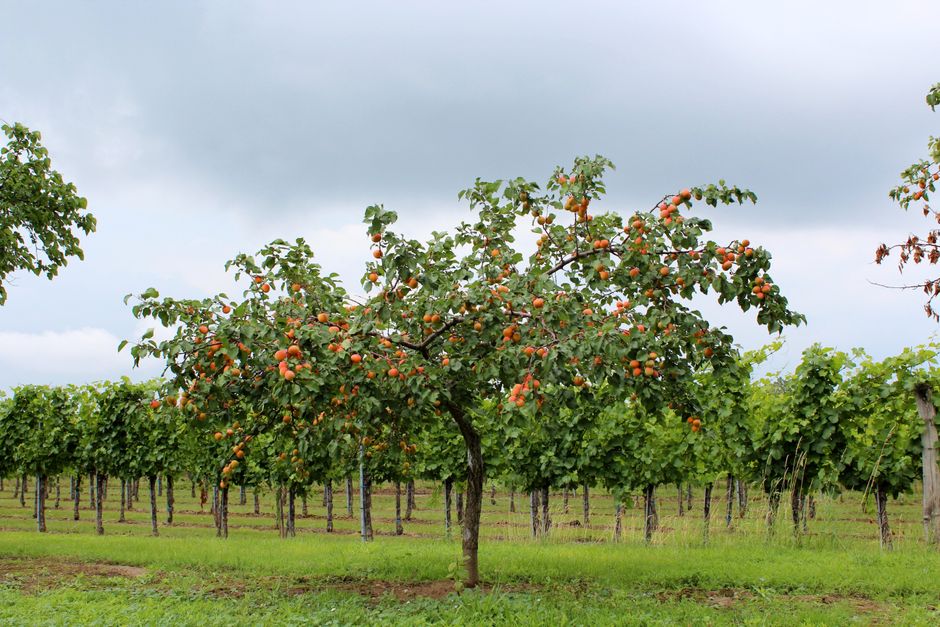
Apricot trees are particular. Prune them at the wrong time of year and you've basically invited bacterial canker to move in. (It will accept, and it will not leave — at least not without your help and a sharp saw.)
The good news: once you know the window, the method isn't complicated. The bad news: that window is narrower than most guides let on, especially here in the Fraser Valley where our wet winters give the pathogen exactly what it needs.
Direct answer: How to trim an apricot tree in Surrey, BC — prune right after harvest in late July or August, or in late winter before buds open, on a dry day. Open the canopy to a vase shape. Remove crossing branches, water sprouts, and dead wood. Never take more than 25–30% in one go. And don't touch it in fall.

When to trim an apricot tree
There are two windows. Both work. One is better depending on how much you have to do.
Window 1 — right after harvest (late July to August). The preferred timing for established trees. The tree is still in active growth mode, wounds seal quickly, and July and August in Surrey are dry enough that canker doesn't get its foothold. You can also see what the productive wood actually produced, which tells you where to focus next year.
Window 2 — late winter, before budbreak (February to early March). Without leaves you can see the branch structure clearly. The tree isn't actively growing yet, so you're not cutting into tissue that's working hard. This is the better window if the tree needs significant restructuring — you get a clean view of what you're doing.
What to avoid: Fall and early winter. Rain moves bacterial canker spores. Fresh cuts in October are an open invitation. Wait for dry weather — not just a dry day in the middle of a wet spell. A proper forecast window matters more than picking the exact right week on the calendar.
Nine out of ten apricot canker cases I've seen in Surrey trace back to fall pruning or pruning during a wet stretch. The tree doesn't tell you immediately. You find out the following spring when a branch doesn't bud out, and by then the canker has been in there for months.
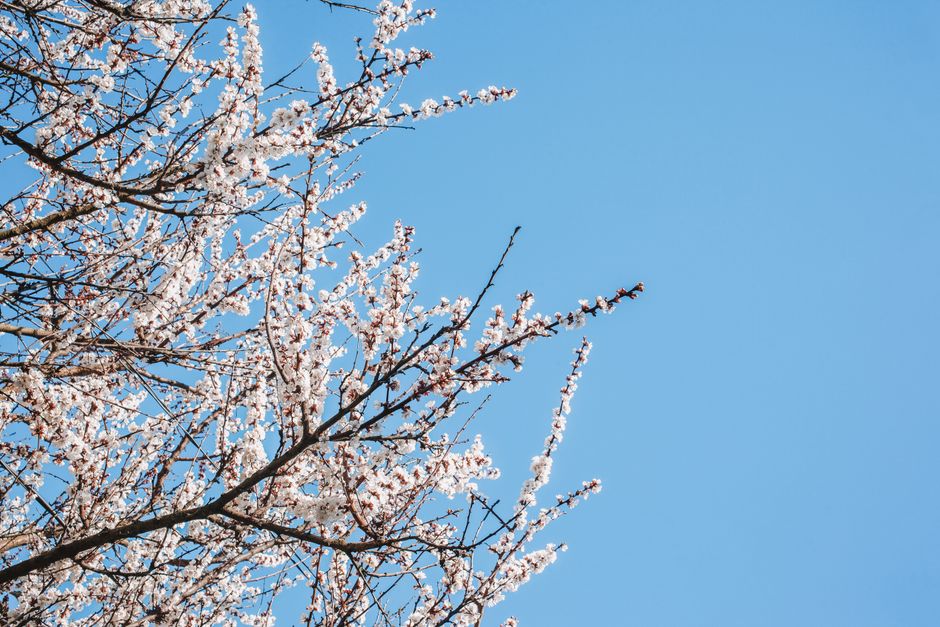
The shape you're aiming for: open-centre
Apricot trees are pruned to an open-centre shape — sometimes called the vase method. You're building a low, wide-spreading tree with no dominant central leader. Three to five main scaffold branches, each coming off the trunk at a wide angle, spreading outward and upward.
The reason is practical: light and air. Apricots fruit on short spurs along older wood. Those spurs need light to produce. A tree with a dense, closed canopy shades its own productive wood into uselessness. Open-centre means you're always managing light distribution, not just shape.
If you're starting with a young tree, remove the central leader in the first or second year. Pick three to four strong lateral branches with wide crotch angles — spaced around the trunk rather than all shooting the same direction. These become your permanent scaffold. Everything else gets removed or subordinated.
I reckon the biggest mistake homeowners make at this stage is keeping too many branches. Four well-placed scaffold branches will outperform eight poorly spaced ones every time. You're building the framework the tree lives with for decades.
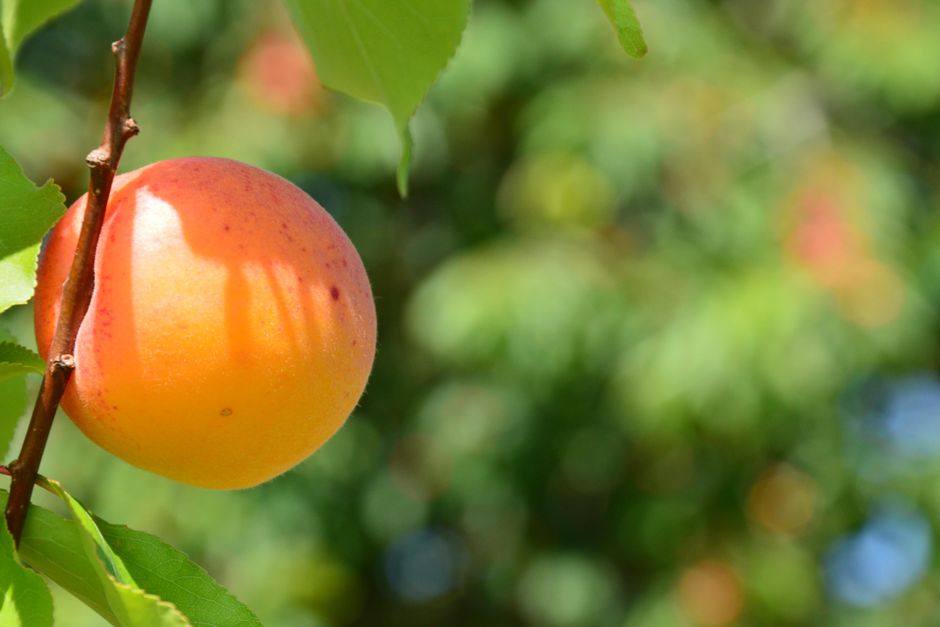
What to cut and what to leave alone
Always remove:
- Dead, damaged, or diseased wood — first priority, every time
- Crossing branches (two branches rubbing against each other — one goes)
- Water sprouts (the fast, vertical shoots that grow straight up from scaffold branches — vigorous but rarely productive)
- Root suckers from the base of the trunk
- Branches with narrow, tight crotch angles — they're structurally weak and prone to splitting under fruit load
What to keep:
- Your established scaffold branches — they're the skeleton of the tree
- Short fruiting spurs on older wood — apricots fruit here, not on long wands
- Well-placed laterals growing outward with wide branch angles
Rule of thumb on cuts: use thinning cuts where possible. A thinning cut removes a branch at its point of origin. It opens the canopy without stimulating the cluster of regrowth you get from heading cuts. For apricots, a clean canopy is easier to manage and less prone to disease than a dense one.
Good equipment matters. Dull blades crush tissue instead of cutting it cleanly. A sharp bypass pruner or a clean pruning saw means the wound heals faster and gives canker less to work with. For similar reasons, the same principles apply when pruning peach trees, which are close relatives and share many of the same disease vulnerabilities.
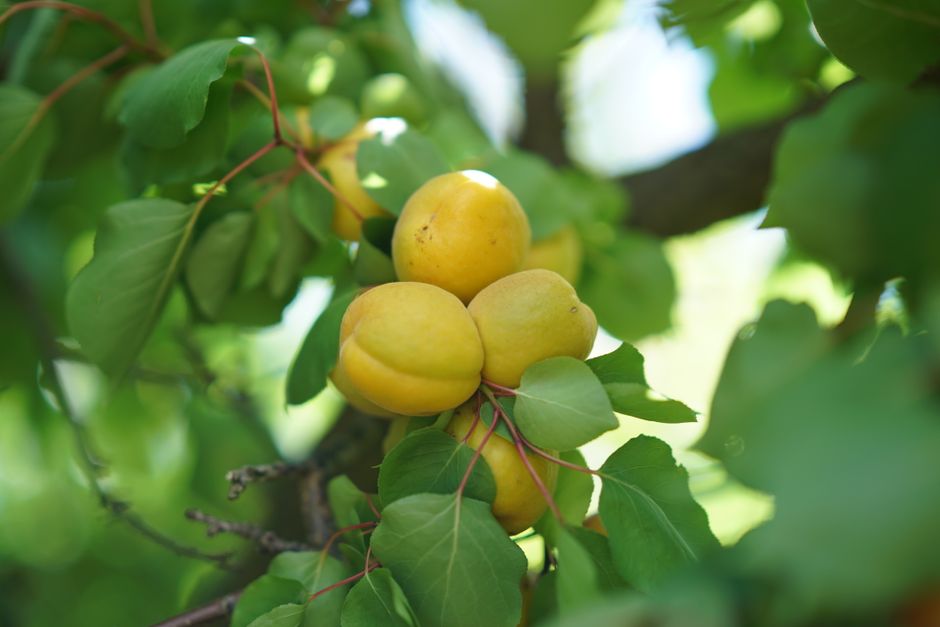
BC's wet winters and the canker problem
Bacterial canker — Pseudomonas syringae — is endemic to BC's coastal and near-coastal regions. It spreads in wet conditions, enters trees through wounds, and kills branches from the inside out. The infection is often invisible in fall. By the time you notice amber-coloured gum oozing from the bark in spring, the damage is months old.
The practical implication is straightforward: don't prune apricot trees between October and January in Surrey. The combination of frequent rain and open wounds is exactly what the pathogen needs. Even a "mostly dry" week in November has enough wet days to move spores.
When you do prune — in summer or late winter — sterilise your tools between cuts if you're working on a tree with any history of canker. A 10% bleach solution or isopropyl alcohol works. It sounds tedious; it's considerably less tedious than losing a scaffold branch.
The International Society of Arboriculture's pruning guide covers wound management and tool sterilisation in more detail. For trees with established canker, that's the time to call an arborist — infected wood needs to be removed well back into clean tissue, and if you're not sure where clean starts, you can easily spread it further.
How hard can you cut back an apricot tree?
No more than 25–30% of the canopy in one season. That's not a guideline — it's a ceiling.
Go harder and the tree's stress response kicks in. It produces a flush of vigorous water sprouts that look productive and are almost entirely useless. You've also removed more fruiting wood than you've replaced. The harvest the following year will tell you about it.
For a badly neglected tree — say, one that hasn't been touched in five or six years — renovation happens over two or three seasons. Take a third the first year, assess the response, take another third the next. It takes longer. The result is better.
I've seen homeowners try to fix years of neglect in one hard prune and end up with a stressed tree that didn't produce for two seasons. A client in White Rock called us after taking roughly 60% of the canopy off their Tilton apricot in one go, following a YouTube tutorial. The tree survived but didn't fruit for two years. We did a corrective prune the following winter and they had a decent crop the year after. The total cost to sort it out: $700 on top of the DIY effort that caused the problem.
Young trees vs. established trees
Young trees (years 1–3). The focus is structural, not production. You're building the scaffold — selecting and positioning the three to five main branches the tree will carry for its life. Remove the central leader to encourage the vase shape. Shorten laterals to keep growth proportional. Light cuts only; the tree needs to put energy into establishing.
Established trees. The scaffold is set. Maintenance pruning means keeping the canopy open, removing dead and crossing wood, renewing fruiting spurs by cutting back to shorter laterals, and controlling height so the tree stays manageable. Most established apricot trees in Surrey need two to three hours of work once a year to stay in good condition. Skip a few years and the renovation job multiplies.
A tree health assessment every couple of years catches structural issues before they become expensive ones — on apricots or any fruiting tree. It's considerably cheaper than sorting out a canker infection or a split scaffold branch after the fact.
When not to do this yourself
Most apricot tree pruning is manageable DIY work. Specifically, the pruning that happens within reach from the ground or from a stable ladder with a clear landing zone. Short-handled bypass pruners for spurs, loppers for smaller laterals, a hand saw for anything thicker than your thumb.
Call a certified arborist when:
- The work requires climbing — anything beyond a stable six-foot ladder is arborist territory
- The tree shows signs of canker or other disease and you're not certain where the infection ends
- A major scaffold branch has split and needs to come down without hitting anything beneath it
- The tree is near a structure, a power line, or a fence you'd rather not have to explain to your neighbour
- You're not sure whether what you're looking at is dead wood or just dormant wood — cutting dormant wood is a recoverable mistake; cutting into canker without containing it isn't
Honestly: if you're moving a ladder to reach the work, give us a call first. Not because the technique is complicated, but because a mistake from height is a different order of problem than a mistake from the ground. Our fruit tree pruning service runs $300–$800 flat for a typical Surrey apricot. That's the honest number.