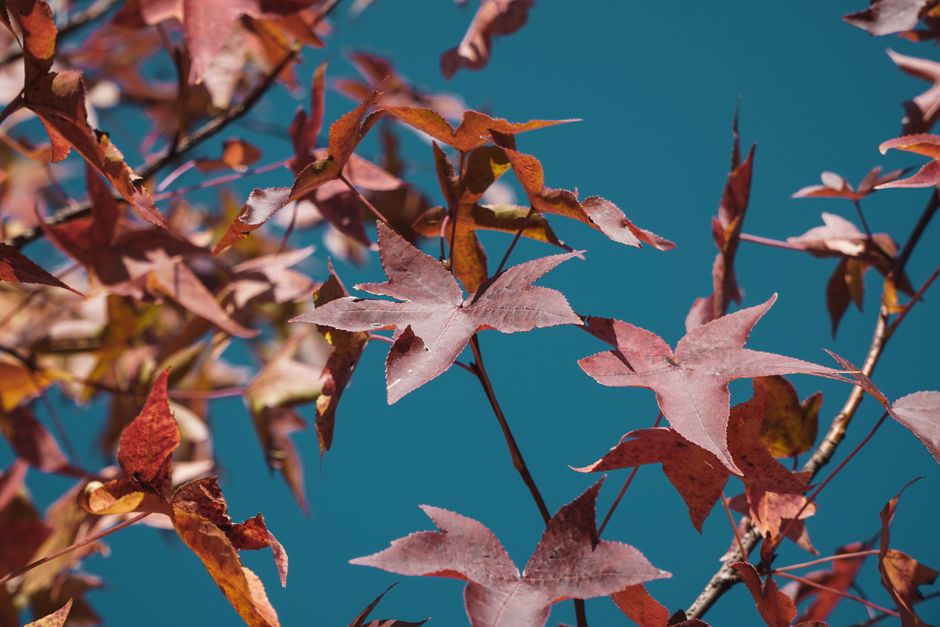
The name is a bit ambitious when the tree starts turning green on you. A crimson maple losing its colour is one of the more common calls we get in Surrey — and nine out of ten times, the fix costs less than the worry.
Quick answer: A crimson maple (usually the Crimson King cultivar of Norway maple) turning green is almost always rootstock reversion. Green-leafed shoots from below the graft point are taking over. Remove them and the burgundy growth resumes. For pests, disease, and removal questions — read on.
What follows is what I actually tell people when they call about their crimson maple — not a species profile lifted from a horticulture textbook.
What a crimson maple actually is
"Crimson maple" usually refers to Acer platanoides 'Crimson King' — a cultivar of Norway maple selected for its deep burgundy foliage. It is not a distinct species. The burgundy growth is grafted onto standard Norway maple rootstock, which is why the green-leaf reversion happens at all.
The tree is handsome in the right setting. Fast-growing, dense canopy, reliable colour through the season. It does what landscape architects want — fills space quickly, stays dramatic until leaf drop. The problems come later, once it is established and the surrounding plants start competing poorly, or the rootstock decides to reassert itself.
Norway maple was brought to North America as a street tree because it is tough. Drought-tolerant, urban-hardy, fast to establish. The same qualities that made it a popular planting choice are also why it has become a significant invasive concern across the Pacific Northwest.

Why your crimson maple is turning green
Almost always rootstock reversion. The tree you bought is a graft — burgundy-leafed Crimson King wood fused onto a Norway maple rootstock. The rootstock grows green leaves. If any shoots from below the graft union are allowed to grow, they outcompete the grafted portion because rootstock is more vigorous. Within a season or two, the green takes over.
The fix is simple: find the graft union (a visible scar or bulge low on the trunk, usually 15–30cm above soil level) and remove any shoots growing from below that point. Pull or cut at the base rather than clipping — clipping encourages regrowth. Do it early in the season before the green shoots get a head start.
If the green growth is coming from the crown rather than the base, the cause is different. Deep shade leaches colour from the leaves. Excess nitrogen fertiliser does the same — pushes vegetative growth at the expense of the anthocyanin pigments that give the tree its red. Rule of thumb: if you have been fertilising heavily, ease off and see what the following season brings.
Occasionally the grafted portion dies back and only the rootstock remains. If the entire canopy has gone green and the original burgundy growth is absent, that is a different conversation — one that usually ends in replacement rather than rescue.
Common pests and diseases on crimson maples
Norway maples attract specific problems. Most are manageable.
Aphids — specifically the Norway maple aphid (Periphyllus lyropictus). If you have parked under your tree and returned to a sticky car, this is almost certainly the culprit. Aphids colonise the undersides of leaves in summer and excrete honeydew at an impressive rate. A healthy tree handles light infestations without much trouble. Heavy pressure — curling leaves, early leaf drop, obvious honeydew pooling — is worth addressing. A strong directed water spray at the undersides of leaves is the first move, not a pesticide.
Powdery mildew — white dusty coating on the leaf surface, usually mid-summer. Cosmetic in most cases. Improves with better airflow around the canopy. I reckon most trees recover fine without treatment given a dry spell.
Maple tar spot — black spots on leaves by late summer. Alarming-looking, low impact. The fungus (Rhytisma acerinum) overwinters in fallen leaves, so raking and disposing of leaf litter each autumn is the main management strategy.
Verticillium wilt — this one matters. Caused by a soil fungus, verticillium wilt blocks the tree's vascular system. Symptoms are sudden wilting or scorch on individual branches while the rest of the tree looks normal. Cross-section through an affected branch shows olive-green or brown discolouration in the wood. There is no cure. Management means keeping the tree as healthy as possible — consistent watering, no excess nitrogen, removal of affected limbs — and waiting to see if the tree can compartmentalise the infection.
If you are seeing branch dieback and you are not sure of the cause, a tree health assessment is worth having done before you make any decisions. Verticillium wilt and drought stress look similar on the outside. They are managed very differently.
When and how to prune a crimson maple
Late winter is the window — February through mid-March, before bud break. The tree is dormant, wounds compartmentalise quickly once growth resumes, and you can see the branch structure clearly without the leaf load.
Avoid pruning in late spring. Norway maples bleed heavily when the sap runs, and a freshly pruned tree dripping amber sap is not great for the tree or the patio furniture beneath it. Avoid summer pruning of significant branches — wounds are slower to close in the heat. A light cosmetic tidy after leaves have fully hardened in July is fine. Structural work waits for winter.
Never remove more than 20–25% of the canopy in a single season. Beyond that threshold, most trees respond with vigorous water sprouts — fast-growing vertical shoots from each cut point that create more work and more hazard points over time. I have seen maples that were severely topped spend four years producing competing leaders before the whole thing needed coming down. The original pruning cost a fraction of what the damage cost to correct.
On topping: don't. Norway maples are sometimes topped by contractors who either don't know better or won't say otherwise. Topping removes the natural leader and triggers the water sprout response above. The tree looks shorter briefly, then becomes a bigger problem than it was. If size is the issue, proper crown reduction removes 20–30% of overall height and spread through selective lateral cuts. It is structurally sound. Topping is not.
One more thing: don't use climbing spikes on maples. The bark wounds they leave are genuine entry points for disease. We use a saddle or rigging — not spikes — on any climbable maple. This is a line I won't move regardless of budget pressure.

Norway maple and BC's invasive species situation
Norway maple — including the Crimson King cultivar — is a regulated invasive species in parts of BC and across the Pacific Northwest. The BC Invasive Species Council includes it on their watch list. Metro Vancouver and some Fraser Valley municipalities have it on regulated plant lists.
In practice: if your tree is producing seed — the winged samaras that helicopter down each fall — those seeds are viable and will germinate readily in neighbouring gardens, boulevard plantings, and natural areas where they crowd out native understory. Norway maple forms such a dense canopy that almost nothing grows under a mature specimen. That is part of why it outcompetes.
This does not mean your tree needs to come down. It does mean: manage the seed load each year, dispose of seed clusters in the garbage rather than the compost, and if you are replacing the tree at any point, choose a native species. Bigleaf maple, vine maple, and Pacific dogwood are all well-suited to Surrey's climate and far less trouble over the long term. The BC native plants guide has a useful species list if you are planning a replacement.
My honest position: native species perform better in BC over the long term. They are adapted to our pests, our rainfall, our winters. The Crimson King maple is a beautiful tree that many Surrey homeowners have had for decades — I am not suggesting mass removal. But if yours is declining and you are choosing a replacement, there are better options than planting another Norway maple.
Removal: honest costs and what most services won't tell you
Here is the thing about the tree service industry: removal pays better than pruning. A lot of companies will quote removal on a struggling maple when the honest answer is that it needs a proper assessment and possibly a crown reduction.
A few years back I was called in to look at a Norway maple that another company had quoted $1,600 to remove because it was "declining." When I assessed it: yes, it had verticillium wilt in a few upper branches. The rest of the tree had plenty of healthy structure. We removed the affected limbs ($450) and the tree looked better within a season. The homeowner saved over a thousand dollars and kept a tree that shades their deck.
Get a second opinion before agreeing to removal. The assessment call is usually free. It is worth the time. Anyone who can't tell you whether the tree is worth saving before they quote removal isn't doing a proper assessment.
When removal is the right answer — because the tree is structurally failed, severely diseased beyond recovery, or you want to replace it with a better-suited species — here are honest Surrey pricing ranges:
| Tree size | Removal cost (CAD, stump included) |
|---|---|
| Small — under 5m / 15ft | $400–$650 |
| Medium — 5–10m / 15–30ft | $800–$1,400 |
| Large — over 10m / 30ft | $1,500–$3,000+ |
| Sectional dismantling near structures | Add $400–$800 |
Stump grinding is included in our removal quotes. A lot of companies leave it out of the headline number and add it at the end. Ask upfront. For a full breakdown of what drives removal pricing in Surrey, see our tree removal cost guide.
When not to call us about your crimson maple
There are situations where you genuinely don't need an arborist — and I will tell you what they are.
- Rootstock reversion — if you can see the graft union and the green growth is clearly below it, you can remove those shoots yourself. Clean cut or pull at the base, gloves on, done. No arborist needed.
- Tar spot or powdery mildew on an otherwise healthy tree — rake the leaves, skip the spray. These are cosmetic. They are not worth a service call.
- Aphids on a large, established tree — if the tree is 7m+ and otherwise healthy, a light aphid load is within normal range. The tree manages it. Your hosepipe manages the rest.
- Minor deadwood pruning under 3m high — if the branch is well within reach and you have a clean sharp tool, small deadwood removal is within a careful homeowner's ability. Cut just outside the branch collar. Don't leave a stub.
Give us a call when the tree is over 5m, when you are near structures or power lines, when you are seeing significant branch dieback, or when you are not sure what you are looking at. That last one especially — an hour with an ISA-certified arborist is cheaper than a year of guessing wrong.