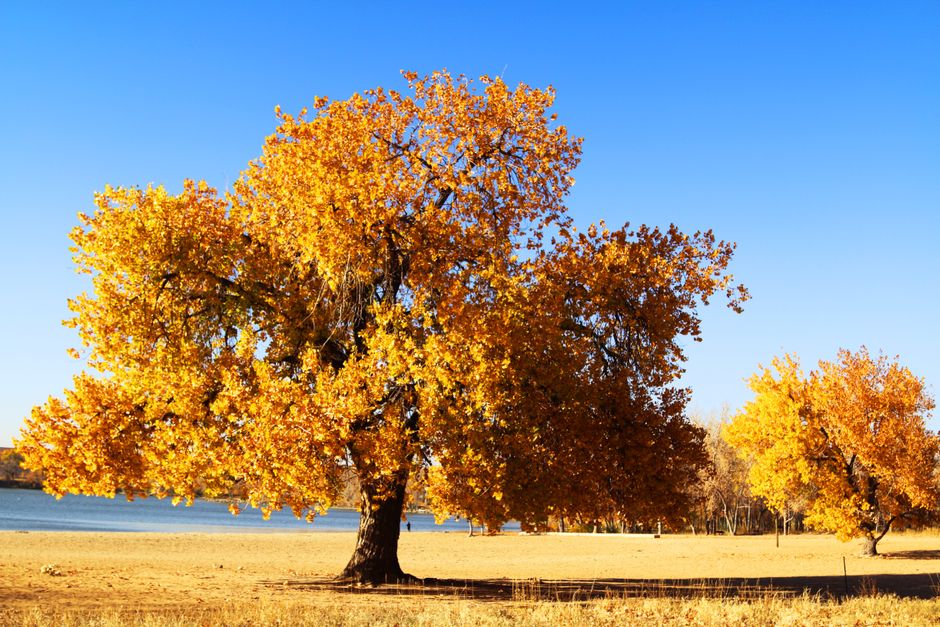
Every May in Surrey, something floats past your kitchen window that looks like it belongs in a snow globe. It settles in the gutters, coats the car, drifts across the deck. (The deck you just cleaned.) It's cottonwood fluff. And if you have a black cottonwood anywhere on or near the property, it's yours now.
Black cottonwood (Populus balsamifera) is BC's largest native broadleaf tree. It grows fast — up to two metres per year when young. It can reach 30 metres at maturity. And the cotton comes every spring without fail.
Quick answer: Most cottonwood complaints — the fluff, the size, the general drama — are manageable without removal. The one exception is root proximity to a foundation or sewer line. Get an assessment before that becomes an emergency.
Most homeowner concerns about cottonwood fall into three buckets: the fluff, the roots, and the size. All three are manageable. Two of them are genuinely not as bad as they look. One — the roots — deserves your full attention.
What is a black cottonwood tree
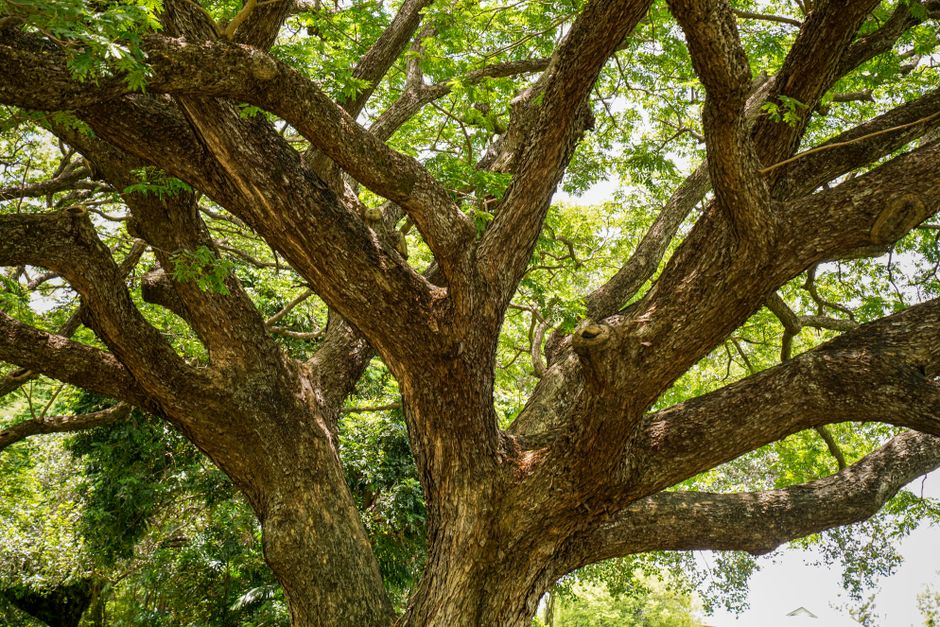
The species you're almost certainly dealing with in Surrey or the Fraser Valley is black cottonwood (Populus balsamifera ssp. trichocarpa) — not the eastern cottonwood (Populus deltoides) you'll find on American gardening sites. They're related but different. The management questions are similar; the scale is not.
Black cottonwood is native to BC. It colonises stream banks, floodplains, and disturbed lowland ground throughout the Lower Mainland. It's not a tree someone planted for landscaping — it seeds itself aggressively, and if you have moist ground anywhere on the property, the seeds will find it.
The tree grows fast. Under good conditions — moisture, full sun — young black cottonwood adds 1.5 to 2 metres per year. By the time it becomes a noticeable presence in your yard, it's usually already 10–15 metres tall. That's the tricky part: the window for easy management is short.
The bark is grey and deeply furrowed on mature trees. The leaves are broadly triangular, dark green on top, whitish underneath — they catch the wind and make a distinctive rattling sound. In fall, they turn clean yellow before dropping. And the buds are resinous and fragrant, producing a sticky amber substance that stains decks and outdoor furniture. (That's the tree doing what it's supposed to. Still annoying.)
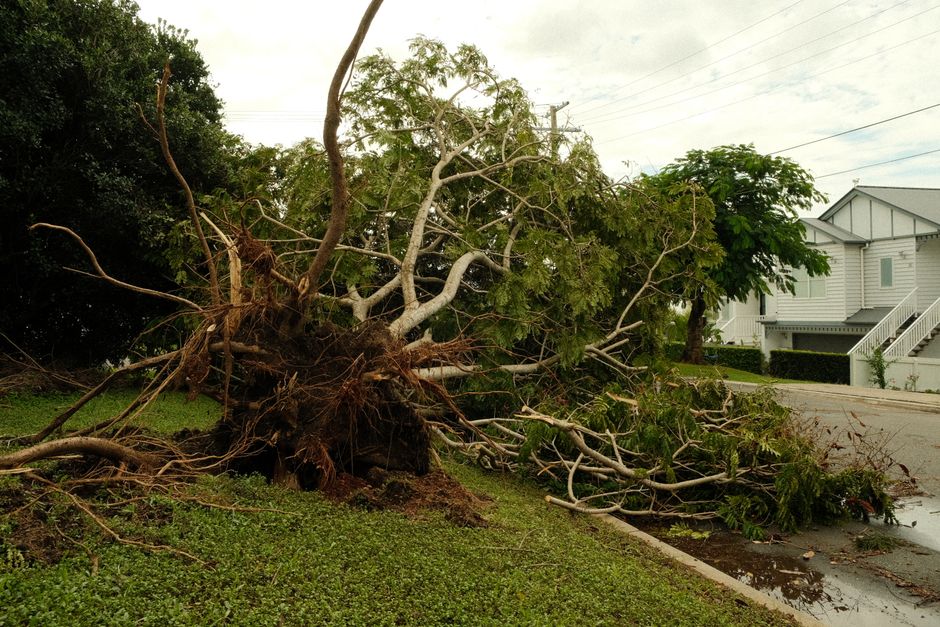
The wood is relatively soft for a tree this size. That matters when you're thinking about storm risk. Cottonwood doesn't fail the way Douglas fir fails — it drops large limbs with less warning, particularly in wet, windy conditions.
The fluff: what it is and what to do
Late May through June. The white fluff floats past every window, settles on every surface, and blocks gutters faster than anything short of a cedar in autumn. Here's the important part: it is not hurting anyone, not a sign the tree is sick, and not pollen. (If you have spring allergies, cottonwood pollen was doing its work weeks earlier, in March and April. The fluff is just the packaging.)
Female black cottonwood trees produce seed capsules that split open in late spring. The seeds are tiny. The white fibrous strands they travel in are very, very light. On a warm day with any wind at all, they travel several kilometres. If there's a cottonwood within two or three streets of you, some of it will reach your yard.
Nine out of ten people who call us about cottonwood fluff are asking how to stop it. The honest answer: you can't stop an established tree from producing fluff. You can reduce it.
Crown reduction removes the outer canopy where most of the seed-bearing branches are concentrated. Done properly, it cuts overall fluff production by 30–50%. Most homeowners notice a real difference after a good crown reduction. But the tree is still a cottonwood. It will still produce some cotton every spring.
If the cotton is your primary complaint — allergies, gutters, vents — crown reduction is worth the cost. We've done it enough times to tell you the difference before and after is significant. What it won't do is eliminate the problem entirely, and anyone who tells you otherwise is selling you something.
Root damage and foundation risk
This is the one that costs homeowners real money. Cottonwood roots are fast-growing and actively seek water — which is a useful trait in a species that colonises stream banks, and a significant liability when your property includes a foundation, a sewer lateral, or a buried utility line.
Rule of thumb:don't plant a cottonwood within 15 metres of a foundation, a septic tank, a sewer line, or any buried utility. The roots will find them. If there's already a crack or a joint, they'll find that specifically.
For trees already established — or self-seeded, which cottonwood does enthusiastically — the options are:
Root barrierscan be installed between the tree and any at-risk structure. This works best when installed early, before roots are already established near the target. It's not cheap. It's cheaper than sewer excavation.
Root pruningby a professional can redirect existing roots. Done wrong, this destabilises the tree. Done right, it buys time. It's not a permanent fix for a tree that's actively growing toward a foundation.
Removal— when the root system is already damaging a structure, removing the tree stops the damage from getting worse. It doesn't reverse what's already happened.
One thing worth knowing: root damage doesn't usually announce itself clearly. By the time you see cracking around a foundation, the roots have often been there for years. Earlier signs include slow-clearing drains, persistently damp ground on one side of the house, or raised paving near the tree.
If you have a mature cottonwood within 10 metres of your foundation, I'd get an independent tree health assessment before the next wet season. Saturated soil shifts. Root pressure on foundations doesn't improve over winter.
Is your cottonwood worth keeping
Yes — with conditions.
Healthy, well-positioned cottonwood trees are genuinely good for a property. They're fast-growing, which means shade and screening arrive sooner than with slower species. They support native bee populations — bees forage on the resinous buds in early spring when not much else is available. They provide nesting habitat for cavity-nesting birds. And they're part of the ecological character of BC's lowland landscapes.
I had a homeowner in Surrey call a few years ago, certain their large cottonwood needed to come down. A different company had already quoted $2,200 for removal. The tree was leaning slightly and dropping a lot of debris. I walked the property. The lean was natural — the tree had always grown that direction toward the light. The debris was normal shedding. The root system wasn't near any structure.
We did crown reduction ($750) and deadwood removal ($350) instead. The homeowner saved $1,100, kept a tree with another 30 years in it, and stopped getting debris on the roof. That's the conversation that should have happened first.
Most tree services in BC don't make that call. Removal is the expensive service. I'd rather tell you the tree is fine and have you call us in three years for a follow-up than remove something that didn't need to go.
If your tree is set back 15 or more metres from any structure, showing no signs of major crown die-back, and not overhanging your roof — nine times out of ten the management answer is pruning and monitoring. Not removal.

When to remove a cottonwood
Removal makes clear sense in four situations:
The tree is dead or significantly declining. A dead cottonwood is a hazard within 12–18 months, sometimes sooner. Cottonwood wood decays faster than cedar or fir, and large dead limbs come down without warning. If more than half the crown is dead wood, removal is usually the right call. For guidance on what that assessment involves, see our signs a tree is dead or dying.
The roots are already damaging a structure.At that point, even removing the tree doesn't undo existing damage — but it stops it getting worse.
The tree is within falling distance of the house and leaning toward it.Leaning isn't always dangerous — natural lean is different from failure lean. But a large cottonwood leaning toward a structure needs a professional assessment, not an educated guess from the back porch.
There are visible structural failure indicators at the base. Multiple cracks at the root flare, visible root plate lifting, fungal growth around the base — these are signs a tree is formally resigning. No pruning fixes those.
What removal doesn't require: a bit of cotton, healthy roots that aren't near any structure, or the fact that the tree is getting large. Size alone is not a removal decision. When I see a removal quote given without a written assessment, I always ask what the assessment showed. Nine times out of ten, there wasn't one.
The International Society of Arboriculture recommends a full written risk assessment before any large tree removal. That's not bureaucracy — it's the only way to know the actual risk level.
What cottonwood tree removal costs in Surrey, BC
Nobody lists prices for this. I don't know why. Here are ours.
| Service | Price (CAD, all-in) |
|---|---|
| Tree assessment / consultation | $150 (credited toward work) |
| Small cottonwood removal (under 30 ft) | $400–$650 |
| Medium cottonwood removal (30–60 ft) | $800–$1,400 |
| Large cottonwood removal (60+ ft) | $1,500+ |
| Crown reduction (20–30% size reduction) | $500–$1,200 |
| Deadwood removal | $250–$600 |
| Stump grinding (standalone) | $200–$500 |
All prices include stump grinding, cleanup, and debris removal. No surprise line items at the end.
The main variable is access. A large cottonwood in an open backyard costs less than the same tree against a fence with power lines nearby. Before we give you a number, we look at the job. The quote covers what we see, and if something changes mid-job, we stop and talk to you before continuing.
The technique that matters most for cost is whether the tree can be felled (dropped in a controlled direction) or needs to be rigged — lowered in pieces using ropes and rigging hardware. Rigging adds cost. It's also the technique that doesn't drop half the tree on your fence.
For BC homeowners wondering about municipal permits: the City of Surrey Tree Bylaw requires a permit for the removal of protected trees on private property. Black cottonwood over a certain diameter qualifies. We handle the permit application as part of the job.
When not to call us
I reckon this section matters as much as anything else here.
If the fluff is your only complaint:that's not a removal job. Crown reduction helps. It won't eliminate the cotton entirely, and if you're expecting otherwise, you'll be disappointed by March.
If you're considering removing a healthy, well-placed cottonwood because it's getting large: talk to an ISA-certified arborist first. Crown reduction is almost always an option, and it's a fraction of the removal cost. BC's native species field guide puts the black cottonwood's natural lifespan at well over 100 years. A 20-metre tree isn't old — it's early middle age.
If a neighbour's cottonwood is overhanging your property:that's a fence-side conversation and potentially a municipal inquiry. Liability questions are complicated. We can assess the risk on your side, but we won't remove someone else's tree without their knowledge and consent.
If you want one quote and no second opinion:for a tree this size, that's not the right approach. Get two assessments. A second opinion costs $150. It often saves considerably more than that, and on a tree that's been growing for 40 years, the decision to remove it deserves more than one arborist's say-so.