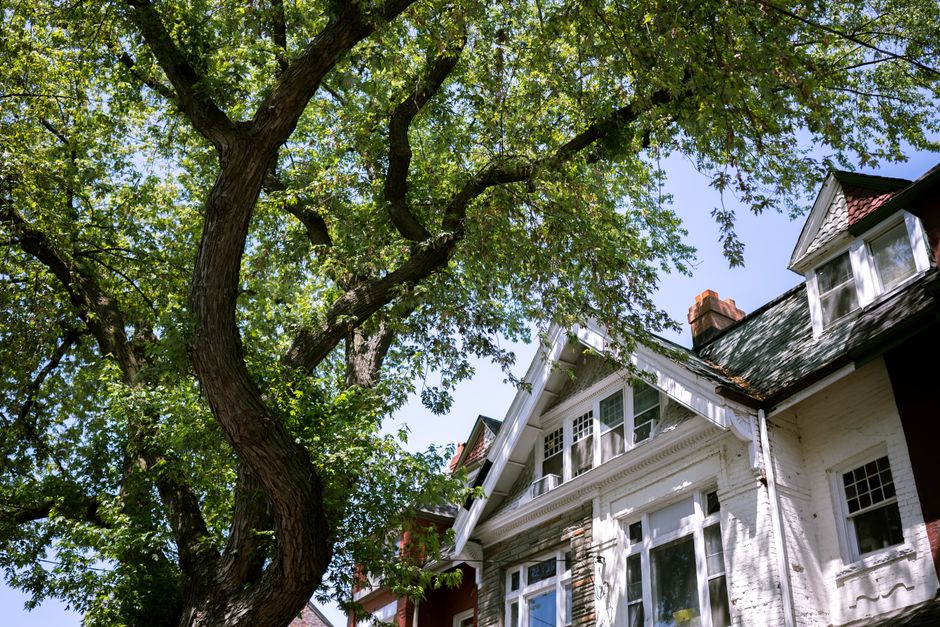
Your neighbour's tree has been threatening your fence for two years. Last Tuesday it stopped threatening and started demonstrating. (Trees are decisive like that — once they commit, they really commit.)
The short answer to who pays for tree removal on property line situations: whoever owns the tree. The longer answer involves property surveys, insurance adjusters, and BC case law — and is considerably less satisfying than that first sentence suggests.
Here's how it actually works.

Who owns a property-line tree in BC?
In BC, the rule is simple: the tree belongs to whoever owns the land the trunk grows on.
If the trunk is entirely on your neighbour's property, it's their tree. If it's entirely on yours, it's yours. Branches crossing over your fence don't change ownership. Neither do roots running under your lawn.
The complicated part: if the trunk grows on or straddles the property line, BC treats it as a boundary tree. Both landowners hold shared ownership. Neither can unilaterally remove it — even if it's causing damage on their side. You need mutual agreement before anyone picks up a chainsaw. Get that agreement in writing.
Nine out of ten property-line disputes I deal with come down to this exact question. The person calling usually assumes the tree belongs to the neighbour. Half the time it's sitting right on the line, or the trunk has grown into it over twenty years. Without a survey, ownership is a guess.
If you're genuinely unsure where the line sits, a legal property survey is the authoritative answer. Not cheap — typically $800–$2,000 in the Lower Mainland — but considerably cheaper than a legal dispute over a 40-foot cedar.
Who pays for removal — the real answer
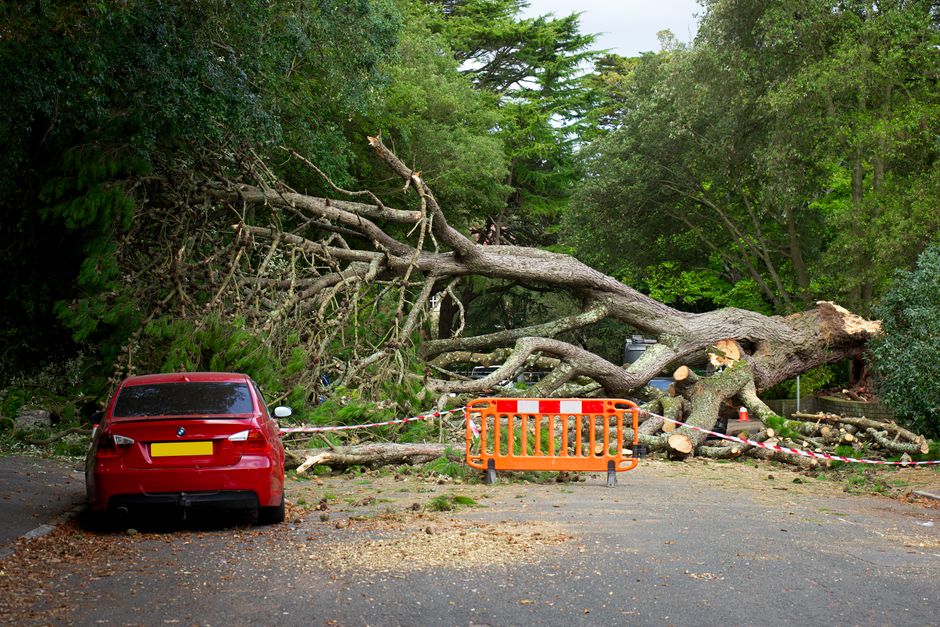
If the tree is on your neighbour's land and it's damaged your property, your neighbour isn't automatically liable. That part surprises most people.
In BC, each property owner is responsible for their own structures. Your homeowner's insurance covers damage to your property — including from a neighbour's tree. Your insurer then decides whether to pursue your neighbour's insurer based on whether the tree was negligently maintained.
Here's the distinction that matters: if your neighbour had a visibly dead or diseased tree and you sent them written notice that it was dangerous, there's a negligence argument. If a healthy tree came down in a freak windstorm, that's an act of God and your insurer handles it.
The Insurance Bureau of Canada's storm damage guide covers what a standard homeowner's policy typically includes and excludes — worth reading before storm season rather than after it.
Whether your neighbour voluntarily splits costs is a separate question entirely. Some do. Some don't. What they're legally required to pay depends on negligence, which is a legal question and not something I can answer from the cab of a truck.
When your neighbour's tree falls on your property
Document first. Arborist second.
I know that's counterintuitive when there's a 40-foot cedar across your fence. But time-stamped photos from a safe distance — before anyone touches the tree — are what your insurance adjuster needs. Once cutting starts, the original scene is gone and so is some of the evidence.
Then call your insurer, not the tree company. Your policy likely covers removal from a structure the tree damaged. It typically won't cover removing the tree from your yard if it missed everything. There's a meaningful distinction buried about four pages into your policy wording.
Stay well away from the fallen tree, especially if part of it is still attached to a standing trunk. Storm-damaged timber is under unpredictable tension. What looks stable at noon can shift by mid-afternoon as wood settles and dries.
If the situation involves power lines, stop everything and call BC Hydro first. Don't approach the tree until lines are confirmed de-energised — even wet soil within a few metres of a downed line can carry current.
Overhanging branches — what you can and can't do
This is the area where your rights are clear, regardless of who owns the tree.
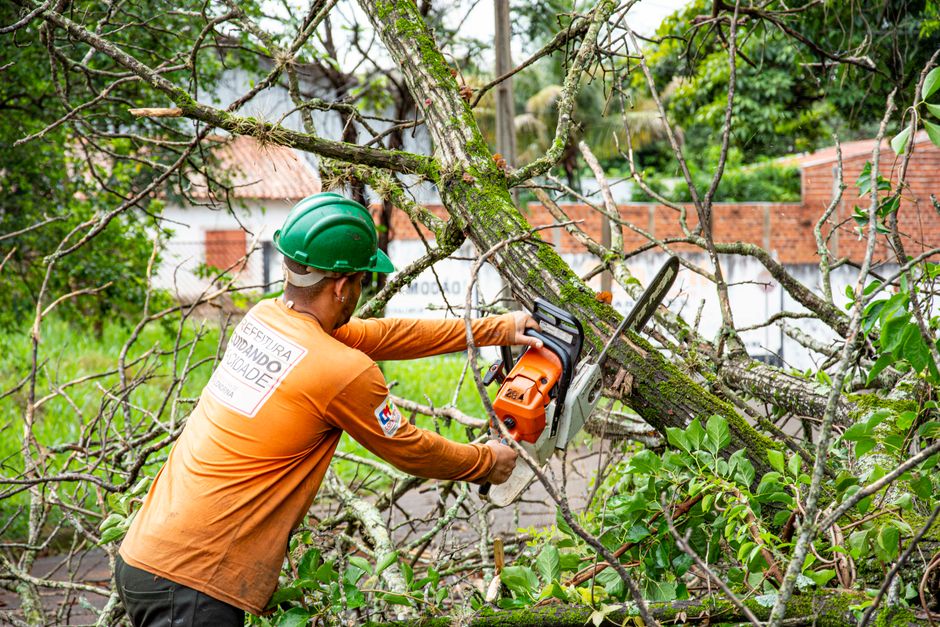
In BC, you're entitled to trim branches and roots that cross your property line, to the property line itself. No permission required. The cuttings technically belong to your neighbour — you're supposed to offer them back — but in practice nobody demands their branches returned.
What you can't do: enter your neighbour's property to do the work, or cut past the property line. Simple in theory. Worth reviewing before your cousin arrives with a reciprocating saw and a confident attitude.
Here's where homeowners get into trouble: removing large branches incorrectly can destabilise the tree or redirect failure toward your side. Rule of thumb — any limb over 10 centimetres in diameter, or anything requiring a ladder, warrants a qualified arborist. The cost of doing it right is less than the liability if a branch comes down sideways.
For a straight read on what's safe to handle yourself and when to stop, our tree pruning service in Langley/Aldergrove covers the full range — from minor trimming to crown reduction on large trees.

When you and your neighbour disagree
Get an independent assessment. It's cheaper than the two alternatives — a stalemate dragging into year two, or a legal dispute dragging into year four.
An ISA Certified Arborist can assess the tree's condition and document it formally — health, structural issues, hazard rating, estimated remaining life. Both parties get the same facts from someone with no stake in the outcome.
I've been called in as a neutral party more than once in Langley/Aldergrove and Langley. The report doesn't tell you who pays — that's a legal question — but it replaces speculation with facts. It's a lot easier to negotiate when both sides are reading the same document.
If the tree is genuinely hazardous and your neighbour won't act, Langley/Aldergrove Bylaw Services and most Lower Mainland municipalities can inspect and order removal of dangerous trees on private land. That process is slower than most people want. It exists.
What does property-line tree removal cost?
Honestly, the same as any other removal. Size, access, and complexity drive the cost — the property dispute doesn't add a surcharge, though the logistics sometimes do.
| Tree size | Typical range (all-in) |
|---|---|
| Small (under 30 ft) | $400–$650, stump included |
| Medium (30–60 ft) | $800–$1,400, stump included |
| Large (60 ft+) | $1,500+, site-dependent |
If both neighbours have agreed to split costs, the quote goes to whoever calls and the division is theirs to negotiate. If access requires working from both sides of the line — or removal angles are restricted by structures on both properties — the rigging gets more involved and the price reflects that.
If the tree is contested, a professional tree health assessment first can determine whether removal is actually warranted, or whether structural pruning resolves the issue at a fraction of the cost. That assessment runs $150 and is credited toward any work.
When not to call us
If your neighbour's tree is healthy and not threatening any structure, this is a neighbourly conversation — not an arborist call. I reckon most of these situations are better handled over a fence than with a crew showing up uninvited.
If overhanging branches are the main issue and they're small enough to handle safely from your side of the line, trim them yourself. You have the legal right.
Where we come in: the tree is structurally hazardous, both parties have agreed on removal, or you need an independent assessment both sides can work from. That's what we're here for.
Most tree services won't tell you this, but about a third of property-line calls I see could be resolved without touching the tree at all. A proper assessment, a direct conversation with the neighbour, and a plan — that's often more useful than booking a crew.