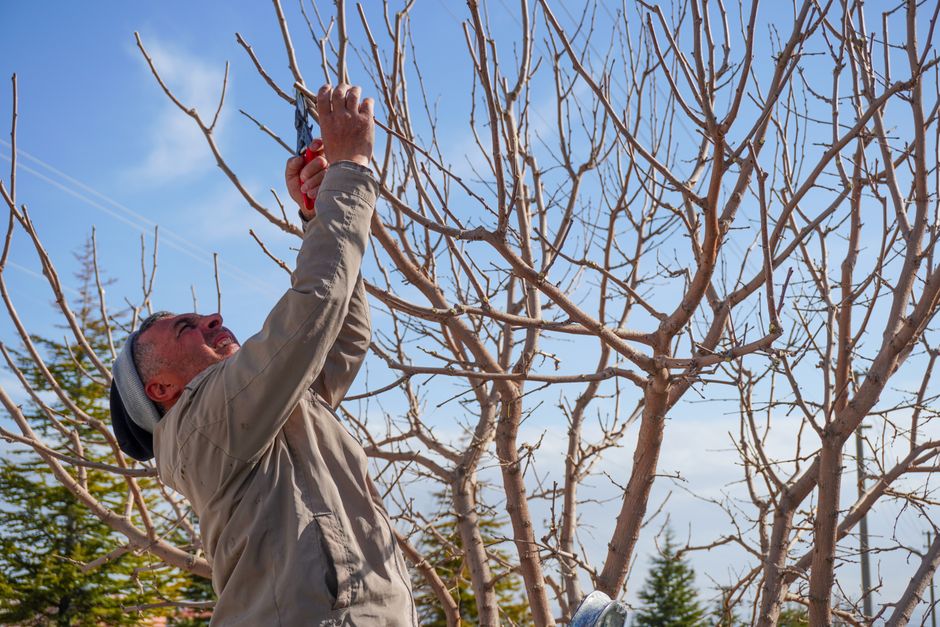
Pear trees are one of the best fruit trees in a Langley/Aldergrove garden. Hardy, productive, and the only tree I've had a client call “pear-fect” to my face. I gave them the discount anyway. The best time to trim pear trees is between late January and mid-March, while the tree is still dormant.
That timing is not optional. Pear trees pruned at the wrong time — especially in fall, or in the middle of summer — respond with excessive water sprout growth instead of productive fruiting wood. And if fire blight is involved, wrong-season pruning with unsterilised tools can turn a contained problem into a serious one.
Quick answer:Trim pear trees in Langley/Aldergrove between late January and mid-March. Remove up to one-third of the canopy, prioritising dead, diseased, and crossing branches. Keep the central leader. If you see any wilted, brown shoots with a shepherd's crook tip, that is fire blight — deal with it carefully using sterilised tools, or give us a call.
Nine out of ten pear trees I see in Langley/Aldergrove gardens are either not pruned at all, or pruned at the wrong time of year. Usually by someone who looked up “how to prune a pear tree” and found advice written for a different climate. Langley/Aldergrove is not the same as the UK or the US Pacific Northwest, even though it looks similar on paper.

When to trim pear trees in Langley/Aldergrove
The window is late January through mid-March. That is when pear trees are fully dormant in the Fraser Valley — no active growth, no sap flow, no energy being directed upward. It is the safest and most productive time to prune.
Three reasons this window works:
Structure is readable. Without leaves, you can see every scaffold branch, every crossing stem, every water sprout from last season. You make better decisions when you can see what you are working with.
Cuts close cleanly. Dormant tissue heals efficiently once growth resumes in spring. Pruning wounds made in late winter are typically compartmentalised and sealed by early summer.
Fire blight bacteria are less active. The pathogen that causes fire blight is present year-round, but its spread is far more aggressive during warm, wet weather when the tree is in active growth. Pruning in winter reduces the window during which a contaminated tool can infect fresh tissue.
Do not prune in fall.Fall pruning stimulates soft new growth right before Langley/Aldergrove's first frosts — typically late November. That growth has no time to harden. It dies back, and you are removing the same material again in late winter. Rule of thumb: if the leaves are still green, leave the pruners in the shed.
Summer pruning is limited and specific. The only tasks appropriate in summer are removing water sprouts — the fast, vertical shoots that shoot straight up from scaffold branches — and any obviously dead or diseased material that is a hazard. Full structural pruning in summer causes stress and triggers regrowth that takes energy away from fruit development.

What to cut — and how much
Start with the obvious. Dead, diseased, and damaged branches come out entirely — back to healthy, white wood at the cut face. No exceptions. Those are not candidates for one-third-back; they come out fully.
Next: crossing branches. Where two branches rub against each other, one of them goes. You are choosing the better-positioned branch and removing the other entirely, not trimming both back to a meeting point.
Then: water sprouts. These are the fast, vertical, non-fruiting shoots that grow straight up from scaffold branches. They draw energy away from fruiting wood. Remove them at the base, cleanly.
Finally: length reduction. Once dead, diseased, crossing, and water sprout material is out, you can shorten remaining scaffold branches by up to one-third of their length. Cut just above an outward-facing bud. The bud below the cut becomes the new leader for that branch, directing growth outward rather than upward and inward.
The one-third limit is firm.Removing more than one-third of the canopy in a single season causes the tree to respond defensively — a flush of water sprouts and suckers instead of productive fruiting wood. You end up with more to remove next year than you removed this year. I have seen this happen on trees where someone decided to “get it done properly” in a single aggressive session. The tree does not agree with that approach.
Central leader: how pears are shaped differently
This is where a lot of people go wrong, particularly if they have already pruned peach or cherry trees.
Peaches and cherries are pruned to an open-centre vase shape — you remove the central leader and encourage several scaffold branches to fan outward and upward, creating an open canopy. That maximises light penetration and keeps the fruiting zone accessible.
Pears are different. They naturally want to grow with a strong central leader — one dominant upright trunk that continues through the canopy, with scaffold branches radiating off it at intervals. You work with this tendency, not against it. The result is more of a Christmas-tree silhouette than a wine glass. Lower scaffold branches are longer; upper ones are shorter, so the tree tapers toward the top.
For young pear trees in their first three to five years: choose a single leader early. Remove any competing stems that grow at a similar angle and rate. Establish scaffold branches at roughly 45-to 60-degree angles from the trunk — not too upright (which crowds the canopy) and not too horizontal (which weakens the attachment point).
For mature trees: maintain the central leader. Do not top it. Topping a pear tree — cutting the leader at a height convenient for you rather than a natural branching point — triggers dense, misdirected regrowth from below the cut. It is one of the most counterproductive things you can do to a pear tree, and yet it is incredibly common in Langley/Aldergrove gardens where someone has decided the tree is “getting too tall.”
If height is a genuine problem, the correct approach is lowering through reduction cuts at natural branching points, spread over two seasons. That is not a DIY job on a large tree — give us a call.
Fire blight: the one thing that changes everything
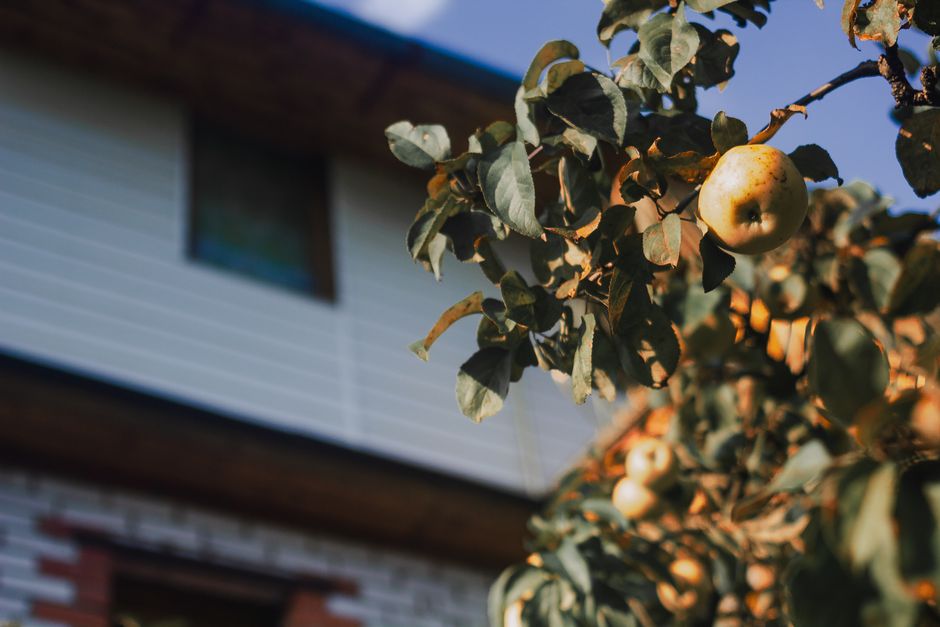
Fire blight is the most serious disease affecting pear trees in BC. It is caused by the bacterium Erwinia amylovora and spreads through open wounds, insects visiting flowers, and — critically — contaminated pruning tools.
The symptoms are not subtle. Affected shoots turn brown or black and wilt, often with a characteristic bend at the tip — like a shepherd's crook. New shoots look scorched. It can spread from a single affected branch to the whole canopy within one or two seasons if left unchecked.
The pruning protocol for fire blight is strict:
- Sterilise your blades between every single cut. A quick wipe with rubbing alcohol or a dip in a 10% bleach solution (one part bleach, nine parts water). This is not optional — it is the main way the disease spreads during pruning.
- Cut 30cm (12 inches) below visible infection. The bacteria travel further into the wood than the visible symptoms suggest. Cutting at the edge of the discolouration leaves infected tissue behind.
- Cut back to clean white wood. Infected wood has a rust-brown or pink tinge in cross-section. Keep cutting until you see clean white wood at the cut face.
- Don't compost the cuttings. Bag them and bin them, or burn them. Fire blight survives in plant material and will reinfect if composted.
I reckon fire blight is the one situation where the “do it yourself” advice I normally give has real limits. If you are not certain what you are looking at, or the infection looks extensive, get an arborist to assess it first. An incorrectly treated fire blight infection can cost you the whole tree.
The Agriculture Canada fire blight guide has the full technical detail on identification and management if you want to go deeper.
How to make the cuts
Use bypass pruning shears for stems up to about half an inch. Loppers for anything thicker up to about an inch and a half. A pruning saw for heavier branches.
Always use bypass pruners, not anvil pruners. Anvil pruners cut by pressing the blade down onto a flat plate — they crush the stem as they cut. That damaged tissue is slower to heal and more vulnerable to infection. Bypass pruners cut past each other like scissors, making a cleaner wound.
The cut itself: at roughly 45 degrees, just above an outward-facing bud. The slope directs rainwater away from the bud. Too close to the bud and you risk damaging it. Too far above and you leave a stub that dies back and opens an entry point for disease.
No wound sealant. It was recommended for decades and is now known to do more harm than good — it traps moisture and creates ideal conditions for fungal growth. The tree closes its own wounds. Let it do that.

Restoring a neglected pear tree
If your pear tree has not been pruned in three or more years, the one-third rule becomes even more important — not less. It is tempting to try to fix everything in one go. Don't.
Spread the restoration over two, sometimes three seasons:
Year one: Remove all dead, diseased, and damaged material. Cut out the worst crossing branches — the ones actively rubbing and wounding each other. Remove all water sprouts and root suckers. This is corrective work, not structural work. You will still be well within the one-third limit.
Year two:Now you do the structural work. Reduce scaffold branch length, address any remaining competition for the central leader, and thin the canopy for better light and air movement. By this point, you can see the tree's true structure without the dead weight of year one obscuring it.
Year three if needed: Fine-tuning. Height reduction through proper reduction cuts if the tree has grown beyond a manageable height. At this point, the tree should be in a state where annual maintenance keeps it in good shape.
One thing I see fairly often with neglected pear trees in Langley/Aldergrove: someone cuts out most of the canopy in a single session — fifty percent or more — and then wonders why the tree produces nothing but water sprouts for the next two years. The tree is not punishing you. It is just responding to stress the only way it knows how.

When not to call us
A healthy pear tree of modest size is a DIY-friendly pruning job. I will say that clearly, because most tree services would rather you called.
Handle it yourself if:
- Your tree is small enough to reach the scaffold branches from the ground with loppers, or from a stable step ladder without overreaching
- You are doing annual maintenance — dead wood, crossing branches, one-third back
- No signs of fire blight are present, or you have identified it clearly and understand the sterilisation protocol
- You have sharp bypass pruners, loppers, and rubbing alcohol ready to go
Call an arborist if:
- The tree is large enough that reaching the upper scaffold branches requires climbing — that is not a ladder job
- You suspect fire blight but are not certain what you are looking at
- The tree has not been pruned in many years and you are not sure how to phase the restoration without stressing it
- The central leader has been previously topped and the tree has a complicated, multi-stemmed crown that needs structural assessment
- A scaffold branch has cracked or split at its attachment point — that is a safety issue before it is a pruning question
For context on professional tree pruning in Langley/Aldergrove, that page covers what we offer and how it's priced.
What pear tree pruning costs in Langley/Aldergrove — honest numbers
Nobody posts prices. I reckon they should.
| Scope | Typical range (CAD) |
|---|---|
| Annual maintenance prune, small to medium pear tree | $150–$350 |
| Annual maintenance prune, large mature pear tree | $300–$550 |
| Renovation pruning, neglected tree (year one) | $350–$650 |
| Fire blight assessment and treated pruning | $200–$400 |
| Young tree formative pruning (years 1–3) | $150–$300 |
These assume reasonable ground-level access and no special equipment. If the tree is close to a structure, requires climbing, or has active fire blight that needs careful management, that changes the time and the price. Every quote is confirmed before any work starts — no price changes once the pruning begins.
For a broader picture of how fruit tree pruning fits into overall tree trimming costs in Langley/Aldergrove, that post covers the factors that move the price across species and situations.