Hedges don’t have opinions about when they get cut. You do, usually once a year when they’ve grown past the fence line and you can’t put it off any longer. The problem is, one cut a year — at whatever time happens to be convenient — isn’t the right answer for most hedges.
The right answer is twice a year, in specific windows. Here’s what those windows are and why the species you have determines the rest.
The twice-a-year rule
Cut one: Late February to mid-March. The goal here is to shape the hedge just before it breaks dormancy and puts energy into new growth. You’re not removing a lot of material — you’re setting the lines the new growth will follow.
Cut two: Late July to mid-August. The spring flush has settled and hardened by now. This cut tidies up the season’s new growth and keeps the hedge dense through autumn.
Nine times out of ten, homeowners who say their hedge “looks terrible” have skipped one of these two windows for two or three years running. It takes longer to fix than to prevent. (Renovation work on a seriously neglected hedge is a different job — and a bigger one.)
Anything trimmed after mid-September risks encouraging fresh growth that won’t harden before the first frost. In the Fraser Valley, that frost window opens from late October onward — earlier in inland areas.
Why the species changes everything
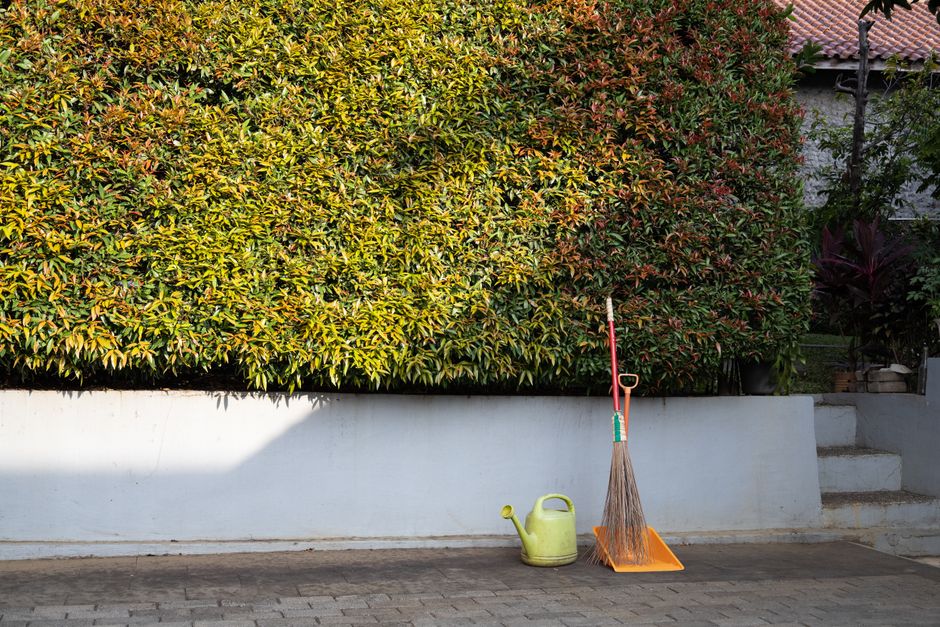
Western red cedar — the default hedge of Surrey, Langley, White Rock, and half the Fraser Valley — follows the twice-a-year rule closely. Trim once in late February, once in late July. Cedar holds its shape well and doesn’t put on growth so aggressively that you need a third pass.
English laurel is tougher and faster-growing. It can take a harder cut and bounce back quickly. Spring reshaping (April, once nesting is checked — more on that below) followed by a light summer tidy in August. Laurel that’s been left uncut for three or four years is a renovation job, not a maintenance job. That’s the time to call an arborist rather than do it yourself.
Boxwood grows slowly. One cut in late spring, after the last frost risk passes, is usually enough for residential hedges. Two cuts if it’s in a particularly sunny or sheltered spot with active growth.
Deciduous hedges — hawthorn, hornbeam, beech — do well with a late summer trim when leaves are still on but growth has slowed, usually late August to early September. Heavy renovation cuts on deciduous species are better done in late winter, before bud break, when the branch structure is visible and the plant can direct energy into recovery.
Flowering hedges — forsythia, lilac, mock orange — are the outlier. The rule of thumb is: cut right after flowering, not before. If you trim in late winter or early spring, you’re removing this year’s flower buds. (This is the mistake that convinces people a flowering hedge“stopped producing.” It didn’t. It just got cut at the wrong time.) For more on timing and technique, our guide to pruning flowering shrubs covers the principles.
The bird nesting window in BC
Between roughly April and late July, most songbirds in BC are nesting. Under the BC Wildlife Act, disturbing an active nest is an offence — eggs, chicks, or in-use nesting material. Running a hedge trimmer through one counts.
Before cutting between April and July, do a slow visual walk along the hedge. Robins, house sparrows, and song sparrows all nest low in dense hedging — especially cedar and laurel. If you find a nest with eggs or active chicks, leave the hedge alone and come back in August.
This isn’t just the right thing to do. It’s why professional arborists won’t touch hedges in May or June without a pre-cut walk-through. If you’re booking a professional trim in spring, ask them what their nesting protocol is.
When NOT to cut

There are a few windows where cutting does more harm than good:
- After mid-September. Fresh cuts on evergreen hedges encourage new growth that won’t harden before frost. You’ll see tip dieback through winter and brown patches the following spring.
- During a drought or heat wave. Cutting stressed plants is cutting them twice. Wait for a mild, overcast day.
- During hard frost. Frozen foliage snaps rather than cuts cleanly, and you’re opening tissue to ice damage at the same time.
- Right before a wind warning. Fresh cuts are exposed tissue. A windstorm on newly trimmed foliage strips tips and can cause irregular dieback across the hedge face.
When not to hire us. A routine maintenance trim on a healthy, accessible hedge is something most homeowners can handle themselves with a decent pair of electric or battery trimmers. The right tool, the right angle — cut slightly narrower at the top than the base so light reaches the lower branches — and don’t rush it. Where you want professional help: renovation of a seriously overgrown hedge, any hedge over 2 metres that requires working at height, or laurel or cedar that’s encroaching on a structure or a fence line in dispute. Our guide to trimming a hedge covers the technique side in full.
What hedge trimming costs in Surrey, BC
A standard residential hedge trim runs $150–$350 depending on the length of the hedge, its height, and how accessible it is. A cedar hedge on a flat, open property is straightforward. A two-metre laurel hedge on a slope with tight access to one side takes longer and costs more.
Renovation work — taking an overgrown hedge back hard and reshaping the form — is a separate job. Rule of thumb: if the hedge hasn’t been trimmed in three or more years, expect to pay more for the first visit. After that, regular maintenance is cheaper because there’s less to do each time.
We quote a flat price before starting. No surprises when the invoice comes. If you’re in Surrey, Langley, White Rock, or Delta, give us a call at (437) 771-4741 and we’ll come have a look. See the full range of tree and hedge services we cover in the Lower Mainland.
I’ve been in this area long enough to know that the hedges most homeowners describe as “impossible to keep tidy” are almost always species that were planted in the wrong spot — a fast-growing laurel against a fence that was supposed to stay at chest height, or a cedar that’s been sheared into a narrow form it can’t sustain. If yours feels like that, an ISA Certified Arborist assessment can tell you whether you’re fighting the plant or just managing it badly. Usually the latter. Easier to fix.