
The oldest known tree in the world is roughly 4,789 years old. It was a seedling when Stonehenge was still under construction. I’ve been doing tree care since 2009 — which, in the grand timeline of trees, barely registers. (My crew has pointed this out on multiple occasions.)
Here’s the direct answer: the oldest trees in the world are Great Basin bristlecone pines, found in California’s White Mountains. Methuselah, the most famous specimen, is confirmed at 4,789 years. A Chilean alerce may edge past it at an estimated 5,484 years — but that dating is still being peer-reviewed. If you count clonal root systems rather than individual trunks, a Norway spruce in Sweden named Old Tjikko reaches back 9,550 years.
None of them are in Surrey. But BC has its own ancient trees, and the principles that keep those thousand-year-old specimens alive apply to the big Douglas fir or Garry oak sitting at the edge of your property right now.
What “oldest” actually means
The word “oldest” depends on how you define a tree. There are two categories, and they’re genuinely different things.
An individual treeis a single organism — one trunk, one root system, one set of genes. Methuselah is this. The trunk you see today is the same organism that germinated in what’s now called California roughly 4,789 years ago.
A clonal colony is a root system that generates new trunks over thousands of years. Old Tjikko, a Norway spruce in Dalarna, Sweden, looks like an ordinary 16-foot tree. But the root system underneath it has been regenerating trunks for 9,550 years. Carbon dating confirmed this in 2008. The tree above ground is maybe a few hundred years old. The roots are ancient. Same rules apply to Pando, a trembling aspen colony in Utah — a single root system estimated at 80,000 years old, covering 106 acres and containing roughly 47,000 individual trunks.
Both are genuinely old. But they’re old in very different ways. When most people ask about the oldest trees in the world, they mean individual organisms — which puts Methuselah firmly at the top.

The world’s oldest trees
Here are the standout specimens, in rough order of confirmed age.
Methuselah — 4,789 years (California, USA)
A Great Basin bristlecone pine in the White Mountains of California. Its exact location is kept secret by the US Forest Service to protect it. Dendrochronologist Edmund Schulman dated it in 1957 and nearly wept, by most accounts. It’s the oldest confirmed living non-clonal tree in the world.
The location-keeping-secret part says something about us. We found a 5,000-year-old living organism and immediately needed to be kept away from it. Fair enough.
Gran Abuelo (Alerce Milenario) — possibly 5,484 years (Chile)
A Fitzroya cupressoides — commonly called alerce — growing in Alerce Costero National Park in southern Chile. In 2022, researcher Jonathan Barichivich estimated its age at 5,484 years using a partial core and growth models. That would make it older than Methuselah. The scientific community is still reviewing the methodology, so it hasn’t been officially crowned. But it’s worth watching.
Sarv-e Abarkuh (Zoroastrian Cypress) — 4,000–5,000 years (Iran)
A cypress tree in the city of Abarkuh, Iran. It’s a national monument and one of the most famous trees in the world. Local tradition holds it was planted by Zoroaster himself. I reckon the actual age is somewhere in the 4,000–4,500 year range, but the symbolism is as old as the tree.
Llangernyw Yew — 4,000–5,000 years (Wales)
A yew tree in the churchyard of St Digain’s Church in Llangernyw, North Wales. Yews are notoriously difficult to date because their cores often rot out, making ring counting impossible. The age estimate comes from girth and historical records. It was included in the 50 Great British Trees list in 2002.
Old Tjikko — 9,550 years (Sweden)
The clonal record-holder. Named after geologist Leif Kullman’s dog. The visible tree is unremarkable — a scraggly spruce you’d walk past without noticing. The root system beneath it is nearly twice as old as agriculture. As records go, it’s a humbling one.
How scientists figure out a tree’s age

The main method is dendrochronology — counting annual growth rings. Each ring is one year of growth. Count them, get the age. Simple in theory.
In practice, you need to get to the rings. For a living ancient tree, you don’t want to cut it down to count. Instead, scientists use an increment borer — a thin hollow drill that extracts a core sample the width of a pencil lead. The rings show up in that sample. You count them, note the pattern, and match that pattern against a master chronology for the region.
The matching part matters because tree rings aren’t perfectly uniform. Wide rings mean good growing years. Narrow ones mean drought, cold, or stress. By comparing these patterns to a regional record built up over decades of research, scientists can cross-date specimens and catch errors. It’s more rigorous than it sounds.
For trees too old to core reliably — or clonal trees where the above-ground portion is young — radiocarbon dating of the root system confirms age. That’s how Old Tjikko was dated.
For the trees in your yard, a rough age estimate doesn’t require any of this. I can usually get within 20–30 years just from species, diameter, and growth patterns. Good enough for practical purposes. A professional tree assessment will give you that and a structural health picture at the same time.
Ancient trees of British Columbia
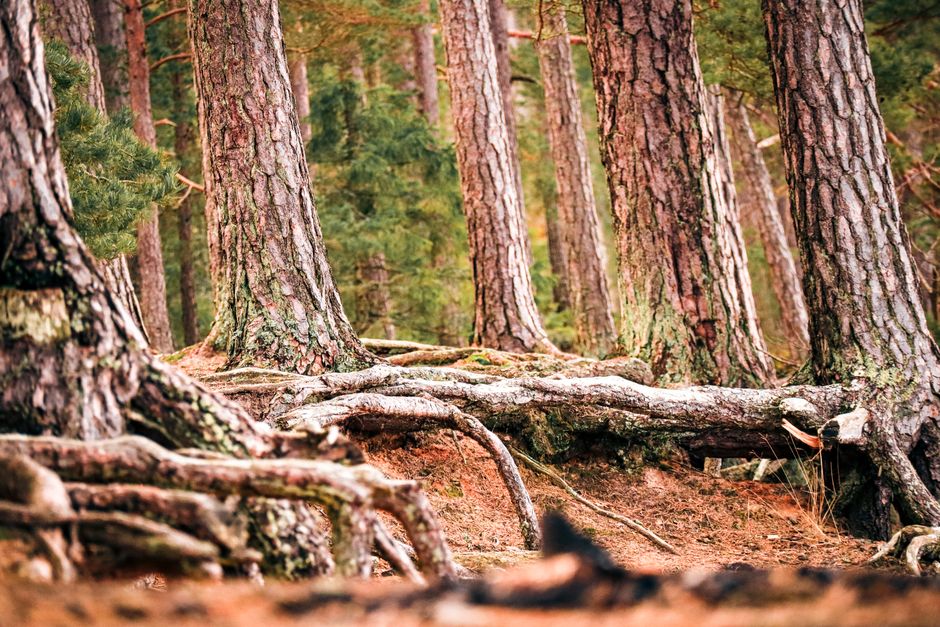
BC has some of the most impressive old-growth trees in Canada. The province hasn’t been around long enough to rival the White Mountains bristlecones — European settlement started clearing coastal forests in the 1880s — but what survived is remarkable.
Western red cedar at Cathedral Grove in MacMillan Provincial Park on Vancouver Island reaches ages over 800 years. Some specimens in remote mainland stands exceed 1,000. These trees were already centuries old when the first European ships came around Cape Flattery.
Douglas fir commonly hits 500–750 years in protected old-growth areas. The province’s BC Big Tree Registry documents some of the most notable specimens — worth looking at if you’re curious about what’s out there.
Garry oak— BC’s only native oak — can reach 400 years under the right conditions. They’re slow-growing, long-lived, and increasingly rare. A mature Garry oak in Surrey is irreplaceable in any meaningful timeframe.
The Lower Mainland was heavily logged and developed through the twentieth century, so true old-growth is rare in Surrey itself. But old specimens survive in neighbourhood lots, ravines, and parks. I’ve seen Douglas firs in White Rock and South Surrey that I’d estimate at 150–200 years old. Most homeowners have no idea what they have.
The International Society of Arboriculture estimates that large mature trees can add $1,000 to $10,000 or more to a property’s assessed value. The number varies by species, size, and condition. Point is, what’s growing in your yard isn’t just scenery.
What old trees teach us about care

The world’s oldest trees have some things in common. They grow slowly. They live in conditions other trees struggle with — high altitude, thin soil, cold dry climate. They have almost no competition. And crucially, humans largely left them alone until recently.
None of that is entirely replicable in a Surrey backyard. But a few principles translate.
Species choice matters more than anything else.My strongest opinion in 15 years of tree care: native species in BC outlive introduced species because they’re adapted to the conditions here. Douglas fir, Sitka spruce, western red cedar, bigleaf maple, Garry oak — these trees belong here. They’ve evolved alongside local pests, fungi, and weather patterns. Leyland cypress, ornamental cherries, some introduced maples — I remove more of these per year than any other category, and almost always for preventable reasons.
Nine out of ten Leyland cypress removals I do could have been avoided by planting a native equivalent in the first place. Not a criticism — nobody tells you this when you buy a hedge plant at a nursery. But it’s true.
Slow growth isn’t weakness.The bristlecone pine grows about one inch in diameter per century. That density makes the wood almost impervious to insects and decay. The fastest-growing trees in urban landscapes are often the ones that fail first. There’s a lesson in there about patience, though I try not to push the metaphor too hard.
Old trees accumulate structural complexity.A 200-year Garry oak has a root system and branch structure that took two centuries to build. When it’s gone, it’s gone. You can plant a new one, but the timeline is real — you won’t see a replacement of the same scale in your lifetime or your children’s lifetime.
A homeowner in North Surrey called me a few years back about a Garry oak that another company had quoted for removal at $2,400. Their reason: it was “leaning.” I went out and assessed it. The lean was natural — the tree had grown toward a gap in the canopy decades ago and stabilised that way. There was some deadwood in the upper crown and two crossing branches. I removed the deadwood ($300) and did a targeted crown thin ($650). The tree is still there. The homeowner saved $1,450 and kept a tree that was probably 120 years old and irreplaceable on that lot.
Rule of thumb: before you remove any large, old tree, get a second opinion from an ISA-certified arborist. The cost of the assessment is $150. The cost of being wrong is a tree that takes a century to replace.
When not to call us — and when you absolutely should
No need to call:a large, old tree that’s clearly healthy. Full canopy, no dead branches hanging over the house, no cracks in the main stem, no soil heaving at the base. An old tree doing its job doesn’t need anything from you except space, reasonable soil health, and the occasional drainage check. Leave it alone and let it keep doing what it’s been doing.
Worth calling about:
- Deadwood hanging over a structure. Dead branches in an old tree don’t fall on schedule. Knowing how to spot dead wood can prevent an expensive roof repair.
- A lean that has changed direction or increased in the last year or two.
- Cracks in the main stem or junction of major limbs — particularly vertical splits.
- Soil heaving at the base, which suggests root failure.
- Crown dieback — sections of the canopy that aren’t leafing out when they should.
- Cavity formation or fungal growth on the trunk or root flare.
Any of those signs in a large old tree near a structure warrant a professional assessment. Not because the tree is necessarily coming down — often it isn’t — but because old trees with structural issues don’t give much warning before they fail.
Give us a call at (437) 771-4741. We’ll tell you straight what we’re looking at and whether it needs action. If it doesn’t, we’ll tell you that too. We’ve talked more than a few homeowners out of removing trees that didn’t need to come down.