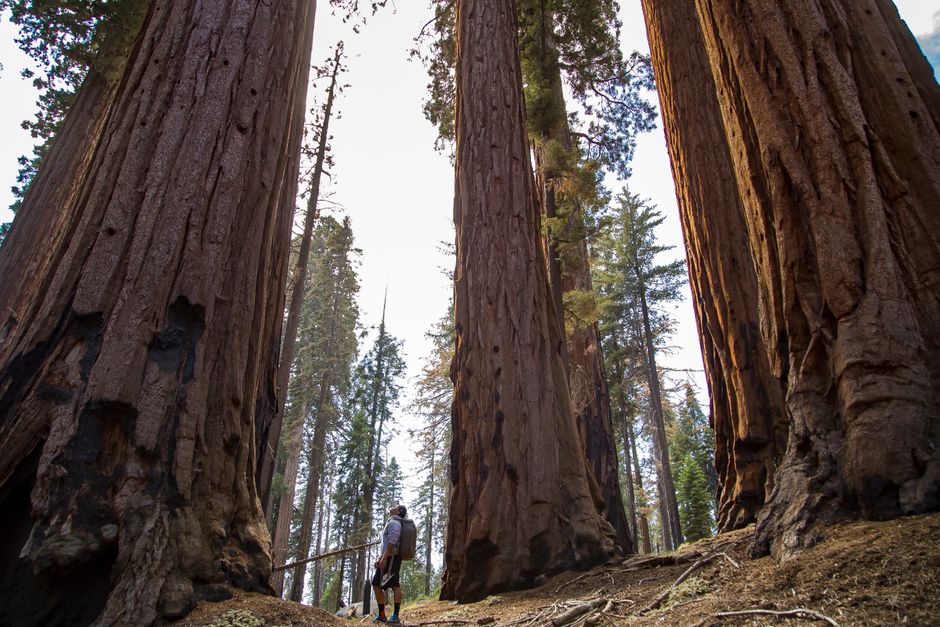
A coast redwood is the tallest tree on earth. A giant sequoia is the heaviest. Neither is native to Surrey. That said, both get planted here on occasion — which is, I reckon, the arborist version of buying a puppy without checking how big the breed gets.
The short answer on sequoia tree vs redwood: you're comparing two separate species in the same family. Coast redwood (Sequoia sempervirens) grows along the California and Oregon coast in foggy, wet conditions. Giant sequoia (Sequoiadendron giganteum) grows on the western slopes of the Sierra Nevada, at elevation. They've been separated by millions of years of evolution. The shared name is mostly coincidence.
The actual difference: redwood vs sequoia
Start with the records. The coast redwood holds the world height record — Hyperion, in Redwood National Park, measures 115.9 metres. That's roughly the height of a 35-storey building. The giant sequoia doesn't compete for height. It competes for mass. The General Sherman Tree in Sequoia National Park has a volume of approximately 1,487 cubic metres and an estimated weight of 1.4 million kilograms.
Two different trees. Two different categories of enormous.
Taxonomy-wise: both sit in the family Cupressaceae. Coast redwood is genus Sequoia; giant sequoia is genus Sequoiadendron. They're cousins, not twins. The third member of this loose family — the dawn redwood (Metasequoia) — gets ignored in most comparisons. It shouldn't, because it's the most relevant one for anyone in Surrey looking to actually grow one. More on that below.
How to tell them apart
If you're standing next to one and genuinely unsure, here's what to check.
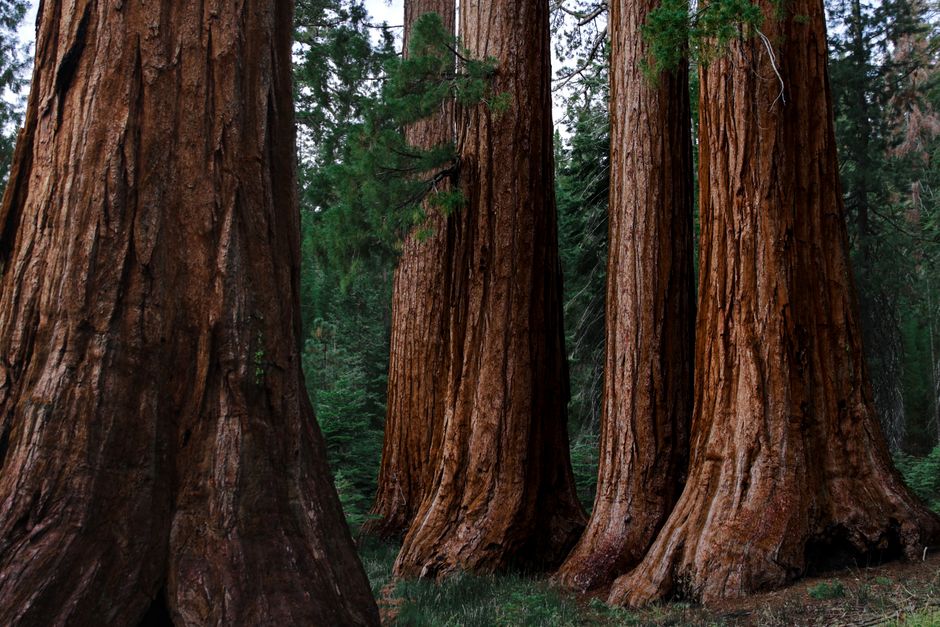
Bark. Giant sequoia bark is thick, fibrous, and a distinctive cinnamon-orange — almost spongy to the touch. Coast redwood bark is dark reddish-brown and more deeply furrowed. Both are thick enough to survive ground fires, which is partly why the species have lasted as long as they have.
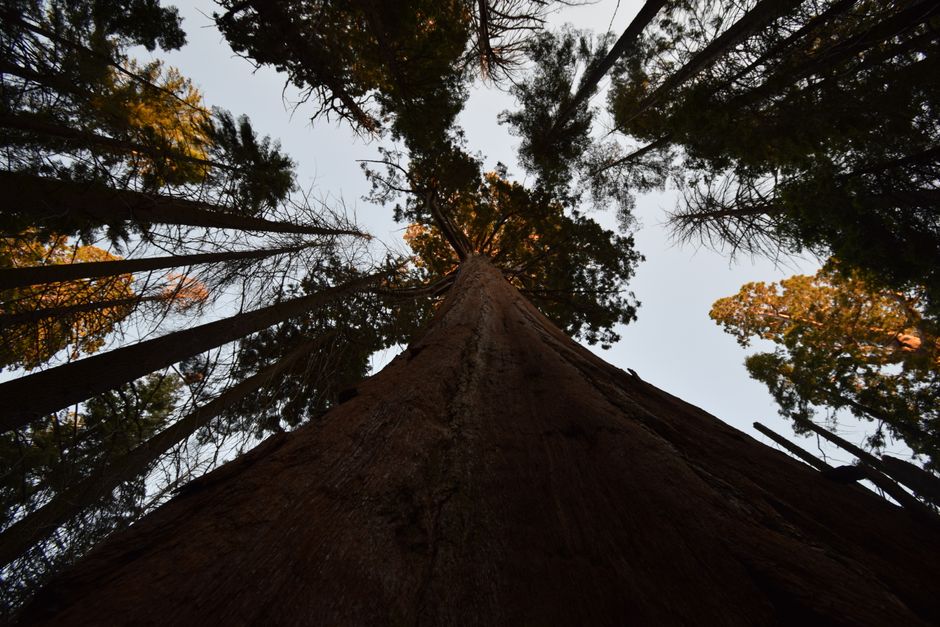
Base. Giant sequoias have a dramatically flared, buttressed base — the trunk widens sharply near the ground. Coast redwoods are more cylindrical.
Cones. Sequoia cones are roughly egg-sized (5–9 cm), oval, and woody. Redwood cones are much smaller — about 2–3 cm — and ripen faster.
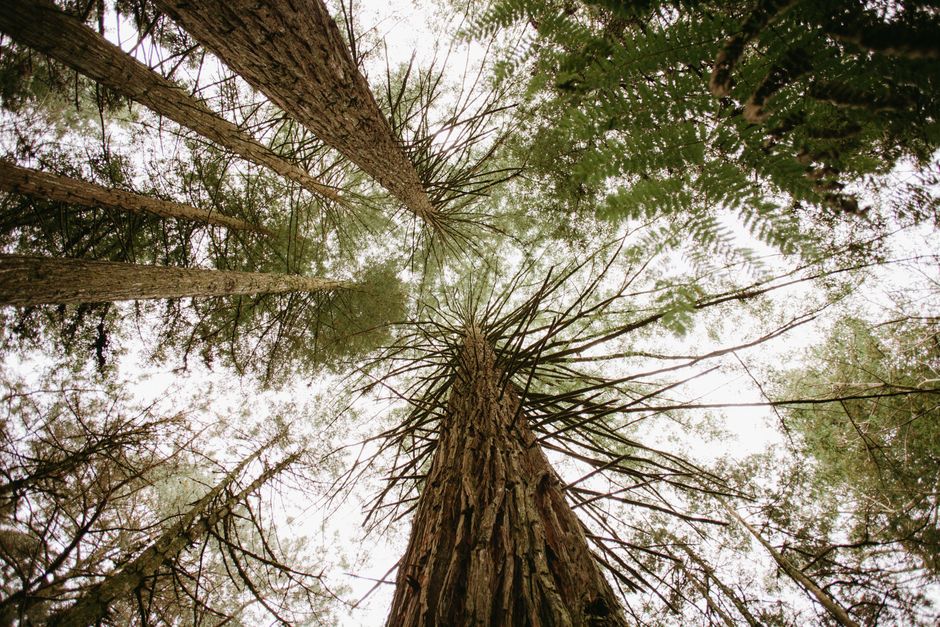
Needles. Coast redwood has flat, feather-like needles arranged along horizontal sprays. Giant sequoia has awl-shaped needles that spiral around the branch.
| Feature | Coast Redwood | Giant Sequoia |
|---|---|---|
| Max height | 115 m | 85 m |
| Trunk volume | Narrower profile | Up to 1,487 m³ |
| Bark colour | Dark reddish-brown | Cinnamon-orange |
| Base shape | Cylindrical | Dramatically flared |
| Cone size | 2–3 cm | 5–9 cm |
| Native habitat | Coastal fog belt (CA/OR) | Sierra Nevada, 1,400–2,100 m |
| Lifespan | 500–2,000 years | 2,000–3,400+ years |
Can either grow in Surrey, BC?
Surrey sits in USDA hardiness zone 8b. That's mild enough for a wide range of species — but neither coast redwood nor giant sequoia is designed for it.
Giant sequoiais the better bet. It handles moderate cold better than its California home would suggest. Several mature specimens grow on Vancouver Island and in Metro Vancouver — UBC Botanical Garden has a notable example. They need good drainage and some room, because a twenty-year-old giant sequoia in favourable conditions can reach 10–15 metres. After forty years, you're looking at something your grandchildren will be managing.
Coast redwoodis borderline. It prefers coastal fog and moderate winters. Zone 8b is within its theoretical range, but Surrey winters can dip below what it handles comfortably. A protected south-facing spot, consistent moisture, and shelter from cold east winds give it a reasonable chance. Without those, you'll end up with a tree that struggles more than it thrives.
If the goal is an impressive conifer that actually suits this climate, consider Douglas fir, which is native, long-lived, and genuinely striking without the planting gamble. Or, for something in the redwood family that reliably grows here, keep reading.
The third one nobody mentions: dawn redwood
Most sequoia-vs-redwood guides skip the dawn redwood entirely. That's a mistake, because it's the most practical of the three for anyone in the Lower Mainland.
Metasequoia glyptostroboides — dawn redwood — is a deciduous conifer. It sheds its needles in autumn, which surprises most people who expect conifers to stay green. It looks like a feathery, soft-textured pine until October, when the foliage turns a warm rust before dropping. The bare winter shape is elegant rather than scraggly.
It's also a living fossil. The species was thought extinct until a living population was found in a remote part of Hubei Province, China, in 1941. It grows quickly — 60–90 cm per year when established — and handles BC winters reliably. If you want something in the redwood family that actually belongs in zone 8b, dawn redwood is the answer.
Growth note: dawn redwood reaches 20–30 metres at maturity. Not a giant sequoia, but still a tree that needs managing as it ages. Nine out of ten people who plant one underestimate how large it gets. The lower canopy will eventually need shaping, and any structural work above about 4 metres is worth having an arborist assess.
Growth rate and root systems
All three species have relatively shallow root systems that spread wide rather than deep. Coast redwoods, in their native habitat, interlock roots with neighbouring trees for mutual support. Worth noting if you're planting one alone in a Surrey yard — it won't have that structural benefit.
Giant sequoia and dawn redwood roots also spread laterally. In BC's clay-heavy soils, roots can struggle to establish depth. Poor drainage stresses the root system over time. If your soil drains slowly, address it before planting.
Giant sequoia typically puts on 60–90 cm per year when young, under good conditions. Expect the lower end of that range in Surrey. Dawn redwood is similar or slightly faster when established. Coast redwood will likely grow slower here than in its native California range.
The honest take on all three: they're a long-term commitment. A giant sequoia planted today will outlive most of the other trees on your property. That's the appeal. It's also the obligation. “Occasionally needs trimming” becomes “requires a certified arborist” once the tree reaches any significant size. The ISA Canada arborist finder is how you verify credentials before any large conifer work.
When to call an arborist — and when not to
The “when not to” version first, because it saves time.
You don't need an arborist for: collecting fallen cones, raking autumn needle drop from dawn redwood, or pruning ground-level branches on a young tree under about 4 metres. Those are manageable homeowner tasks.
Call an arborist for:any crown work on a tree that's reached 6 metres or more. Structural pruning decisions on a fast-growing species — removing the wrong branch on a young sequoia can create a co-dominant leader that becomes a genuine hazard thirty years later. Crown raising for access or sight lines. Any dead or damaged wood, because large conifers with decay present a serious weight risk.
And if you're looking at a well-established giant sequoia or dawn redwood and wondering whether to remove it — get a second opinion first. A tree that size, properly maintained, adds real value to a property. An unnecessary removal doesn't. I've seen a few situations where a homeowner was quoted removal of a mature coast redwood because of “lean”. The lean was natural growth. Crown reduction brought the profile back to a manageable shape, saved the tree, and cost about a third of what removal would have run. Worth asking about.
For a reference on what removal costs if it does come to that: a large conifer in the 15–25 metre range typically runs $1,500–$3,000+ depending on access, proximity to structures, and whether crane work is needed. Our tree removal cost guide has the full breakdown, or give us a call and we'll give you a straight number on your specific situation.
The Save the Redwoods League has solid reference material on both species if you want deeper identification and conservation context.