
Evergreens are not, despite the name, ever-forgiving about when you cut them. (That’s the last pun. Probably.)
Most evergreen trees should be pruned in late winter to early spring, just before new growth pushes. In the Lower Mainland, that window runs roughly February through mid-April. Cut too late in summer and you risk triggering a flush of tender new growth that can’t harden before October arrives. Cut into old bare wood at any time of year, and you’ve made a permanent mistake. Evergreens don’t bud back from it.
Quick answer: For pruning evergreen trees in Surrey BC — prune in late winter to early spring. Remove dead or crossing branches any time. Never cut past the last green needles on a pine, Douglas fir, or spruce. Western red cedar and hemlock are more tolerant. Trees over 20 feet need a certified arborist.
Nine out of ten homeowners who call about evergreen pruning have the same two questions: when, and how far back. The answers are different for almost every species on your property.
Whorl-branched vs. random-branched: why it matters
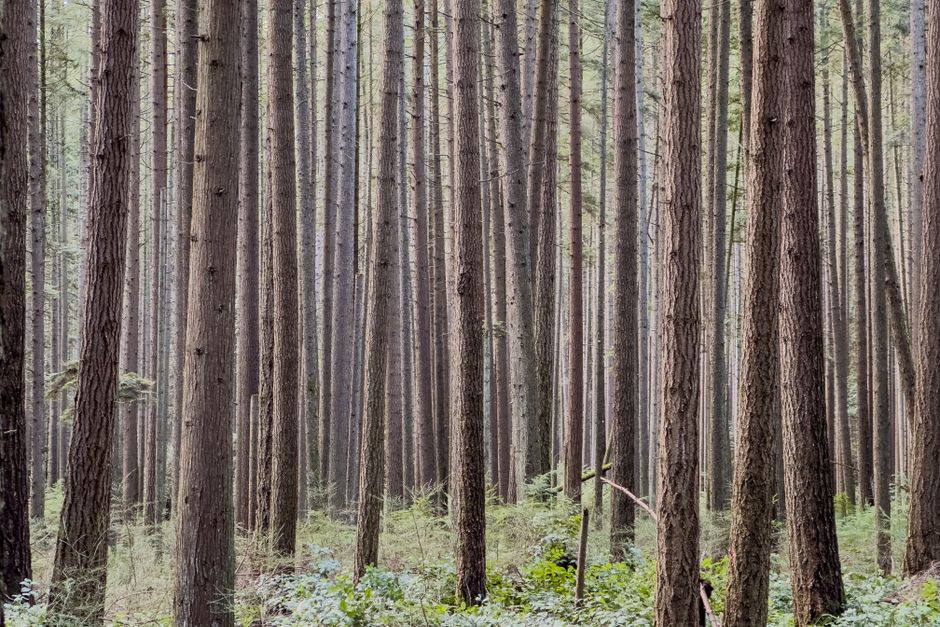
Not all evergreens are built the same. The conifers in your Surrey back garden almost certainly fall into one of two categories, and that distinction changes everything about how far back you can cut.
Whorl-branchedtrees are the classic Christmas-tree shape: branches emerge in rings around a central stem. Douglas fir, Sitka spruce, and pine are all whorl-branched. New growth only happens at the branch tips and in the whorls. If you cut a branch back past the last green needles, you’ve removed the only place it can grow from. Nothing comes back. The cut end just sits there, drying out and slowly inviting problems.
Random-branchedevergreens — western red cedar, hemlock, arborvitae — can regenerate from older wood. Not indefinitely, but considerably more than their whorl-branched cousins. This is why cedar hedges tolerate regular shearing while pine trees don’t. You’re working with different biology.
Yew is the outlier: it tolerates hard pruning better than almost any other BC conifer. But it grows slowly, so “tolerates” shouldn’t be read as “benefits from.”

BC native evergreens — what each species needs
The Lower Mainland is one of the few places on earth where a 100-year-old Douglas fir might be growing in someone’s back garden. These are forest giants by nature. They need to be treated as such.
Douglas fir:Whorl-branched. Structural pruning should be minimal. Limit it to dead, crossing, or genuinely hazardous branches. Candelabra pruning — pinching back the new candles in spring before they harden — can slow vertical growth if managed height is the goal, but only if it’s done at the precise right moment and not taken too far back. I’ve assessed firs that someone “reduced” by cutting past the green. The stubs are permanent. The tree never recovered its shape and the wound points are now a beetle risk.
Western red cedar: Random-branched, which makes it more forgiving. Tolerates crown reduction up to 20–25%. Cuts still need to land on lateral branches, not stumped back to bare wood. Cedar hedges can be sheared regularly. Individual large cedars need more thought about structure before anything starts. Anything beyond 30% crown reduction stresses the tree and opens it to cedar leaf blight and other secondary problems.
Sitka spruce:Whorl-branched and very low pruning tolerance. The main job here is deadwood removal. Leave the branching structure alone unless there’s a compelling safety reason — and document that reason before anyone picks up a saw.
Western hemlock: Random-branched and moderately tolerant of reduction. Does well in the shaded conditions of a Surrey garden. Responds better to selective thinning than hard reduction cuts.
When to prune: timing matters more than you think
Late winter to early spring is the window. February through mid-April in Surrey, though a wet, cold spring can push it slightly later.
Why not summer? Two reasons. First, pruning stimulates growth. New growth pushed in July or August doesn’t have time to harden before the first frost. On younger trees, that sets them back a season. On stressed trees, it’s a real problem. Second, bark beetles and fungal pathogens are at peak activity in summer. BC’s bark beetle species are strongly attracted to freshly cut conifer wood in warm months. A February pruning job and an August pruning job are not equivalent.
Rule of thumb:dead wood can come out any time of year. You don’t need to wait for the right season to remove a genuinely dead branch. It’s not going to get worse by cutting it in September, and leaving dead wood in a tree over the winter creates its own risks.
The best time to have your evergreens assessed is August or September — early enough to identify any problem branches before storm season, late enough that summer stress has had time to show up. Then the actual pruning work happens the following February. That’s the sequence I recommend to most homeowners.

The dead zone: what not to cut
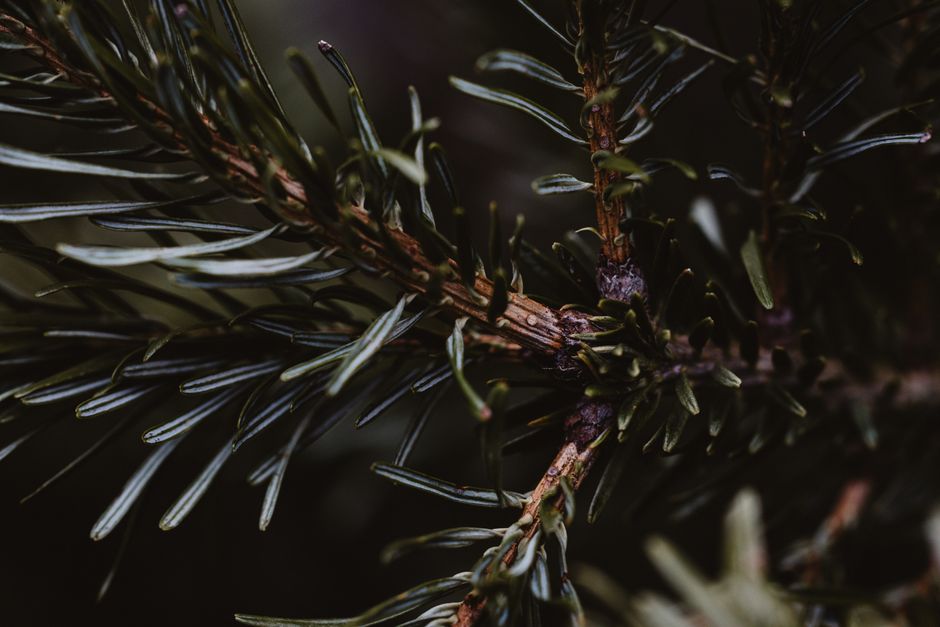
Every whorl-branched conifer has a dead zone. That’s the part of the branch — from the trunk outward — where there are no needles and no latent buds. Cut into it and the branch stays exactly that length forever. Except it now has a stub end that’s an open wound and a potential entry point for fungal infection. (The dead zone. Sounds like a TV show. It’s worse than a TV show.)
If you remember one rule for pruning evergreen trees, make it this: don’t cut past the green.
This is why topping a pine or Douglas fir is so destructive. Removing the central leader kills back the top of the tree to the nearest whorl below. Nothing fills the gap cleanly. The tree’s structure is permanently changed and the open wound is now a pest target. I reckon about a third of the “reduction” quotes I see on large conifers are actually topping jobs dressed up in polite language. Just walk away from those.
A homeowner in South Surrey called us a couple of years back. He’d rented a boom lift and pruned his own Douglas fir the previous spring — took branches back well past the green to “tidy it up.” Two seasons later, every cut point had a dead stub and two of them showed bark beetle frass. Crown cleaning plus stub removal ran $800. Properly done crown thinning the first time would have been $500. The saving turned into a loss.

When not to hire us
If your evergreen is under 15 feet and you’re removing a dead branch or two — you probably don’t need to call anyone.
Get a quality hand pruner or a pruning saw with a clean blade. Make the cut just outside the branch collar — the slight swelling where the branch meets the trunk. Don’t leave a stub, don’t cut flush to the trunk, and don’t use wound sealant (it’s been shown to slow healing, not speed it). That’s honestly most of what there is to know for a small-scale job. The ISA’s pruning guidelines cover the fundamentals clearly and are worth a read before you start.
What moves it into call-us territory:
- Any work on a tree over 20 feet. Ladder falls in trees are not a hypothetical injury risk.
- Crown reduction or structural work — the difference between a correct crown reduction and a bad one isn’t visible until two years later, and the bad version is permanent.
- Trees near power lines, a structure, or within fall distance of your roof.
- A tree showing signs of stress: unusual needle colour, significant needle drop, weeping resin, or visible bark damage.
A full tree services assessment runs $150 and that fee is credited toward any work that follows. Ninety minutes on the property tells you more than any phone call can.
What evergreen tree pruning costs in Surrey
Honestly, the range is wide because the work is wide. A medium cedar hedge and a 70-foot Douglas fir are not the same job.
| Service | Price range (CAD) |
|---|---|
| Tree assessment / consultation | $150 (credited toward work) |
| Crown cleaning — deadwood removal | $300–$600 |
| Crown reduction (20–30%) | $500–$1,200 |
| Deadwood removal — single or multiple branches | $250–$600 |
| Large conifer (60ft+), site-dependent | $1,500+ |
Pricing is all-in — stump grinding on any associated removal is included, no surprise charges for cleanup. If the scope changes once we’re up there, work stops and you get a revised number before it continues.
Rule of thumb: if a quote for a large conifer sounds surprisingly low, something’s not in it. Usually that’s the rigging, the cleanup, or the ISA-certified crew. One of those comes out of someone’s pocket eventually.