
A willow oak is an oak tree — just one that apparently decided to dress up as a willow and never changed back (identity crisis, botanical style). The leaves are narrow, lance-shaped, and unmistakably willow-like. The rest of the tree — the acorns, the bark, the stubborn century-long lifespan — is all oak.
In Surrey BC, you'll see willow oaks planted as street trees and in parks. They handle our wet winters reasonably well. But they are not native to this province, and that changes the math on whether you should plant one, keep one, or call us when something goes wrong.

What is a willow oak tree?
The willow oak (Quercus phellos) is a deciduous oak native to the southeastern United States — Virginia down to Florida, across to Oklahoma and Texas. It belongs fully to the oak family. It produces small, round acorns. It has the dense canopy and long lifespan you would expect from any oak. It just looks like someone accidentally grafted willow leaves onto it.
The species became popular for street planting across North America because it tolerates urban conditions better than most oaks — compacted soils, moderate drought, air pollution. That is why you see it in planted boulevards from Vancouver to Halifax.
It is not, for the record, a hybrid of a willow and an oak. No such thing exists in nature. The name is entirely about leaf shape, and it has confused homeowners for as long as I have been in this business.
How to identify a willow oak: the leaf nobody expects
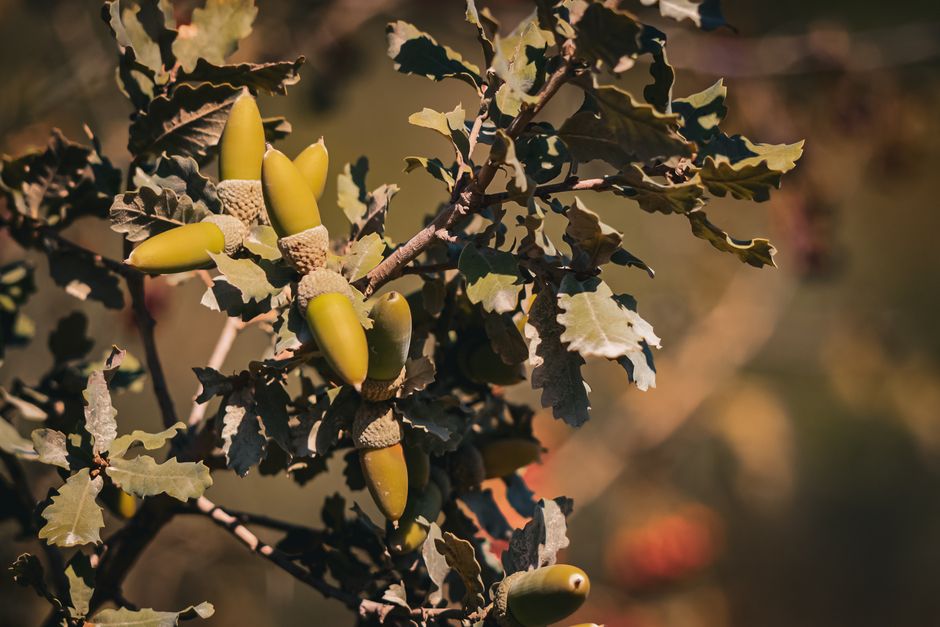
Start with the leaves. A willow oak leaf is 5–12 cm long, narrow, unlobed, and lance-shaped — nothing like the classic lobed, rounded leaf most people picture when they think "oak." Seeing one covered in acorns is a bit disorienting the first time.
Other identifying features:
- Acorns. Small (under 1.5 cm), round, with a thin, shallow cup. Produced abundantly once the tree matures, which takes 15–20 years.
- Bark. Grey-brown and relatively smooth in young trees, developing furrowed ridges with age.
- Fall colour. Leaves turn yellow, russet, or bronze before dropping — typically October to November in Surrey.
- Form. Pyramidal when young, broadening into a rounded oval canopy at maturity.
Rule of thumb: if the tree has acorns and willow-like leaves, it is almost certainly a willow oak. Nothing else looks quite like it.
Does a willow oak grow in Surrey BC?
Yes. Surrey is in USDA zone 8b, which willow oak handles without much complaint. The species has been planted across Metro Vancouver as a street tree and in public parks. It tolerates our mild, wet winters and moderate summers — not its native southeastern US heat, but manageable.
That said, Surrey's heavy clay soils are a genuine challenge. Willow oaks prefer well-drained loam. In clay, particularly in low-lying areas, you get waterlogging around the roots — leading to soil compaction, anaerobic conditions, and the chlorosis you will read about below.
The other BC-specific consideration: willow oak is not native here. BC's native oaks are the Garry oak (Quercus garryana), which grows naturally on Vancouver Island and in a few pockets of the Lower Mainland. The BC Forest Service maintains detailed profiles on native oak species if you want to compare them side by side.
I reckon that distinction is worth knowing before you plant one. More on why in the wildlife section below.
How big does a willow oak get?
In BC, most willow oaks top out between 15 and 20 metres tall with a canopy spread of 9–12 metres. Growth rate is moderate — around 30–45 cm per year in good conditions, slower in poor or compacted soil. In their native range in the American southeast, willow oaks can reach 25 metres or more. Our cooler temperatures keep most specimens smaller here.
What this means practically: a willow oak planted on a standard Surrey lot will eventually take over the backyard. The canopy shades out most plants underneath it at maturity. The root system spreads to roughly 1.5–2 times the canopy diameter. If you are planting near a foundation, a driveway, or a septic system, that needs to be part of the decision before the tree goes in the ground.
Willow oaks also drop a significant amount of leaf litter, acorns, and small twigs. In autumn, expect several bags of material from a mature tree. That is not a reason to skip the species, but it is worth knowing before you install the white deck chairs underneath it.
Wildlife value — why these trees earn their space
Despite being non-native, willow oaks are reasonably productive for wildlife. Acorns are consumed by jays, woodpeckers, squirrels, and deer. The dense canopy provides nesting cover. The tree produces enough acorns annually that it contributes meaningfully to local food webs.
That said, a Garry oak delivers far more ecological value in our specific context. As a BC native, it has co-evolved with local insects — over 200 invertebrate species are associated with Garry oak ecosystems according to the Garry Oak Ecosystems Recovery Team — most of which a willow oak cannot support in the same way.
This is the native species argument in a nutshell. Native species (Douglas fir, Sitka spruce, western red cedar, Garry oak) have longer, deeper relationships with local insects and birds. Introduced species, even productive ones, cannot replicate that in a single tree's lifetime. If you are choosing between the two at planting time, the Garry oak wins on ecological grounds — and it will outlive you anyway.

Common problems with willow oak trees in BC
Most willow oaks in Surrey don't cause major drama. But there are a handful of issues that show up regularly in our local conditions:
Chlorosis (iron or manganese deficiency). Willow oaks prefer slightly acidic, well-drained soil. Surrey's heavy clay — and seasonal waterlogging — can create alkaline conditions around the roots that lock out micronutrients. The first sign is yellowing leaves with green veins (interveinal chlorosis). A soil test tells you which nutrient is deficient; the fix is usually soil acidification or chelated iron applications.
Aphid infestations. Willow oaks attract significant aphid populations, particularly in spring. Heavy infestations produce honeydew, which drips onto surfaces below the canopy and encourages sooty mould. Nine times out of ten, a healthy tree manages aphid pressure on its own — beneficial insects handle the population by midsummer. Persistent, severe infestations on a stressed tree are worth a conversation with a certified arborist about treatment options.
Compacted soil around roots. Street-planted willow oaks in Surrey often grow in confined soil volumes — paved surfaces cutting off root expansion. Compacted soil reduces oxygen exchange and water infiltration, weakening the tree over time. Aeration, mulching the drip zone, and addressing pavement encroachment all help.
Structural branch issues. Without proper pruning in the first 15–20 years, willow oaks develop co-dominant stems, included bark, and crossing branches. These are structural weaknesses that matter more as the tree gets bigger. A branch failure on a 5-metre tree is annoying. The same failure on a 15-metre tree over a roof is a different problem entirely.
Oak wilt. Not currently established in BC, but worth knowing about. Oak wilt (Bretziella fagacearum) is a serious fungal disease spreading through eastern North America. Canadian federal plant health authorities monitor for it actively. The precaution is simple: avoid pruning willow oaks from April through August (peak risk season) and seal fresh cuts promptly.
Pruning and caring for a willow oak
The best time to prune a willow oak in Surrey is late January to mid-March — while dormant and before new growth begins. Avoid spring and summer pruning; that is when oak wilt risk peaks, even in BC where the disease is not yet established.
For young trees (under 10 years), structural pruning is the priority: select a single dominant leader, remove competing stems early, and eliminate crossing branches before they develop included bark. This work, done right in the first decade, prevents far more expensive surgery later.
For mature trees, I would recommend an assessment every 2–3 years. We look for deadwood, structural weaknesses, root zone condition, and signs of disease or pest pressure. Most years there is not much to do. Some years there is. The difference is knowing before something comes down in a windstorm rather than after.
DIY pruning makes sense for the lowest branches — anything you can reach safely from the ground with a hand saw and sound technique. For anything that requires a ladder, or any work near a structure, that is the time to call an arborist. More detail on timing and technique is in our guide to pruning oak trees at the right time.

When not to call us — and when you should
Skip the arborist call for:
- Leaf litter and acorn cleanup in autumn — that is raking, not tree work
- Minor aphid populations in spring — a healthy tree manages this on its own
- Pruning low branches (below 2 metres) that you can reach safely from the ground with the right tool
- Deciding whether to plant a willow oak — a nursery is better placed to advise on species selection than a tree service
Do call us for:
- Any structural pruning on a tree over 5 metres — competing leaders, crossing branches, large deadwood
- Significant chlorosis that is not resolving with standard treatment — sometimes that signals a deeper soil or root issue
- Any branch failure, cracking sounds from the trunk, or tree leaning toward a structure
- A pre-purchase assessment if you are buying a property with a mature willow oak — the tree's condition affects what you are buying
- A second opinion before any removal quote — we see willow oaks recommended for removal when proper pruning would solve the problem at half the cost
Our assessments are $150, credited toward any work we end up doing. If we look at the tree and tell you nothing needs doing, that is still the $150 well spent.
A story. A homeowner in South Surrey called me a few years back about three struggling trees on her property. Two were marketed as willow oaks by the previous owner — one turned out to be a weeping willow that had been misidentified for about a decade (which explains a lot about how it was being cared for). The genuine willow oaks were struggling: heavy clay soil, poor drainage after the rains, root girdling that had never been addressed.
She wanted all three removed. I told her to think about it first. The weeping willow was beyond saving — that one was the right removal. But one of the willow oaks still had potential. We removed the worst one, treated the other, and sorted the drainage. Then she asked what to plant in place of the ones we took out. My answer: Garry oak and bigleaf maple — both native, both long-lived, both far better suited to that specific lot. Those replacement trees are doing well. So is the willow oak we kept, now that it's getting proper drainage.
What willow oak tree care costs in Surrey BC
Honest numbers, based on what we actually charge:
- Tree assessment: $150 (credited toward any work we do)
- Young tree structural pruning (under 8 metres): $300–$500
- Crown thinning or deadwood removal (mature tree): $500–$900
- Full removal (medium tree, 10–15 m): $900–$1,400, including stump grinding
- Full removal (large tree, 15–20 m): $1,500–$2,500, depending on access and proximity to structures
A flat quote without seeing the tree is not a real quote. Anyone doing that is guessing, and the guess almost always moves upward on arrival. We provide written estimates on-site after a proper look. For a full breakdown of what each service includes, see our tree services page.
And if you have just received a removal quote and are wondering whether it is necessary — give us a call. Second opinions are part of the job. A willow oak that has been assessed properly is almost always a better outcome than one that was removed because nobody looked closely enough.