
An unpruned fig tree gives you figs. An overpruned fig tree also gives you figs. The difference is one of them is making a cry for help — and if you've been staring at yours since last summer wondering what to do, the fig has been doing the same.
Fig tree pruning in Langley/Aldergrove and the Fraser Valley is best done in late January through early March, while the tree is fully dormant and the sap has decided to stay put. That timing window matters more than most guides will tell you.
Quick answer:Prune in late January to early March, before bud swell. Remove dead wood, crossing branches, inward-facing shoots, and water sprouts. Don't take more than 30% of the canopy in a single year. The tree is forgiving — but it's more forgiving when you use clean, sharp tools and leave the structural cuts for the right season.

The timing window: late January to early March
The fig's seasonal rhythm gives you a clear window. Late January through early March in the Lower Mainland: the heavy rain is mostly behind you, the tree is fully dormant, and buds haven't started to swell. That's the window.
Why does timing matter specifically for figs? Because fig trees bleed. Cut an active branch and you get a thick, milky-white latex sap flowing from the wound. It's the tree's defence mechanism — impressive in theory, annoying in practice, and a genuine pest magnet if it's running in July. Prune in dormancy and the sap mostly stays put.
The wet winters here add another consideration. An open cut sitting in standing water for three weeks has more exposure to fungal pathogens than one made in February and allowed to callus before spring kicks in. Generic pruning guides written for drier climates tend to skip this — it matters in Langley/Aldergrove and the Fraser Valley.
Rule of thumb:if you can already see buds starting to swell, do light tidy work only. Save the structural cuts for next winter. The tree won't suffer from one season of patience.

What to cut — and what to leave alone
Start with the unambiguous cases.
Dead wood:cut back to where the wood turns green-white and healthy inside. If it's dead all the way to the main scaffold, remove the whole branch at the collar. The tree won't miss it.
Crossing branches: where two branches rub or cross each other, pick the weaker one — the one with worse shape, less vigorous growth, or the one putting weight in the wrong direction — and remove it cleanly.
Inward-facing shoots: branches growing toward the centre of the canopy block light and airflow. The figs produced on shaded, poorly ventilated wood tend to be smaller and more disease-prone. Remove them and let the sun reach the interior.
Water sprouts: those aggressive, whippy vertical shoots that spring from main scaffold branches. They look productive. They produce almost no fruit. Remove them entirely, back to their point of origin.
Leave alone:the older, slightly grey wood with small knobbly spurs along it. That's where this year's crop will come from. Newer growers sometimes mistake these for dead wood — they're not. The figs live here.
For more on what our tree pruning services cover — including ornamental and fruit trees — that's all on the services page.
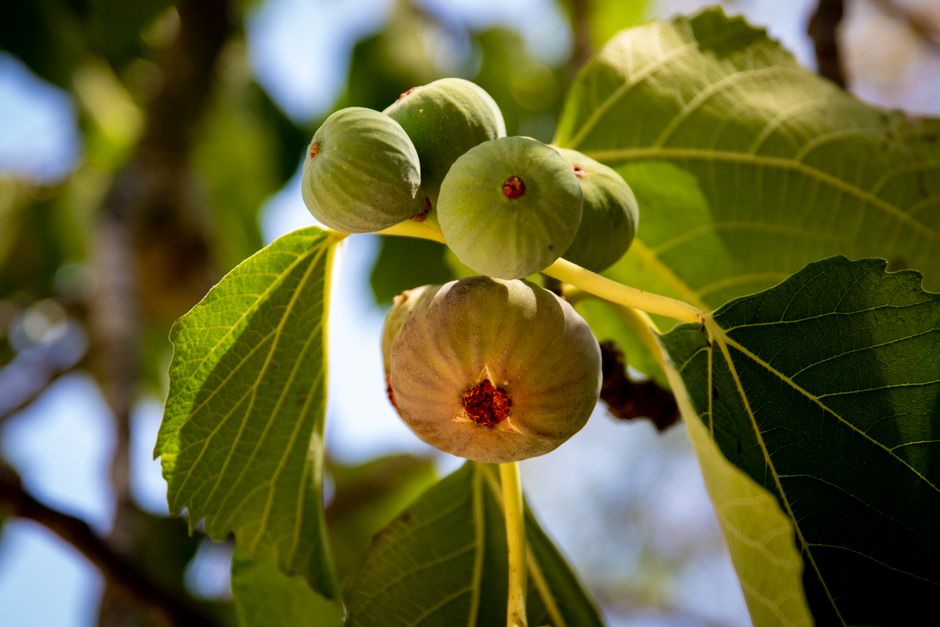
Young trees vs mature trees
Young trees (roughly years one to three) and mature trees need different treatment. Conflating the two is one of the most common fig pruning mistakes.
Young trees:you're building the skeleton, not harvesting fruit. Select three to five well-spaced scaffold branches that splay outward from a short trunk. Remove everything else growing from the base. Cut the central leader back to encourage lateral branching. An open-centred structure — sometimes called vase or goblet form — gives better light distribution and an easier tree to manage for the next twenty years. Accept that you'll sacrifice some fruit in years one and two. The tree is building its resume.
Mature trees (four-plus years):you're managing what you have. The work each winter is renewal pruning — cutting a proportion of the older fruited wood back to short stubs to force new growth for next season's crop. I reckon cutting back two or three of the older scaffold shoots each winter keeps the tree productive and prevents the kind of congestion that takes three seasons to untangle.
One thing that's genuinely specific to Langley/Aldergrove and the Fraser Valley: fig trees here tend to grow more vigorously than in drier climates. The wet growing season and mild winters push a lot of new wood. Manage for that — this isn't a tree that needs minimal intervention. Canadian Figs has solid documentation on BC-specific fig growing behaviour if you want to go deeper.
Tools you need (and one you don't)
The kit for fig tree pruning isn't complicated.
Bypass secateurs — not anvil — for shoots up to about 1cm diameter. Anvil secateurs crush the cut, which is also a fine approach if your goal is to upset the tree. Bypass shears slice cleanly. Crushed wood calluses slower and is more susceptible to disease entry.
Long-handled bypass loppers for branches between 1cm and roughly 3cm. These are the workhorse of most residential fig pruning.
A pruning saw for anything thicker than about 3cm diameter.
Clean your tools between trees — particularly if you're moving between fig trees in the same season. Use diluted bleach or isopropyl alcohol on blades. One infected tree can pass fungal spores to the next.
What you don't need: wound sealant or pruning paint. The practice of sealing cuts has been largely discredited — research has consistently found it can trap moisture and delay natural callus formation. Clean, angled cuts made at the right time are enough.
Summer pruning — the light version
Summer pruning is a real technique — just a very different operation from what you do in winter.
From late June through July, once you can see the embryonic figs forming on branch tips, pinch out growing tips after about five or six leaves have formed. This redirects the tree's energy into swelling the fruit already there rather than producing new wood. I reckon it makes a measurable difference on vigorous varieties — some growers report noticeably larger fruit from consistent summer tip-pinching.
That's the limit of summer work. Structural cuts in summer — removing scaffold branches, taking out large sections of the canopy — should wait. The latex flows, wounds don't callus well in warm weather, and you risk stressing the tree during the period it's working hardest.
If you have diseased or broken material that genuinely can't wait until winter, make the cut on a dry, mild day and keep the wound as small as possible.

When you don't need an arborist
Here's the honest answer: most residential fig tree pruning is something a homeowner can do themselves, and I'd feel like a fraud if I told you otherwise.
Fig trees are genuinely forgiving. They tolerate imperfect cuts in ways that a Japanese maple or a cherry tree won't. The main risks from DIY pruning are taking too much at once, not cleaning tools between cuts, and pruning at the wrong time of year — none of which are severe if you're reasonably careful.
You don't need to call us for:
- Annual light pruning of an established tree under about 3m — dead wood, water sprouts, light renewal cuts
- A young tree in its first couple of years that needs shaping
- Anything you can reach safely and comfortably from the ground
Do call us if:
- The tree is over 4m and you'd need to work at height
- The canopy is badly congested and you're not sure which scaffold branches to keep
- There's unexplained dead wood or dieback — could be a disease issue worth a proper look
- The tree hasn't been touched in eight or more years and you're not sure where to start
That last situation comes up more than you'd think. A tree left alone for a decade isn't necessarily in trouble — but it usually needs a knowledgeable eye before it needs a saw. An arborist inspection before the first major pruning on a neglected tree is usually worth the cost. If you're unsure whether your fig is structurally sound, an ISA Certified Arborist will give you a straight answer.
Fig trees reward patience more than panic. Prune once in winter, tidy lightly in summer, and they'll produce fruit reliably for twenty or thirty years. The ones that get over-pruned out of anxiety spend the following spring throwing out twenty metres of new growth with a deeply philosophical expression. That's not a malfunction — it's the tree telling you what it thinks of your intervention.