Your dwarf cherry tree is supposed to be small. That's the whole point. (I've said this to more homeowners than I'd like to count — people who called because theirs wasn't growing tall enough and thought something had gone wrong.)
A dwarf cherry tree is not a cherry tree that didn't make it. It's a cherry tree grafted onto rootstock that controls its final size. The fruit is full-sized. The flavour is full-sized. The tree is just manageable. Which is exactly what most Surrey and Fraser Valley backyards need.
Quick answer: Dwarf cherry trees top out at 2.5 to 4 metres depending on variety and rootstock. They need six-plus hours of sun, well-drained soil, and an annual prune after harvest (for fruiting types) or after flowering (for ornamentals). Most common problems — aphids, cherry slug, poor fruiting — don't need a professional. Structural issues, canker, or anything near a structure does.
What a dwarf cherry tree actually is
"Dwarf" in the tree world means rootstock-controlled, not naturally small. A cherry scion — the variety that produces the fruit — is grafted onto a rootstock that limits how tall and wide the whole tree grows. Different rootstocks produce different size outcomes. Gisela 5, for example, produces a genuinely compact tree. Colt rootstock gives you something closer to semi-dwarf.
This matters because two trees sold as "dwarf cherry" at different nurseries can end up quite different sizes at maturity. If you're planting close to a fence, a path, or a structure — ask the nursery specifically which rootstock was used. The tag won't always tell you.
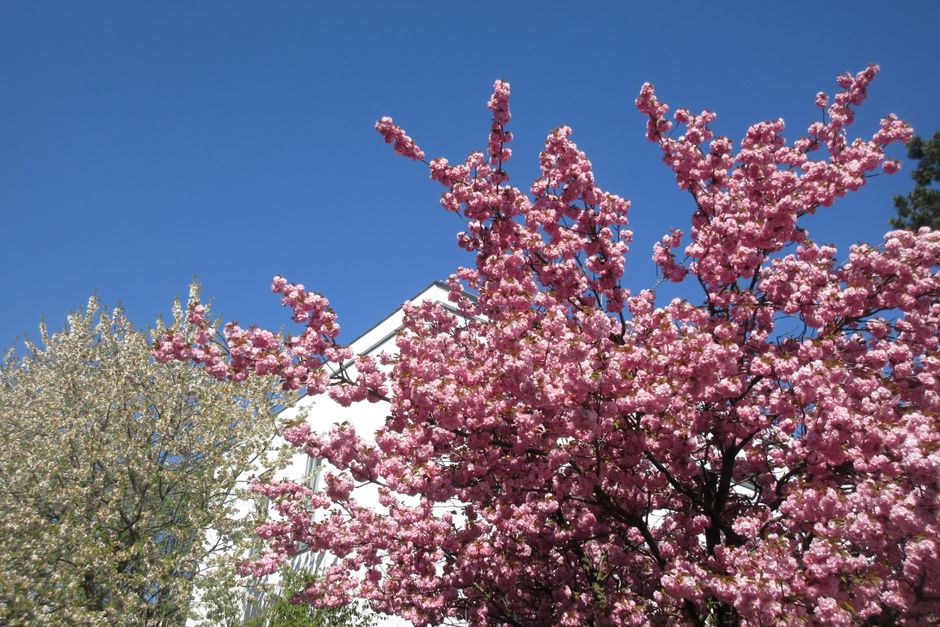
Ornamental dwarf cherry blossom trees — Japanese flowering cherries, weeping varieties, Prunus species grown primarily for the spring display — are a different category. They're often grafted onto weeping or pendulous rootstock for the form rather than the fruit. Beautiful in March. Zero cherries. Worth knowing before you plant one expecting a harvest.
Varieties worth growing in Surrey and Fraser Valley
BC's Lower Mainland is zone 8. Wet winters, mild summers, occasional late frost. Dwarf cherry trees generally do well here — better than in the BC interior, where late frosts can knock out a whole season's crop.
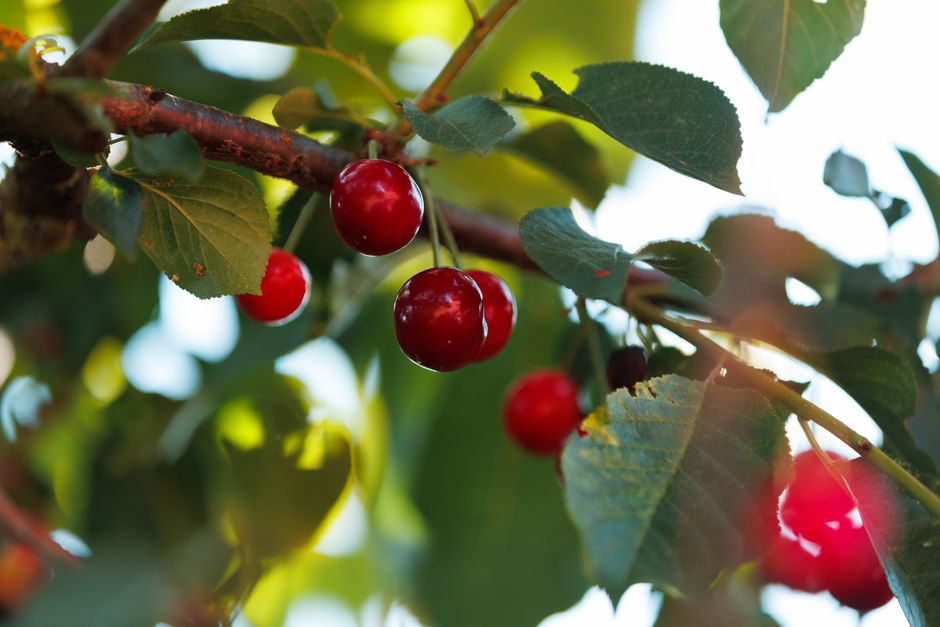
For sweet cherries: Lapins is self-fertile and does reliably well in this climate. Stella is another solid self-fertile choice and one of the more forgiving varieties for cooler springs. Compact Stella is the dwarf form — tops out around 3.5 metres. Both produce large, dark red fruit in July.
For sour cherries: The Saskatchewan Romance Series — Carmine Jewel, Romeo, Juliet — are compact, cold-hardy, self-pollinating, and handle BC's damp conditions without fuss. They're all under 2.5 metres at maturity. Good for jams, wine, and eating straight off the branch if you like tart.
For ornamental blossom: Prunus incisa varieties (Kojo-no-mai is the most widely planted in BC) stay small and bloom in early spring. Good container option. No fruit worth speaking of.
Rule of thumb: if you want fruit, go self-fertile. If you want two sweet cherry varieties for cross-pollination, plant them within 15 metres of each other or you're just decorating the garden with bees.
How to care for a dwarf cherry tree
Sun. Six hours of direct sun daily is the minimum. Eight is better. A dwarf cherry in part shade will grow fine and produce almost nothing. If you're planting against a north-facing wall or under a larger tree canopy, choose a different spot.
Drainage. This is the one thing that kills dwarf cherry trees in Surrey faster than anything else. Our clay-heavy soils hold water, and cherry trees on dwarfing rootstocks are particularly sensitive to wet roots. If you're planting in clay, dig a wider hole than you think you need, amend with grit and compost, and plant slightly raised so the root ball sits above the surrounding grade. The BC Ministry of Agriculture's fruit tree guidance covers this in detail if you want the specifics.
Watering. Regular, deep watering during the growing season. Let the top few centimetres dry between waterings — don't keep the soil consistently soggy. Mulch around the base to hold moisture without waterlogging.
Fertilising. A balanced slow-release fertiliser in early spring, before bud break. Once more after harvest if the tree is actively fruiting. Don't over-fertilise — too much nitrogen pushes leaf growth at the expense of fruit. If you're seeing a lot of lush new growth but few flowers, that's usually the cause.
Graft union. When planting, the graft union — the swollen knob near the base of the trunk — must stay above soil level. If it gets buried, the scion can root directly into the ground and you lose all size control. The tree will grow as large as the scion variety wants to.
When and how to prune a dwarf cherry tree
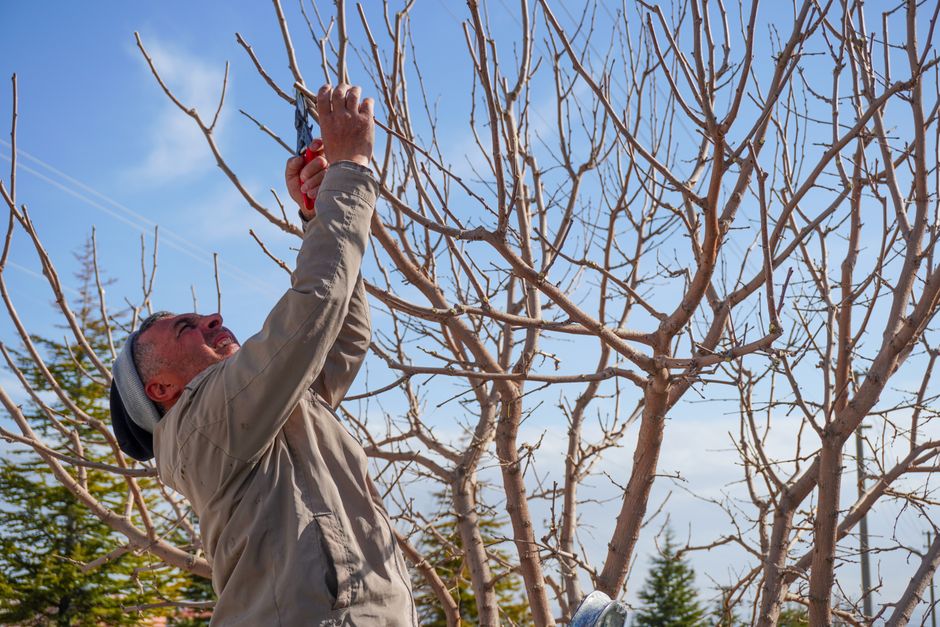
Timing first. For fruiting varieties, prune in summer after harvest — usually July to early August in the Lower Mainland. Stone fruits pruned in the wet season (late autumn through winter) are significantly more susceptible to silver leaf disease and bacterial canker. This is one of those rules that's worth following even if it feels counterintuitive.
For ornamental flowering cherries, prune immediately after flowering in spring. The window is short — a few weeks at most. Prune too late and you're cutting off next year's flower buds.
What to remove. Dead or dying wood first. Then anything crossing or rubbing another branch. Then any branches growing inward toward the centre — the goal is an open bowl shape that lets light and air into the canopy. On a young tree (first three years), focus on building the framework. On an established tree, it's mostly maintenance.
How much to take. Rule of thumb: no more than 20 to 25% of the canopy in any single pruning. Cherry trees can handle more than some other stone fruits, but removing too much at once stresses the tree and can trigger excessive water shoot growth — the vigorous upright shoots that clutter the canopy and produce no fruit.
I had a homeowner in Langley a few years back who'd been watching YouTube tutorials and decided to "renovate" his cherry tree by cutting it back to stubs. The tree came back with forty water shoots and no cherries. We spent two seasons bringing it back to a sensible shape. Would've been a fraction of the cost if he'd called before picking up the loppers. Proper cherry tree pruning isn't complicated — but the cuts you make in the first few years set the structure for the next twenty.
Tools. Sharp, clean secateurs for cuts up to about a centimetre in diameter. Loppers for larger branches. A folding saw if you need it. Clean your blades between trees — cherry trees are particularly susceptible to bacterial diseases that spread on dirty cutting tools. Methylated spirits or a diluted bleach solution works fine.
Common problems and what they mean
Gummosis — amber resin oozing from the trunk or branches. Can be a stress response (physical damage, waterlogged roots), bacterial canker, or brown rot. If it's in one small spot and the wood below is healthy, monitor it. If it's widespread with dead patches of bark, that's bacterial canker and worth a professional look. Our wet winters make this more common in the Lower Mainland than most other parts of Canada.
Cherry slug. Leaves looking skeletonised or scorched on the upper surface from midsummer onwards — that's cherry slug, the larva of a sawfly. Looks alarming. Rarely causes serious long-term damage to a healthy tree. A spray of kaolin clay or a registered insecticide handles it. Not a reason to call an arborist.
Poor fruit set. Flowers but no fruit. Nine times out of ten it's pollination — either a self-sterile variety with no companion, or a cold wet spring where bees weren't flying during bloom. Check the variety first. If pollination isn't the issue, look at whether you pruned too late in spring and removed the fruiting spurs.
Dieback. Branches dying back from the tips, leaves browning and holding on — that's worth looking at. Silver leaf disease in stone fruit shows as a silver sheen on leaves before dieback. There's no chemical control; affected wood has to be removed well below the infection. If you're seeing this across multiple branches, that's a conversation for a certified arborist, not a YouTube video.
When not to call an arborist for your dwarf cherry tree
I'll tell you this even though it's not great for our call volume.
A healthy dwarf cherry tree that you can prune from the ground or from a stepladder — that's homeowner territory. You don't need an ISA Certified Arborist to remove a crossing branch from a two-metre tree. Rent a pair of decent loppers, read up on the cuts, and do it after harvest. It's genuinely not that complex on a small tree.
Cherry slug, aphids, and most foliar problems don't need us either. Your BC government pest management resources will tell you what to use and when. I'd rather you spent that money on a tree health assessment every few years than on a house call for aphids.
Call when: you've got structural damage (a split crotch, a major limb failure), signs of silver leaf or bacterial canker across multiple branches, anything near a structure or overhead line, or if the tree is simply too large to work on safely from the ground. For anything under three metres that's healthy — you're capable of handling it yourself.
That said, if you're not sure what you're looking at, a tree health consultation runs $150 and gets credited toward any work we do. Sometimes the most useful thing we do is tell you the tree is fine and you can put the pruning shears away.