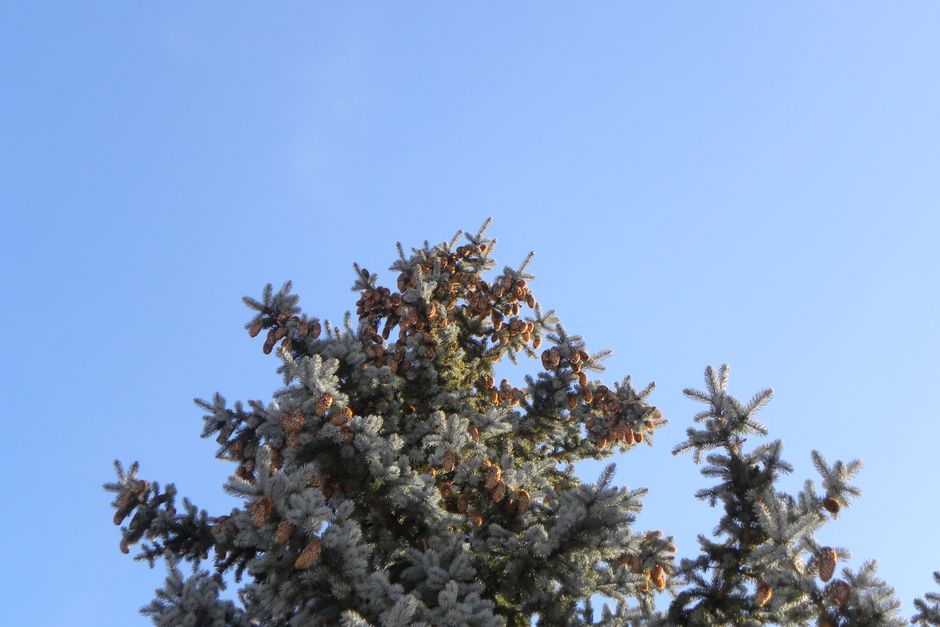
Blue spruce makes a stunning Christmas tree. Dense silvery-blue needles, stiff branches, and it smells like December whether you planned that or not. The problem is what happens in January. It's a tree. Trees grow. (This surprises more people than it should.)
If you've got a living blue spruce that just served as your centrepiece, you're probably wondering whether you can plant it out in the yard. The short answer: yes. The more useful answer involves knowing exactly how big it's going to get — and whether your Surrey lot can actually handle it long-term.
What is a blue spruce Christmas tree?
Blue spruce — Picea pungens — is native to the Rocky Mountain region of the United States. Colorado, Utah, Wyoming. Not a BC tree.
It became popular as a Christmas tree for good reasons. It holds its needles well indoors. The branches are stiff enough to carry ornaments without drooping. The silvery-blue colour looks striking before you've put a single light on it. And it's sold as a living tree in containers or balled-and-burlapped — meaning the roots are intact, and you can plant it out after the holidays.
If post-Christmas planting is your goal, you want the container-grown version. The root ball is less disturbed, the tree handles the transition better, and establishment in the ground is more reliable. Ball-and-burlap can work, but container-grown is the better bet.
There's also a dwarf cultivar — Picea pungens 'Globosa'— that stays under 3 feet. If you're on a smaller lot, that is worth knowing about. It's sold as a blue spruce but it behaves entirely differently in the ground, and it will not become a 50-foot problem.
How big does a blue spruce actually get?
Here's the part that changes minds.
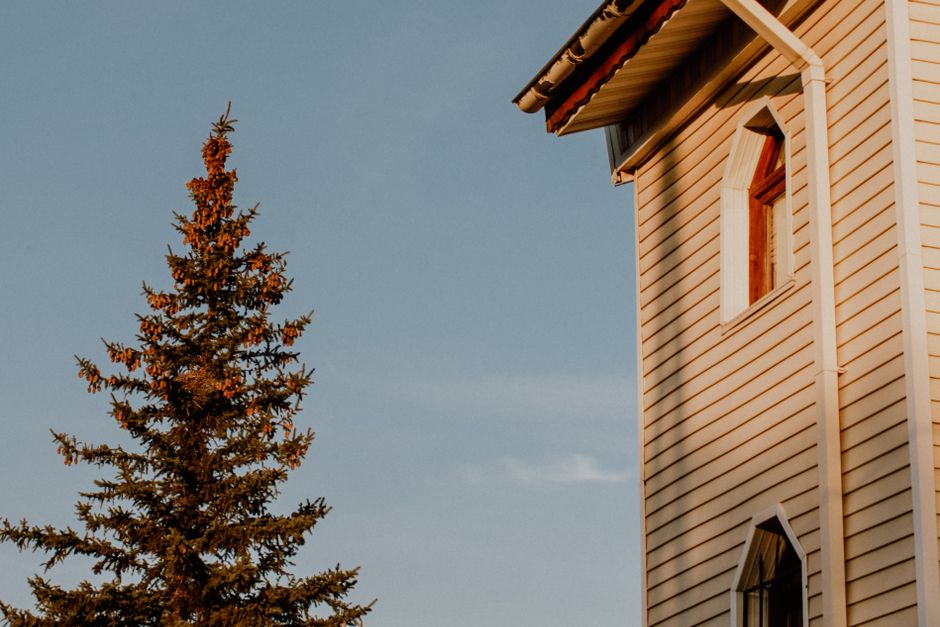
A standard blue spruce reaches 40–60 feet tall at maturity. Canopy spread of 10–20 feet. Growth rate is slow — roughly 30 cm per year when young. But slow does not mean small. Your 2-foot Christmas tree is 6 feet in four years. In ten years, it's hitting the gutters on a bungalow. In thirty years, it's a full-sized tree that costs $1,500 or more to remove.
On a standard Surrey residential lot — somewhere in the 4,000–7,000 sq ft range — a single blue spruce planted in the wrong spot will eventually dominate the entire north or east face of your property. It will shade your neighbour's garden. It will drop branches after every winter storm. And when you finally want it gone, it is a serious removal job.
I reckon the biggest mistake I see with blue spruce is people planting them without this picture in mind. They're beautiful at 8 feet. Considerably harder to love at 45.
Does blue spruce grow well in Surrey, BC?
It grows fine here. Cold hardiness is not the issue — blue spruce is rated for zones 2 through 7, and Surrey sits in zone 8b. It handles our winters with no problem.
The challenge is the wet. Surrey and most of the Lower Mainland gets 1,200–1,500 mm of rain per year, much of it in winter. Blue spruce is from dry mountain country. It prefers well-drained, slightly acidic soil. In the clay-heavy, poorly-drained ground common in parts of Surrey, Cloverdale, and Delta, blue spruce can develop root rot and is prone to Cytospora canker — a fungal disease that works upward from the base, killing lower branches first. If you've seen a spruce with brown dead branches from the ground up, that is usually what you are looking at.
I had a client who came to us after a sequence of Leyland cypress trees kept struggling on his property — disease, dieback, every wet winter taking something else. He'd planted them because they were available and inexpensive. We replaced them with Sitka spruce and western red cedar — native to BC's coast, built for exactly this climate. Those trees are thriving now. The Leyland cypress never got comfortable.
Blue spruce is in a similar position. It will grow in Surrey, but it is not in its element. If you are in a spot with good drainage and decent sun, it can do fine for decades. If you are in a low area that holds water, it will give you grief eventually.
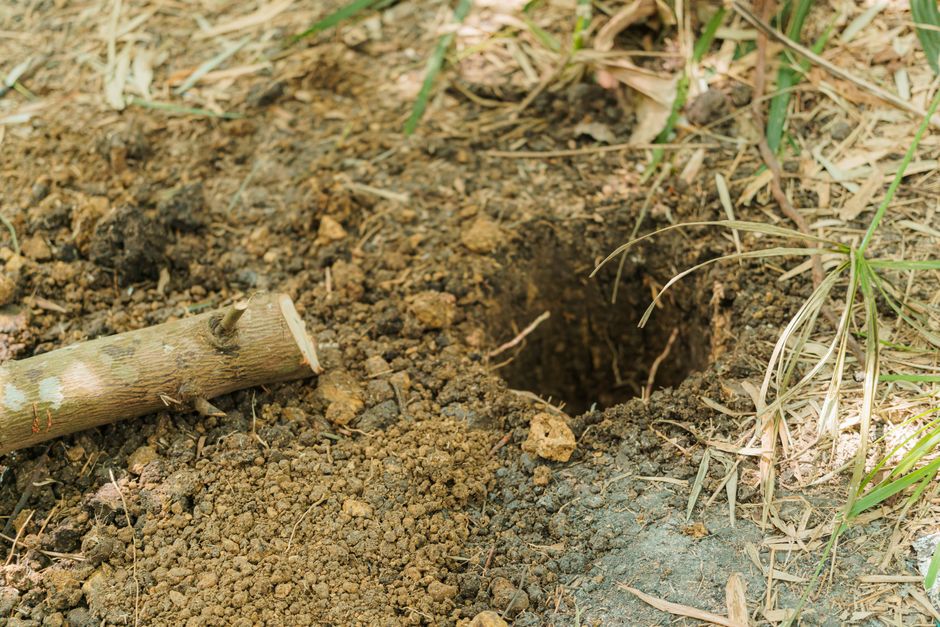
Rule of thumb: dig a test hole 18 inches deep after heavy rain. If water is still standing two hours later, your drainage is not adequate for blue spruce. You are better off with a native conifer.
Caring for your potted blue spruce before planting
If it has been inside for Christmas, a few things matter before you move it out.
Keep it indoors for no more than two weeks. One week is better. A centrally heated living room is about as far from the blue spruce's natural habitat as you can get without crossing an ocean. Put it near a window for natural light. Water it carefully — the root ball should stay moist but never waterlogged. No saucers of standing water.
Before moving it back outside permanently, acclimatise it. A cold porch or unheated garage for three or four days does the job. Going directly from a 20°C living room to a January night outside stresses the roots in ways that can set back establishment for the entire first growing season.
On decoration: LED lights produce far less heat than older incandescent strings. Keep lights on for shorter periods. And real candles on a living tree are, to put it charitably, a bold life choice.
When and how to plant it out after Christmas
Plant it as soon as the holidays are done — late January or February is ideal in Surrey. Waiting until spring increases transplant shock because the tree will break dormancy in its container before it gets into the ground.
Choose a spot with all of the following:
- Full sun — at least 6 hours per day
- Well-draining soil — clay-heavy ground is a long-term problem
- At least 15 feet from any structure, deck, or overhead utility line
- At least 10 feet from property lines — the canopy will spread
To plant: dig a hole twice as wide as the root ball, same depth. Loosen the sides of the hole. Set the tree so the root flare — where the trunk widens at the base — sits level with or just above the surrounding soil. Burying the root flare causes long-term stress and disease entry points. Backfill with the original soil, no amendments. Water deeply. Mulch 2–3 inches around the base, keeping it off the trunk itself.
The first year is the hardest. You may see no visible growth at all — the tree is putting energy into root establishment, not height. Water deeply once a week through the first summer, more in dry stretches. Nine times out of ten, the trees that fail in the first year were planted too deep or went into ground with drainage problems that were already there.
Watch for tip blight: browning needle tips, usually starting on the lower branches, encouraged by our wet winters. Caught early, a copper-based fungicide helps. If it is spreading up into main branch whorls, that is when to get an arborist to assess the tree's health before the conversation becomes about removal.
Blue spruce pruning and long-term care
Blue spruce has a natural symmetrical form. In most cases, the best thing you can do is leave it alone.
If you want to manage the size, light crown reduction every four to five years is the right approach. Timing: late spring to early summer, after new growth has extended but before it hardens. Never remove more than one-third of the canopy in a single season.
Do not top it. Topping destroys the natural leader and creates a structurally weak, flat-topped tree that is harder — not easier — to manage from that point forward. Any crew recommending that you top your blue spruce is a crew worth getting a second opinion on.
Once the tree hits 20 feet, hand the pruning to a certified arborist. Crown reduction in a mature conifer requires climbing equipment, an understanding of how spruce wood fails under load, and the judgment not to take too much at once. It is not a ladder-and-handsaw job.
The International Society of Arboriculture has a solid breakdown of what a certified arborist brings to work like this — and what questions to ask before you hire anyone.
When NOT to plant a blue spruce in your yard
This is the section I actually look forward to writing.
Skip the blue spruce if:
- Your lot is under 5,000 sq ft. In 20 years it will be the dominant feature of your entire property and your neighbour will have strong opinions about it.
- You have poor drainage. It will struggle, develop disease, and eventually need removal — which costs more than doing this right the first time.
- It is going near power lines or your roofline. Blue spruce does not stay tidy up top, and a tree under a utility corridor is a maintenance problem forever.
- You are hoping it stays small. It will not, unless you specifically bought the dwarf cultivar and planted that. Standard blue spruce is a full-sized tree.
- Your neighbour is 8 feet away on the north side. Gifting them 40 years of shade is not as generous as it sounds.
If you want a native evergreen that handles BC's wet winters and stays beautiful without becoming a liability, Sitka spruce and western red cedar are both excellent options. They are adapted to this climate. They live longer. They attract less disease in the Lower Mainland.
Honestly, if you are not sure whether your yard can handle a blue spruce long-term, give us a call before you plant it. That conversation costs nothing. A removal in 2045 costs considerably more — and yes, we know the removal is the bigger payday for us. We still will not recommend planting something in the wrong spot.