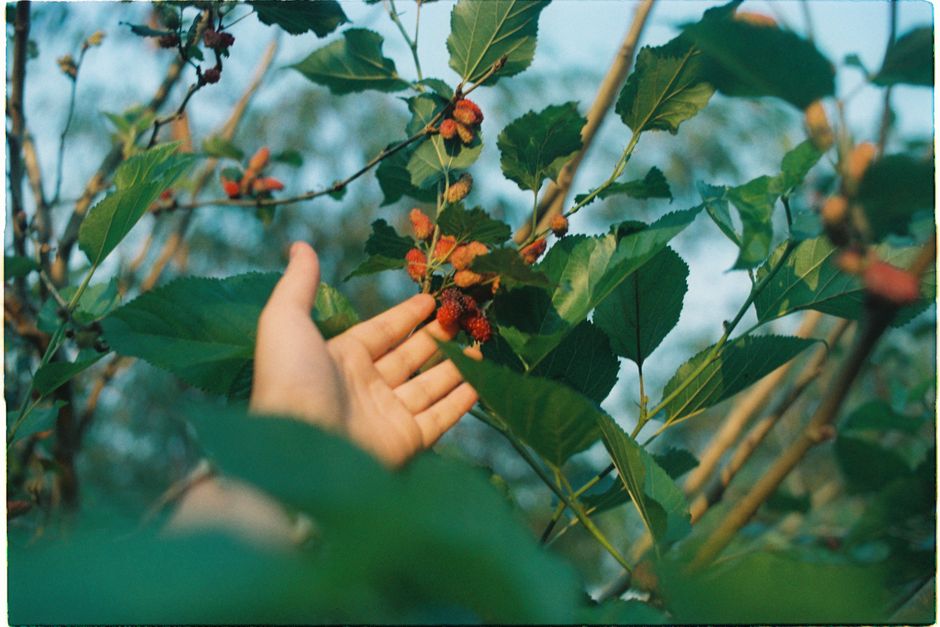
Mulberry trees are generous. They give you shade, fruit, and — if you cut them at the wrong time — enough milky white sap to make you feel like you've stabbed a rubber plant. The good news is that the fix is simple: timing.
Prune mulberry trees while they're dormant. In Surrey and the Lower Mainland, that means late February to mid-March, after the hard frosts have mostly passed but before the buds start to push. Get that window right and you've solved most of the problems at once.
When to prune mulberry trees

The window that matters is dormancy — the period between leaf drop and bud break. For most of BC's Lower Mainland and Fraser Valley, that lines up with late February to mid-March. We get milder winters than interior BC, so dormancy ends earlier here than most pruning guides assume.
Avoid late spring and summer pruning if you can help it. The sap pressure is highest then, the cuts bleed more, and you're stressing a tree that's spending all its energy on leaf and fruit production. The exception is dead or diseased wood — that comes off whenever you find it, no season required.
Early autumn is also a no-go. Pruning in September or October can stimulate new growth that won't harden off before the first frost. You'd be setting the tree up to fail heading into winter.
Why mulberry trees bleed white sap
Mulberries produce a latex-like sap that oozes from any fresh wound. The first time you see it, it looks alarming — a white milky substance running down the bark. (The tree doesn't feel the same way about it.)
The sap is not toxic and it won't kill the tree. The issue is that heavy sap flow during growing season can attract insects and allow fungal pathogens to enter the wound. Pruning while dormant reduces the internal pressure, so the bleed is significantly less — not zero, but manageable.
Don't apply wound sealant or pruning paint. Older arboricultural advice recommended sealing cuts, but the research has shifted. Sealants trap moisture and can actually promote the decay you're trying to prevent. Clean cuts and correct timing are the whole answer.
How to prune a mulberry tree

Work in a specific order. It keeps the scope manageable and stops you from cutting good wood before you've removed the problem wood.
- Dead and diseased branches first. Remove any wood that's clearly dead — dry, brittle, no bark movement. If you're unsure, scratch the surface: green under the bark means alive, brown means dead.
- Crossing and rubbing branches. Two branches rubbing together create wounds that never fully heal. Pick the one with better form and remove the other back to its origin.
- Inward-growing shoots. Growth heading toward the centre of the canopy reduces airflow. An open canopy dries faster and sees fewer fungal problems.
- Size and shape reduction last. Once the structural work is done, step back and assess. You might need less height or spread reduction than you thought.
For tool sizing: hand pruners handle anything up to about ¾ inch, loppers from ¾ to about 1½ inch, and a pruning saw for anything larger. The rule of thumb on cut placement — always cut back to a branch that's at least one-third the diameter of what you're removing. Cutting to a stub smaller than that leaves a dead end with no way to close over.
Nine times out of ten, homeowners make the mistake of leaving stubs. A flush cut or a cut to a lateral branch heals. A stub that's too small to support callus growth just dries out and rots inward.
For a wider look at pruning technique across different species, the International Society of Arboriculture pruning guide covers the biomechanics in more detail.
Weeping mulberry: different rules

Weeping mulberries are a different animal. Where a standard mulberry needs light corrective work every few years, a weeping form needs annual shaping to keep its character.
The goal is to maintain the umbrella canopy. Cut pendulous branches back to selected scaffold points — the main framework that gives the tree its structure. Without annual pruning, the trailing stems touch the ground, the centre gets congested, and within a few seasons you've got a tangle instead of a feature tree.
You can be more aggressive with weeping mulberries than with standard forms. Cutting back to scaffold branches each winter is normal and expected — the tree responds with the graceful cascading growth you planted it for. Skip it for two or three years and you're doing remedial work instead of maintenance.
Same timing applies: late February to mid-March in the Lower Mainland. Same sap rules: expect some bleed, dormancy reduces it.
How much to remove
The 25% rule. Don't take more than a quarter of the live canopy in a single season. I've seen homeowners take half a mulberry down in one go because they wanted it smaller faster. What they got was a tree covered in waterspouts — those fast-growing vertical shoots the tree throws out as a stress response — within eighteen months.
Waterspouts are the tree equivalent of a defensive overreaction. They look messy, create future crossing and crowding problems, and take years to manage. The tree would've been better off with two or three lighter rounds over consecutive seasons.
If the tree genuinely needs a major size reduction — say it's grown into overhead lines or it's blocking a sightline — a crown reduction approach done in stages is almost always better than a single heavy cut. You get the outcome you want without the stress response.
When not to bother calling us
I'll be straight: most mulberry pruning doesn't need a certified arborist. If your tree is under 15 feet, you're removing small branches below ladder height, and you're not near power lines — that's a reasonable DIY job. Get the timing right, use clean tools, don't make stub cuts, and you'll be fine.
Where that changes:
- The tree is over 20–25 feet. Working that high with a saw isn't a ladder-and-nerve problem — it's a dropped-saw problem.
- Any branches are within 3 metres of overhead power lines. That's BC Hydro territory and the liability is significant.
- You're doing structural pruning — removing major scaffold branches or addressing a tree that's been neglected for years.
- The tree is over the house, a shed, or a neighbour's fence. A dropped branch in the wrong spot is an insurance claim.
If any of those apply, give us a call. It's a standard pruning job for us, and we carry $2M liability coverage specifically for the scenario where things go sideways.
BC Hydro has specific clearance requirements for trees near power lines — their tree trimming guidelines are worth reading before you start any work near electrical infrastructure.
What mulberry tree pruning costs in Surrey BC
Honestly, it depends on size and access. For a standard-sized mulberry — say 15–25 feet, decent access, no complicating factors — crown thinning runs $300–$800. Crown reduction for a larger specimen is more like $500–$1,200.
Small ornamental weeping mulberries are quicker jobs. If it's a single-trunk weeping form that just needs its annual shaping, that's often in the $250–$400 range.
The $150 consultation fee gets credited toward any work you proceed with — so if you're not sure whether you need a full prune or just some deadwood removal, it's worth a proper assessment first. A lot of trees that look like they need significant work just need the dead stuff out and a bit of clearance.
I reckon about half the mulberry calls I get are people worried they need a major reduction when what they actually need is a light annual tidy. That's a much cheaper conversation.