Let me cut right to it: pruning live oak trees has clear rules, and most homeowners find out what those rules are after ignoring the tree for six years. (That is the last pruning pun — arborist humour has a short shelf life.)
In BC, the oak we are talking about is almost always Garry oak (Quercus garryana) — the province's only native oak. Long-lived. Genuinely beautiful when maintained. And the species most likely to receive a removal quote when pruning would solve the problem for a third of the cost.
Quick answer: Prune in late fall through winter (November–February) or mid-summer (July–August). Avoid spring. Remove dead, crossing, and hazardous branches first. Never take more than 25% of the live canopy in a single season. Make clean cuts outside the branch collar and skip the wound sealant.
What makes pruning live oak trees different in BC
Most online guides about live oak pruning are written for Texas and the American Southwest. They lead with oak wilt — a fungal disease (Bretziella fagacearum) that spreads through fresh pruning wounds and has devastated oak populations across the US South and Midwest.
As of 2026, oak wilt has not been confirmed established in BC. The BC Ministry of Forests monitors for it actively, and it has not arrived here yet. That is worth knowing when you are reading US-based pruning guides with a lot of fear-forward language about spring cuts.
What is locally relevant in the Lower Mainland:
- Armillaria root disease — a local fungal pathogen that attacks stressed oaks at the root collar
- October through March wind season — dead limbs become projectiles when the big storms come through
- Dense residential planting across South Surrey and Langley that creates canopy competition and interior dieback
The timing advice from those US guides still holds up. Avoiding spring pruning reduces wound exposure to whatever pathogens are locally present. Good practice is good practice regardless of which specific disease you are avoiding.
When to prune your Garry oak — the safe timing window
November through February. The primary window. The tree is dormant, sap movement is minimal, and beetle activity is near zero. Garry oaks compartmentalise pruning wounds slowly compared to faster-growing species, and a dormant tree handles a cut better than one mid-flush.
July and August. The secondary window. After the June push, the tree has committed to its current growth cycle. Beetles are less active than in spring and the wound is less attractive to pathogens. Practically speaking, summer pruning risk is comparable to winter pruning for most routine work.
Avoid March through June. This is when the tree is moving the most sap, when beetles are most active, and when a fresh cut is most vulnerable. Not a guaranteed problem — but if you are going to pick a bad time, this is how it is done.
Dead branches are a different category. You can remove dead wood at any time of year. A dead branch does not carry the same wound-infection risk, and leaving one through a BC winter means it eventually comes down — on your schedule or the wind's.
Signs your live oak needs pruning now
Most Garry oaks in Surrey and Langley do not get pruned until something fails. Rule of thumb: get eyes on the tree every 3–5 years, not when a limb lands on the deck.
Signs you are overdue:
- Dead branches in the canopy — falling hazards, especially over structures, fences, or anywhere people walk regularly
- Crossing or rubbing branches — where two limbs grow into each other, one eventually fails; better to choose now than wait for gravity to choose later
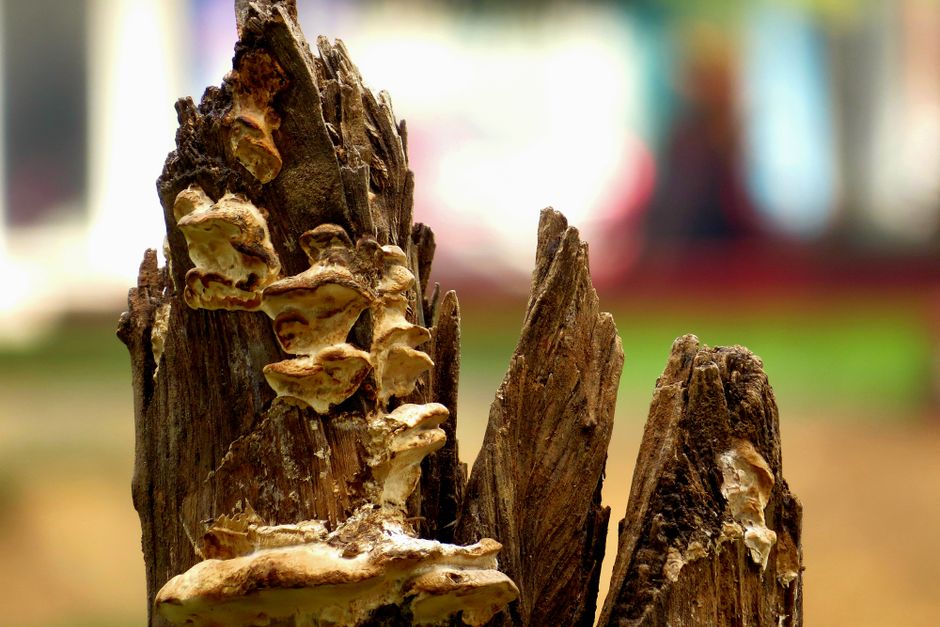
- Fungal growth at the base or on the bark — honey mushrooms or bracket fungi can indicate Armillaria infection; not always fatal, but worth investigating
- Dense crown blocking interior light — when inner limbs die back from shade, the canopy needs thinning
- Significant one-sided growth toward a structure — natural lean differs from failure lean, but a heavy crown growing toward the house deserves a look
Mushrooms at the base do not automatically mean a dying tree. They are a flag worth raising with a certified arborist before deciding everything is fine and waiting another five years.

How to prune a live oak tree — the right cuts
Three rules that hold for any live oak, anywhere:
Cut outside the branch collar. The branch collar is the swollen ring of tissue where the branch meets the trunk or parent limb. That tissue is the tree's natural barrier zone — it compartmentalises the wound and stops decay from spreading inward. Cut through it and you remove the tree's ability to close properly. Leave it intact, always.
No stub cuts. A stub is a cut made too far from the collar, leaving dead branch material attached to the tree. Stubs decay inward. They are worse than a flush cut in many situations and considerably worse than getting it right the first time.
Skip the wound sealant. Painting pruning cuts was common advice for a long time. It has been out of favour in professional arboriculture for at least two decades. Sealants trap moisture, interfere with compartmentalisation, and do not prevent disease. (For years people asked why I did not carry wound compound. The short answer: it does not work. The longer answer involves fifteen minutes on product marketing from the 1970s. You probably do not want the longer answer.)
Use sharp, clean tools. A dull blade tears bark and creates ragged cut surfaces. Clean your tools between trees — especially if any tree on the property shows active dieback or fungal signs. This matters more than most homeowners realise.
For larger limbs over about 3 inches in diameter, use the three-cut method: undercut first to prevent bark tearing, cut from above to drop the branch, then make the final clean cut at the collar. One extra step that prevents a strip of bark from peeling down the trunk.
The 25% rule — how much canopy to remove
Garry oaks compartmentalise slowly. They are resilient trees over the long run — a healthy specimen can outlive four generations of homeowners — but they do not bounce back from aggressive pruning the way a fast-growing maple does.
The standard guideline: remove no more than 25% of the live canopy in a single season. For most routine pruning — dead wood, crossing branches, minor hazard limbs — you will rarely get close to that limit. A healthy mature Garry oak in reasonable condition typically needs 10–15% removed to address what actually needs addressing.
If the goal is significant crown reduction — bringing down a tree that has grown too large for the space — plan to do it across two to three seasons. Impatience costs you. A Garry oak heavily reduced in a single session can spend two years looking rough before recovering. The same result across staged cuts is barely noticeable to the tree.
For our crown reduction service in Surrey, we typically target 20–30% — enough to reduce hazard and restore clearance without pushing the tree past what it should handle at once.
Young vs. mature Garry oak pruning
Young trees (under 15–20 years): This is the highest-leverage pruning you will ever do on an oak. Training a young Garry oak to a single dominant leader, removing co-dominant stems early, and keeping the crown balanced sets up decades of lower maintenance and lower structural risk. A $300 pruning session on a young tree regularly saves $1,200 in corrective work ten years later.
Mature trees (50+ years): The focus narrows to dead and hazardous wood. Structural corrections on an established Garry oak need to be incremental. These trees carry significant load in their existing structure, and removing major limbs shifts weight distribution in ways a young tree absorbs easily and an old one sometimes does not.
Heritage oaks (100+ years): The most conservative approach of all. Assess first, act second. These trees warrant a formal ISA Tree Risk Assessment before any significant intervention. The heritage oaks scattered across South Surrey, White Rock, and Langley are 150–200+ years old. There is no replacing what comes off one of those in an afternoon.
What it costs — honest numbers
A homeowner in Surrey once received a $2,400 removal quote on a 120-year-old Garry oak. Reason given: it was leaning and unsafe. I assessed it. The lean was natural growth toward a light gap — the tree had been growing that way for decades. The dead branches were minor and removable. Crown thinning ($650) and deadwood removal ($300) fixed the problem entirely.
The homeowner saved $1,450 and kept a heritage tree. That oak has another 50+ years in it with reasonable maintenance. The removal quote would have taken it in a single afternoon.
Nine times out of ten when I see a removal quote on an oak, there is a pruning option that costs less and leaves the tree standing. A second opinion is worth the $150. Always.
| Service | Price range (CAD) |
|---|---|
| Tree assessment / consultation | $150 (credited toward work) |
| Crown thinning / light pruning | $300–$800 |
| Crown reduction (20–30%) | $500–$1,200 |
| Deadwood removal | $250–$600 |
| Tree cabling / support system | $400–$800 |
All prices are flat and all-in — no extras for cleanup, no surprise line items for chip removal. For the full range of what we handle, see our tree services page.
When not to call an arborist
The situation that does not require a professional:
- A young oak under 20 feet with obvious crossing branches reachable safely from the ground
- Small deadwood under about 1.5 inches in diameter on accessible lower branches
- A healthy, open-grown tree with no signs of structural stress — general monitoring you can do yourself every couple of years
The situation that does:
- Any work that requires being off the ground
- Branches over the house, deck, or power lines
- Visible stem decay, fungal fruiting bodies, or a sudden lean following a storm
- Any heritage tree where guessing wrong is not an acceptable outcome
I will say what most tree companies will not: if your Garry oak is healthy, under 20 feet, and the work is ground-level, you do not need to call us. Come back when it grows. We are not going anywhere — and honestly, a tree that does not need work yet is a better outcome than one that does.