
Pruning a Japanese maple tree is the arboricultural equivalent of giving someone a very precise haircut — mostly about restraint, picking the right moment, and knowing when to put the scissors down. A Japanese maple that has been topped is still a Japanese maple, technically. The same way a bonsai that has been sat on is technically still a bonsai — just considerably less intentional.
Japanese maples are the most-googled ornamental tree in the Fraser Valley. They are also the most mis-pruned. The two facts are probably related. When something is beautiful and visible, someone always reaches for clippers. Usually at the wrong time of year.
Quick answer: Prune a Japanese maple in late winter to early spring — late January through mid-March in Langley/Aldergrove is the window. Light clean-up can happen in early summer after leaves open. Never prune in late summer or fall. And the 25% rule: never remove more than one quarter of the live canopy in a single season. That is it. Everything else is context.
Nine out of ten calls we get about Japanese maples are from homeowners who either want to know if they can prune now, or who want us to fix what someone else pruned last October. This guide answers the first question so you don't end up needing us for the second.

When to prune a Japanese maple — and when to leave it alone
There are two safe windows, and one hard rule.
Late winter to early spring is the main window. In Langley/Aldergrove and the Fraser Valley, that is late January through mid-March. The tree is dormant, you can see the branch structure clearly without leaves in the way, and any cuts you make have time to begin callousing over before the growing season kicks in. The risk of disease entry through fresh cuts is also lower in cooler, drier weather than in summer.
One thing worth knowing: Japanese maples sometimes bleed sap from fresh cuts during warm spells in late January and February. It looks alarming the first time you see it. It is not a problem for the tree. If it concerns you, wait until late February when the worst of the sap flow has passed — you are still well within the safe window.
Early to midsummer works for light work. Once the leaves have opened and you can see exactly where a branch is crossing or rubbing, removing it in June or early July is fine. Keep it to branches no thicker than your thumb, and keep total removal well below the 25% threshold. The tree is in active growth and seals wounds quickly at this time of year.
Late summer and fall is the hard rule. Do not prune from August through November. Any cuts you make stimulate a flush of new growth that does not have time to harden before the first frost. In the Fraser Valley, cold snaps can arrive in October. That soft new growth is the first thing the season kills. You end up with frost-killed stubs that need removing the following spring — meaning you have done the same job twice and stressed the tree in between. Avoid it entirely.
The same applies to the general seasonal timing rules for trees in Langley/Aldergrove — late winter dormancy is almost always the safest window for structural work across species.
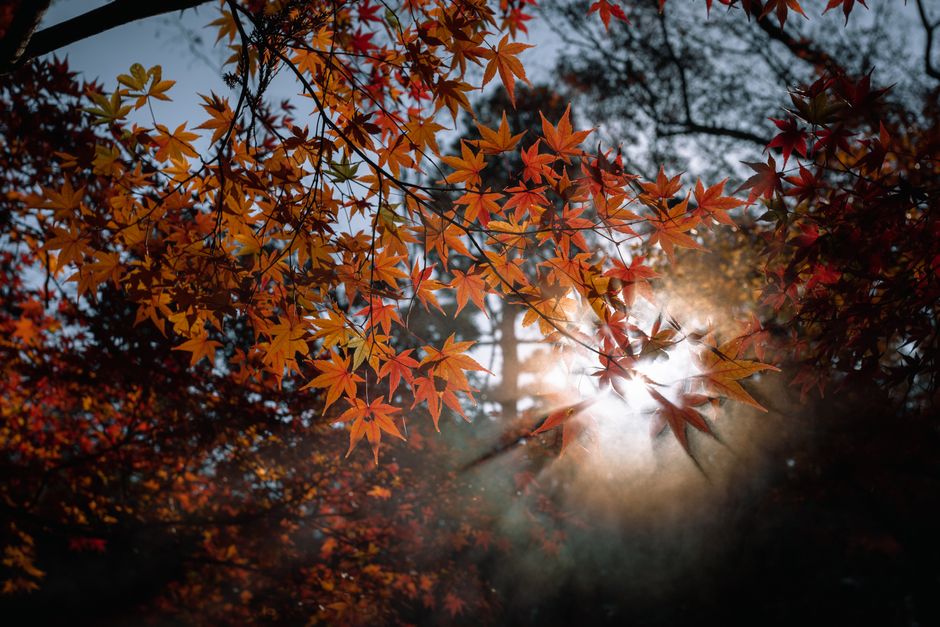
What to actually take off
Japanese maples have a natural layered structure — horizontal branches fanning out in tiers, with the overall form widening as the tree matures. Your goal when pruning is to preserve and reveal that structure, not to impose a different one.
Remove these:
Dead, diseased, or damaged branches. Start here every time. Remove dead wood back to a live junction. Diseased tissue (look for cankers, unusual discolouration, or dieback that does not correspond to drought or frost) should be cut back to healthy wood, and your tools should be sterilised between cuts with a 10% bleach solution or isopropyl alcohol.
Crossing and rubbing branches. Where two branches cross and rub against each other, one of them needs to go. Left long enough, the friction creates a wound that becomes an entry point for disease. Rule of thumb: keep the branch that fits the natural layered structure. Remove the one that is growing into or across a layer rather than along one.
Water sprouts and suckers.Fast-growing, whippy vertical shoots from the base or from branch unions — these are the tree's stress response, often triggered by previous hard pruning. Remove them entirely. They are not structurally useful and they disrupt the tree's form.
Leave these alone:
The horizontal, spreading branches that define the tree's layered canopy. The downward-arching branches on weeping forms. Any branch that is contributing to the overall shape rather than disrupting it. Japanese maples grow slowly and deliberately. The structure you are looking at took years. Do not remove it because it looks like there is a lot there.

How to make the cuts
Use sharp, clean bypass pruners for anything under thumb-thickness. Anvil-style pruners crush the stem rather than cut it — that bruising slows callusing and invites disease. Bypass pruners are non-negotiable for ornamental work.
For branches over thumb-thickness, use the three-cut method to avoid tearing the bark:
First cut: make an undercut about a third of the way through the branch, roughly 30cm from the trunk. This prevents a downward tear when the branch falls. Second cut: cut through the branch from above, about 5cm further out from the first cut — the branch falls without tearing. Third cut: remove the remaining stub just outside the branch collar (the swollen ring of tissue where the branch meets the trunk). Do not cut flush to the trunk — the collar is where the tree seals the wound. Do not leave a long stub — it rots.
Do not apply wound sealant. This used to be standard practice. Research since the 1990s has consistently shown it traps moisture and impedes the natural callusing process. The tree does not need help — it needs you to make a clean cut in the right place and then leave it alone.
Our tree pruning service in Langley/Aldergrove follows ISA best management practices for all ornamental work, including Japanese maples. If you want a professional to assess the structure before deciding what to remove, that is a reasonable use of a call-out.
The 25% rule — why Japanese maples punish impatience
The International Society of Arboriculture sets a standard of removing no more than 25% of the live canopy in a single season. For most trees, this is a guideline. For Japanese maples, I reckon it should be treated as a ceiling, not a target.
Japanese maples respond to over-pruning with water sprouts — fast-growing, whippy, vertical shoots that erupt from cut points across the canopy. They look terrible, they throw off the natural structure, and they take years of follow-up pruning to manage. The tree is not broken. It is stressed. And a stressed Japanese maple is a Japanese maple that is not doing the thing you bought it for, which is looking beautiful while doing very little.
If significant removal genuinely needs to happen — storm damage, corrective work after previous bad pruning — spread it across two or three years. The tree recovers better, and you get a chance to see how it responds before removing anything else.

Common mistakes Langley/Aldergrove homeowners make
Topping.Removing the central leader and major upright branches to "keep the tree manageable." The tree responds by throwing out a dozen weedy upright stems from every cut point. Getting a topped Japanese maple back into anything resembling its original form takes three to five years of corrective pruning — if it is possible at all.
We get called out a few times a year to assess Japanese maples that have been "shaped" by a previous company. The shape in question is usually a ball, or a flat-topped cylinder. Japanese maples do not naturally grow in those shapes. Corrective work — removing the water sprouts, gradually rebuilding the layered structure — runs $200–$400 a year for several years. The original topping cost around $150 in most cases. That is the kind of maths that I find clarifying.
Shearing. Running a hedge trimmer across the exterior of the canopy. Same result as topping, applied uniformly. The exterior looks tidy for about three weeks. Then the water sprouts arrive.
Pruning in fall. Covered above, worth repeating: late summer and fall pruning is the single most common timing mistake. The tree does not go dormant in September. It is still actively moving resources. Cuts made then trigger growth at the wrong time and leave that growth exposed to frost.
Using the wrong tools. Dull or anvil-style pruners, loppers used on branches too large for them, not cleaning tools between cuts. Sharp, clean bypass pruners for anything ornamental. For larger cuts, a proper pruning saw. Between trees — especially if any disease is suspected — wipe the blades with isopropyl alcohol.
When not to call us
This is the section I genuinely enjoy writing.
Do not call us to remove small deadwood. If the dead branches are under pencil-diameter and you can reach them from the ground, you can do this yourself. A pair of sharp bypass pruners, ten minutes in late winter, and you are done. That is not a job that needs an arborist.
Do not call us if your Japanese maple just failed to bud in one spot. Check the branch with the scratch test — scratch the bark with a fingernail; green underneath means live, brown means dead. If it is one small section of deadwood after a dry summer or a cold snap, remove it yourself. That is normal.
Do not call us if someone told you Japanese maples need annual pruning. They do not. A healthy, well-sited tree in a spot where it has room to grow to its natural size may need nothing for two or three years at a stretch. If you are pruning every year because the tree keeps outgrowing its space, the tree is in the wrong spot — that is a replanting conversation, not a pruning one.
Do call us if the tree has a structural problem — a visible split, a heavy lean, a branch over a structure or near power lines. Do call us if you suspect disease or if a previous pruning job went badly and you are not sure how to address it. Those are genuine arborist jobs. Snipping a few twigs is not. If you are unsure, a quick phone call to (437) 771-4741 costs nothing and will give you a straight answer.
What professional Japanese maple pruning costs in Langley/Aldergrove
Nobody lists prices. We think they should.
| Tree size | Typical range (CAD) |
|---|---|
| Small (under 3m, accessible, light deadwood) | $150–$300 |
| Medium (3–5m, some structural work) | $300–$550 |
| Large (5m+, significant structural pruning) | $550–$900+ |
| Corrective pruning (after topping or shearing) | $200–$400/year for 2–4 years |
These are all-in, approved-before-we-start prices. We do not charge for showing up and then add to the invoice once we are in the tree. If we get there and the scope is different from what the phone call suggested, we stop, give you a revised number, and wait for the go-ahead. For a full picture of what our tree services cover, the services page has the detail.
If you want to find a certified arborist anywhere in Canada — not just us — the ISA Canada arborist locator is the place to start. An ISA-certified arborist has passed exams on pruning standards, tree biology, and risk assessment. For ornamental work on a tree you are attached to, it is worth the extra call.