
Red maples are one of the more forgiving trees in the Lower Mainland. Prune them at the wrong time of year, though, and they will spend the next few weeks making that point very clearly — with a lot of sap and a lot of your regret.
The good news is the timing is simple once you know why it matters. Most of the damage I see on improperly pruned red maples comes down to one mistake: cutting in early spring.
The quick answer on timing
Best windows: Late May through June (after leaves fully expand), or November through December (after leaf drop). Avoid February through April. Dead and damaged wood can come off any time.
The reason for those windows comes down to sap pressure, wound compartmentalisation, and one fungal pathogen that red maples are genuinely susceptible to. Worth understanding — it only takes a minute.
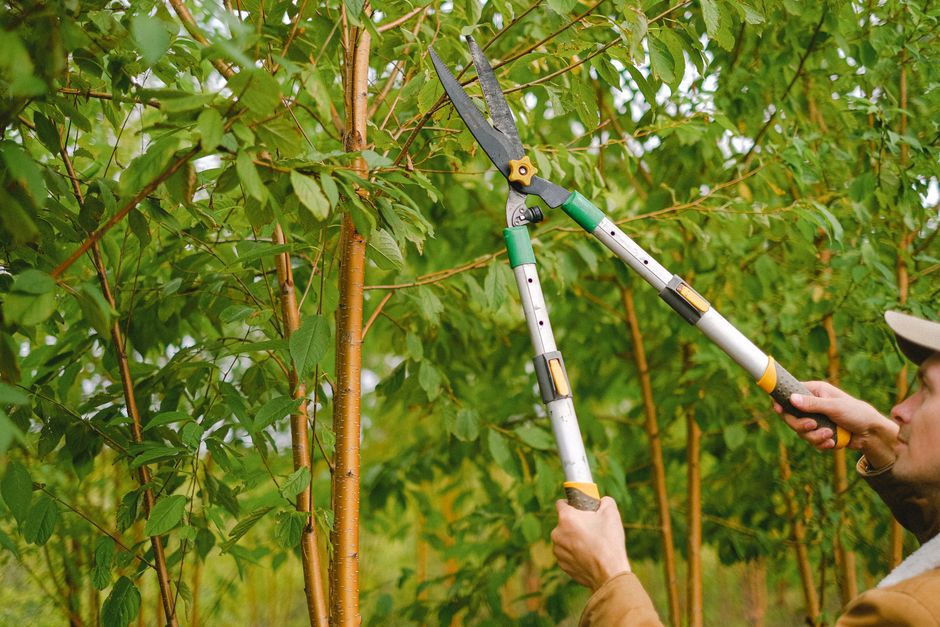
Why red maples bleed sap — and whether it matters
Red maples run sap under positive root pressure in early spring, before the leaves push out. It is the same vascular mechanism that makes maple syrup tapping work — except in this case you are doing it unintentionally with a pruning saw.
Cut into active tissue during that window and you get a running wound that can drip for days. Silver maples do the same thing, to an even more dramatic degree.
The bleeding itself rarely kills the tree. Most arborists consider sap flow a cosmetic and slow-healing concern rather than a mortality risk. The problem is what comes after: an open, seeping cut in early spring is a good entry point for verticillium wilt, a soil-borne fungus that attacks the vascular system. Red maples are notably susceptible. Once verticillium is established, management options narrow quickly and removal sometimes becomes the conversation.
Rule of thumb: if you can wait until June, wait. The wound closure difference between a May cut and a March cut on a mature red maple is significant.
A homeowner in South Surrey called me a couple of years back because his red maple was looking rough after he'd done his own pruning. He'd used pruning sealant on every cut, topped two of the main branches to tidy the shape, and done the work in March. The tree had three separate cankers forming at wound sites. We spent an afternoon removing the compromised wood and correcting the structure — about $650 worth of work. He'd have paid $300 to $400 and got a better result if the timing and technique had been right from the start.
The three pruning windows for BC
Late spring (May–June) — the primary window. After the leaves fully expand, the tree shifts from root-driven sap pressure to leaf-driven transpiration. Pruning during this window gets clean cuts and fast wound compartmentalisation. For structural work — removing competing leaders, addressing crossing limbs, managing the scaffold — this is the best time. Most of our red maple work in Surrey and Langley happens here.
Late fall (November–December) — the dormant window. After leaf drop, the tree is dormant and sap movement is minimal. You lose some canopy visibility — it is harder to assess the structure without the leaves — but you gain a closed vascular system and predictable wound behaviour. For large-scale pruning of mature trees, this window is what I generally recommend. Anything done before Christmas works cleanly.
Avoid: February through April. Early spring is when the sap rises before leaf-out. Light dead wood removal is fine. Heavy pruning on live tissue is not. (Note that "light" here means removing an obviously dead branch, not a significant structural cut.)
The ISA pruning guidelines and the BC Ministry of Forests tree management documentation both support this timing approach, though neither is specific to red maple sap dynamics — that part is practical experience.
What you can prune any time
Dead, diseased, and damaged branches can come off whenever it is safe to do so. The pruning calendar applies to live tissue — a dead branch above your driveway does not respect the seasonal windows and neither should you.
Similarly, limbs that are actively rubbing together, crossing at contact points, or creating injury to the bark can be addressed when the problem is clear. The goal is removing the hazard, not waiting for the ideal sap-pressure month.
One note for summer: red maples can look stressed in a hot July — drooping leaves, a slightly wilted appearance. That is often heat and water stress rather than a dead branch. Give it a scratch test (scrape the bark with a thumbnail — green cambium underneath means alive) before removing anything significant. Nine out of ten times in a BC summer, the tree is fine. It is just warm.
For an overview of what routine pruning includes and what it costs, see our tree pruning services page.
What not to do: topping, sealant, and climbing spikes
Do not top a red maple. Topping — cutting the main trunk or major scaffold limbs back to stubs — is one of the most damaging things you can do to any tree, and red maples handle it particularly badly. It forces multiple weakly-attached new leaders from the cut sites, creates massive open wounds that rarely compartmentalise properly, and puts the tree in a cycle of repeated hazardous regrowth. It also looks exactly as bad as it sounds. Most trees I have seen that needed removal within ten years were topped at some point.
Do not seal pruning cuts. Pruning sealant (the black tar compound) traps moisture under the bark and slows the natural wound compartmentalisation process. A clean, properly-angled cut heals faster without it. We stopped carrying pruning sealant years ago. If a company recommends it on your maple, that is worth asking about.
Do not let anyone climb with spikes. Climbing spikes (gaffs) damage the cambium layer at every contact point. On a tree being removed, they are fine — the tree is gone anyway. On a tree being pruned and kept, they leave a series of wound sites up the trunk. Red maples are sensitive to trunk damage. Any arborist doing pruning work on your tree should be using a saddle and rope system, not spikes.
I reckon nine out of ten improper red maple pruning jobs I see involve at least one of the above three. Usually the timing problem and the sealant together.
When to call a professional — and when not to
Dead wood removal up to about 10 feet — reachable from the ground with a pruning pole — is reasonable DIY territory if you know what a proper collar cut looks like. Anything above that on a mature red maple is professional work.
Structural decisions — competing leaders, scaffold limbs, crown reduction to manage size or risk — need someone who can assess the whole tree, not just the branch in question. Red maples can reach 60 to 80 feet at maturity. A structural error at 30 feet creates a problem you will not notice for two or three years, and by then correcting it costs more than getting it right originally.
We do red maple pruning across Surrey, Langley, White Rock, and Delta. Crown thinning on a mid-size red maple typically runs $300 to $500 depending on access and scope. An assessment is $150 and gets credited toward the work.
Here is when to skip calling us: if your red maple is under 15 feet, you can reach everything with a standard pole pruner, and all you are doing is removing obviously dead twigs and small crossers — do it yourself. A decent pair of bypass pruners and 30 minutes on a weekend morning handles small trees fine. No need to pay an arborist for that.
If the tree is larger, the structure is unclear, or anything is near a roof, fence, or power connection — that is worth a conversation. The assessment will either confirm you needed us, or confirm you didn't, and either outcome saves you money or regret.