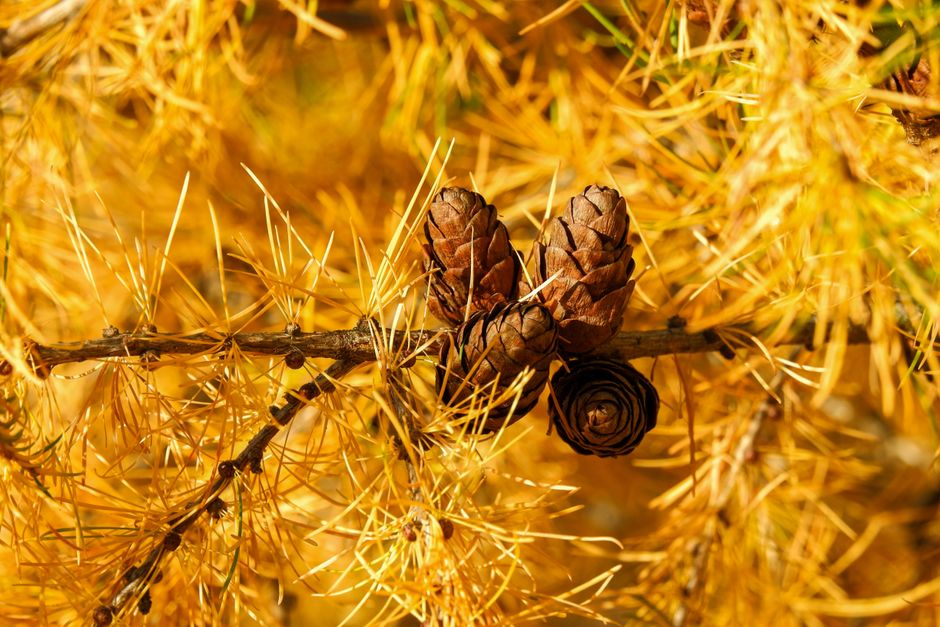
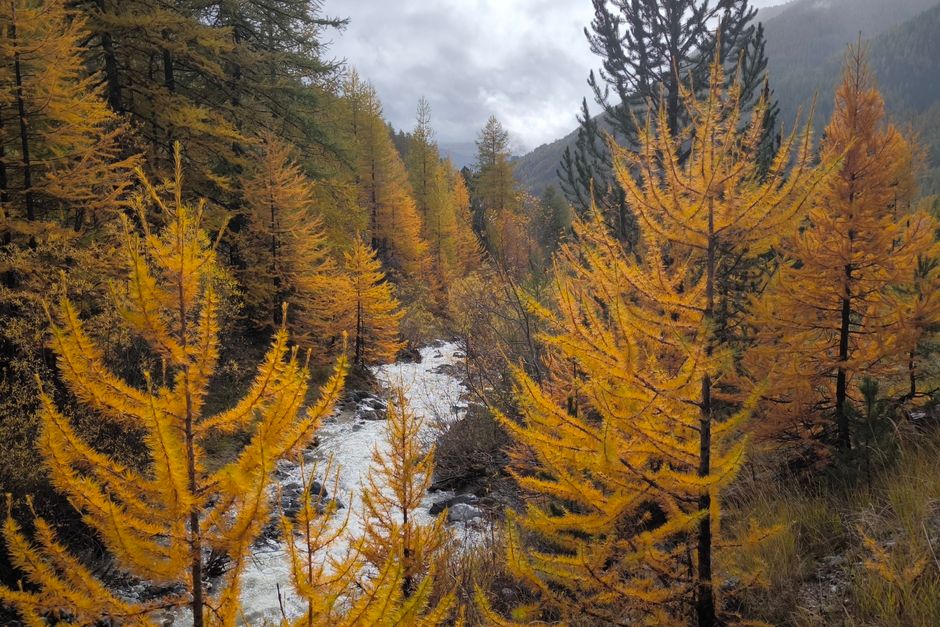
Every autumn, at least a dozen homeowners call me about their larch tree. The needles have turned golden, the branches are bare, and they've concluded — with some certainty — that the tree is dead. (One couple had already called a removal company for a quote.) The tree was fine. Larches are the only common conifer that drops all its needles every winter. They're deciduous conifers, which sounds like a contradiction, but there it is.
So: if your larch tree is losing needles in October or November and the needles are turning gold before they fall — that's normal. The tree will bud out again in spring, same as it has every year.
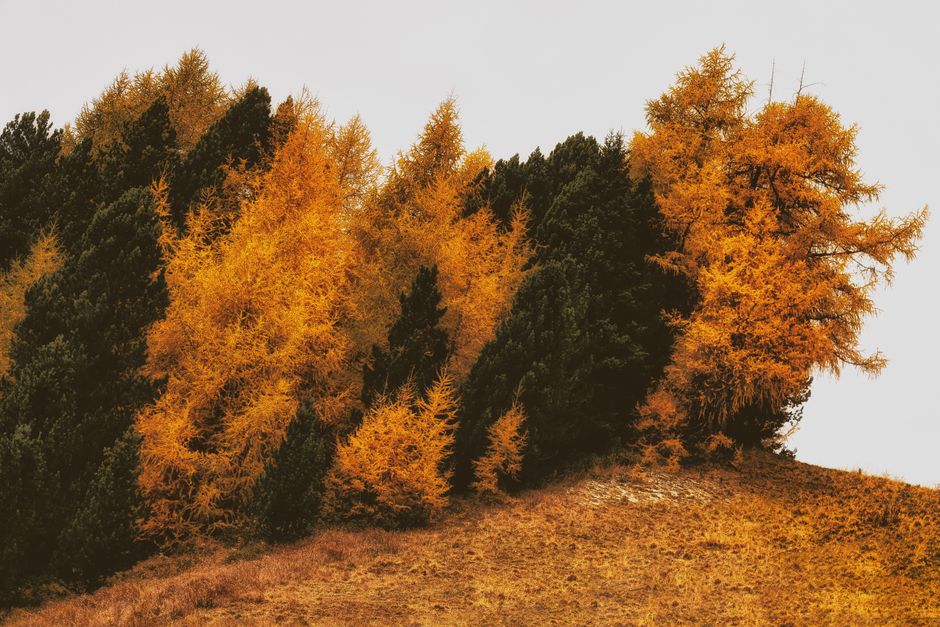
What is a larch tree, exactly?
A larch (genus Larix) is a conifer. It produces cones, has needle-like leaves, and looks every bit like it belongs alongside spruce and fir. The one meaningful difference: it drops those needles every autumn and grows them back every spring.
North America has three native larch species. The western larch (Larix occidentalis) is the one that defines BC — you'll find it through the interior, Okanagan, and Kootenays, where it grows to 30 or 50 metres. That said, Japanese larch (Larix kaempferi) and European larch (Larix decidua) are both planted as ornamentals across the Lower Mainland and Fraser Valley, so if you've got one in your Surrey garden, it's most likely one of those two.
All three behave the same way in autumn. Needles turn yellow or gold, then drop. Every year, like clockwork, for the life of the tree — which can be several hundred years for western larch in the right conditions. Ornamental varieties still reach 80 to 150 years under reasonable care. A larch in your garden is a long-term commitment.
One quick way to confirm you're looking at a larch and not a dead spruce: larch needles grow in clusters, as soft tufts of 15 to 40 needles on short woody spurs. Spruce and fir needles attach individually all along the branch. If your "spruce" goes bare every winter, I reckon it's a larch.
Why larch trees drop needles in autumn
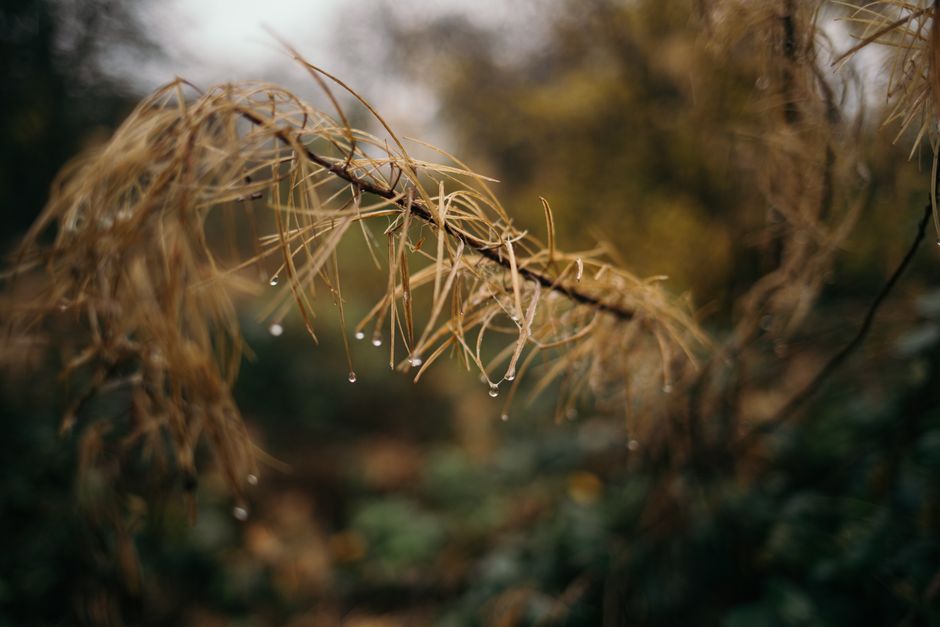
Because that's what they do. The biology is the same as any deciduous tree — as day length shortens in autumn, the tree stops producing chlorophyll, the needles change colour, and they fall. The larch spends winter bare, conserving energy, and resumes growth when temperatures warm in spring.
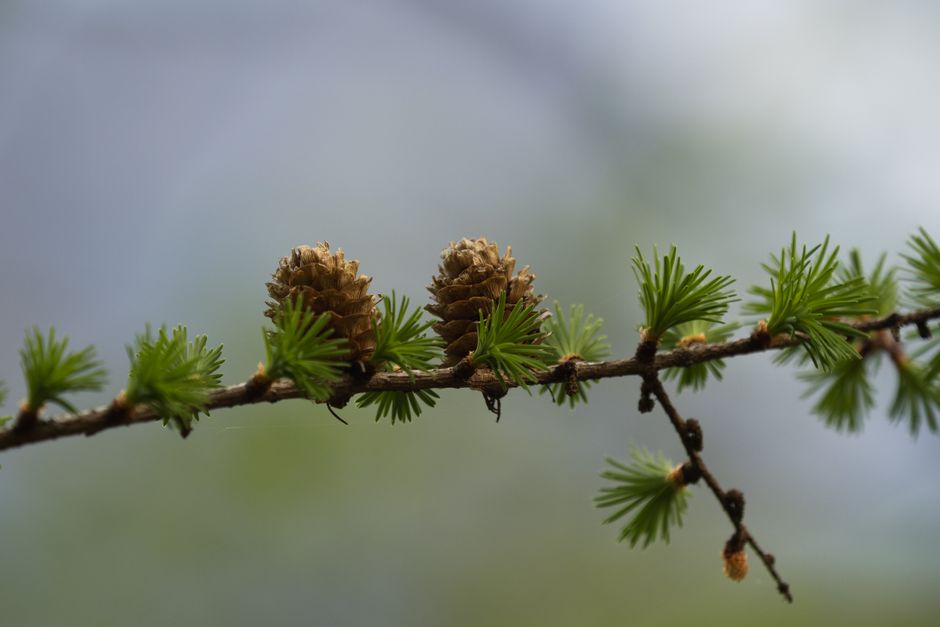
In Surrey and the Lower Mainland, the needle drop usually starts in September and finishes by November depending on the year and the location. New growth comes in March or April — bright, soft green tufts on the branch ends. Within three to four weeks, the canopy is full again.
The autumn colour can be quite striking, for what it's worth. A large larch in full golden-yellow stands out against BC's backdrop of evergreen Douglas fir and cedar. Worth the mild heart attack the first time you see it.
The main point: if your larch drops needles in autumn and the needles are turning gold before they fall, nothing is wrong. You've got a healthy tree doing exactly what it's supposed to do.
When needle drop is actually a problem
There are situations where needle loss on a larch is worth paying attention to. The biggest flag is timing: needles dropping in spring or summer, or browning from the tip inward rather than turning an even gold.
Larch casebearer (Coleophora laricella). An introduced moth species. The larvae feed inside individual needles over winter, then emerge in spring and eat foliage from the outside. A heavy infestation strips a larch by early summer. The giveaway is that needles brown from the tip inward and die without turning gold — quite different from normal autumn drop. The BC Ministry of Forests has resources on casebearer management, though options for a single garden tree are limited.
Larch blight (Meria laricis).A fungal disease that causes new shoots to die back and needles to brown and drop during the growing season. More common in wet springs — which describes most of the Lower Mainland's climate. This is one reason western larch doesn't thrive on the coast the way it does inland.
Drought stress. Larches are adapted to drier interior conditions. In a hot, dry Surrey summer, a planted larch can drop needles early under moisture stress. Not fatal, but worth addressing with deep watering through dry periods.
Root problems. Poor drainage, compacted soil, or root rot (Armillaria or Phytophthora) can cause progressive needle loss and canopy dieback. If the tree is dropping needles along with dead branch tips, bark discolouration, or fungal growth near the base — get a proper tree health assessment before assuming it's fine.
Rule of thumb: autumn needle drop in gold or rust, following normal spring budbreak, on a consistent annual cycle — that's a healthy larch. Anything outside that pattern is worth a closer look.
Caring for a larch tree in Surrey BC
Honest answer: larches don't ask for much. Planted in the right spot with decent drainage and enough sun, they generally take care of themselves. What they actually need:
Full sun.Larches are sun trees. They'll tolerate some shade, but they're less vigorous and more vulnerable to disease when crowded. If your larch is increasingly overshadowed by neighbouring trees, that's worth addressing.
Good drainage.Waterlogged soil is the fastest way to stress a larch. They handle moist conditions better than most conifers, but standing water over winter is a problem. If yours is in a low-lying area that pools, that's a risk factor worth understanding.
Minimal pruning. Dead or damaged branches can come off any time. For anything significant — a crossing branch, structural work, shaping — late winter, January to February in Surrey, is the right window while the tree is fully dormant. Avoid late summer pruning, when any wound is most vulnerable to fungal entry. For a guide to timing across other tree species, the ISA Canada arborist locator is worth bookmarking.
Nine times out of ten, the larches I assess in Surrey are in reasonable shape and need nothing more than observation. The anxiety is usually about the autumn needle drop, not the tree itself. (The scratch test — scratch a young branch, check for green underneath — takes about four seconds and answers the main question.)
When to call an arborist (and when not to)
Don't call us for autumn needle drop. That's what this post is for. Put a reminder on your phone for October: "Larch drops needles in autumn. This is normal."
Do call us — or any ISA certified arborist — if:
The needle loss is happening in spring or summer, especially if needles are browning from the tip rather than turning an even gold. You notice dieback in the canopy — dead branch ends while the rest of the tree is still active. There's fungal growth, unusual bark discolouration, or anything soft or hollow at the base. The tree has been in decline two seasons running and you're not sure why.
A few years back, a homeowner in Langley called me about a mature larch they'd been told needed removal. The tree had been "losing needles all summer," and a tree company had quoted removal at $2,100. When I assessed it, the pattern was consistent with a spring-summer casebearer infestation — not a dead or failing tree. We did a thorough inspection and removed the deadwood that had accumulated ($550 total). The tree budded out fine the following spring. Homeowner kept a mature larch and saved $1,550. That's the sort of outcome I'd rather deliver than a stump.
Most tree services will tell you a tree needs to come down. It's easier and it pays more. I'd rather tell you the tree is fine, charge you for the assessment, and walk away. That said, if a larch genuinely is declining and removal is the right call, I'll say so clearly — and you can get a second opinion before committing to anything. That's always the right move on a job this size.
If you're not sure whether your larch is in trouble, give us a call or send a photo. Assessment is $150, credited toward any work that follows. We'll tell you straight whether it's a normal dormancy or something that needs attention.