
Magnolia trees are beautiful. They're also very good at getting large in a hurry and then refusing to cooperate when you try to do something about it. (I reckon trees have heard the word “chainsaw” and decided height is their best defence.)
Here's the direct answer: yes, you can trim an overgrown magnolia tree back to a manageable size. But it takes two to three seasons, not one hard cut. Remove no more than 20–25% of the live canopy per season, and always prune after the tree finishes blooming in spring.
Quick answer: Prune magnolias in the 4–6 weeks after the last flower drops — typically late May to early July in Surrey and Langley. Remove dead, crossing, and crowded branches first. Never take more than 20–25% in one season. Trees over 15 feet are best handled by an ISA-certified arborist.
Can You Actually Cut an Overgrown Magnolia Back?
Yes — magnolias respond to what arborists call renovation pruning. But they're less forgiving than a deciduous fruit tree or a hedge. They grow slowly, they recover slowly, and they remember a bad cut for years.
Most overgrown magnolias can be brought back over two to three years of staged pruning. The problem comes when someone tries to do it in one season. Cut 40% or more in a single go and you'll get water sprouts, dieback, and a tree that looks worse at year two than it did before you started.
The root cause of most magnolia problems isn't the tree. It's the expectation that it should look like a shrub. Magnolias are trees. They want to be trees. Your job isn't to fight that — it's to guide it.

When to Trim an Overgrown Magnolia Tree
Rule of thumb: prune magnolias immediately after blooming, in late spring to early summer. The timing matters more here than with most trees.
Magnolia flower buds form on growth from the previous year. Prune in late summer or fall — when those buds are already set — and you're removing next year's blooms. Prune in early spring before blooming and you get the same result.
The window is roughly 4–6 weeks after the last flower drops. In Surrey and Langley, that's typically late May to early July depending on the year and the variety.
The exception: dead or crossing branches. Remove these any time. Don't wait for the spring window if a dead limb is a safety issue — every season you wait is another season of damage building, and dead wood doesn't improve with age.
This is the opinion I hold about pruning timelines generally: stop waiting for “the right time.” If something is dead or structurally compromised, the right time is now. I've seen trees in the Fraser Valley carrying three years of dead wood because the owner was waiting for the perfect window. The tree paid the price.
How Much Can You Cut Off at Once?
Maximum 20–25% of the live canopy per season. That's the number most arborists work to, and it's there for a reason.
Magnolias produce large wounds that are slow to callus. Remove too much at once and the tree diverts most of its energy into wound response rather than new growth. The result: a stressed tree with poor structure and a multi-year setback.
Nine out of ten magnolias I see that have been “pruned” by someone without tree training had 30–40% removed in a single cut. Those trees recover eventually. But it takes years longer than it should, and the intermediate shape is not pretty.
In practice, 20–25% in year one usually means:
- All dead, dying, and broken branches removed
- Three or four of the longest lateral branches reduced by one-third
- Interior crowding opened up by removing crossing or rubbing growth
That's usually enough for year one. Let the tree settle through a full growing season before going back in.
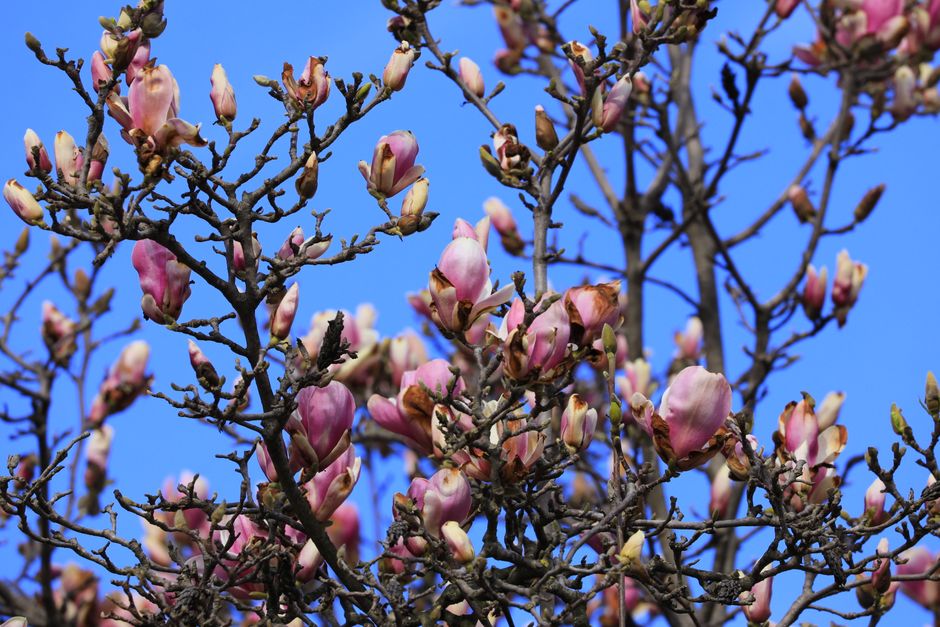
Step-by-Step: How to Trim an Overgrown Magnolia
If the tree is under 12–15 feet and all the work is reachable from the ground or a step ladder, this is manageable yourself.
- Start with the obvious. Dead, dying, and broken branches come out first. Make cuts just outside the branch collar — the raised ridge at the base of the branch where it meets the trunk or parent branch.
- Remove crossing branches. Where two branches rub, one goes. Pick the one with the better angle and structural position.
- Identify the worst offenders. The branches making the tree look overgrown are usually long, vigorous laterals growing straight up or at odd angles. Pick three or four of the worst and reduce each by no more than one-third.
- Don't flush-cut.Never cut flush with the trunk. Leave a short stub at the branch collar and let the tree's chemistry close the wound. Magnolias have enough of a hard time — don't make it harder.
- Step back often. Magnolias are unforgiving of overcommitting. Cut one branch, walk back 10 metres, look at the tree. Then cut the next. (This also keeps you from getting caught up in a rhythm and removing more than you planned.)
- No wound sealant. Old advice. Current practice is to leave wounds open. The tree heals itself.
Tools: sharp bypass pruners for small stems, a clean hand pruning saw for anything over a couple of centimetres. Clean your blades between cuts if you see any sign of disease.
For anything requiring climbing or work above head height, our tree pruning and crown reduction service handles the staged reduction safely. Magnolias have brittle wood at attachment points — a handsaw and a ladder is not the right combination above two metres.
Common Mistakes That Set Magnolias Back Years
Topping.This is the single biggest mistake, and it's almost always done by general landscapers who don't specialise in trees. Cutting the central leader removes the tree's structural framework. What follows is a flush of poorly attached water sprouts that look vigorous but are structurally weak. Topped magnolias spend years in a compromised state.
I've seen this play out. A homeowner in Langley hired a general landscaper — not an ISA-certified arborist — to deal with an overgrown star magnolia. The landscaper took roughly 40% in one cut, topped it, and left large stubs the tree couldn't close properly. The tree spent three years recovering. A proper two-season renovation would have been $500 in year one and $300 in year two. By the time we were called in, the recovery work ran $900 — and that doesn't account for three years of a tree that looked terrible and stressed.
Pruning too late in the season.Anything after early August in our climate risks triggering growth that won't harden before the first frost. The new tissue gets hit, dies back, and the tree has more wound surface going into winter.
Wrong tools. A hedge trimmer is for hedges. Magnolia branches need clean, precise cuts at the branch collar. Ragged cuts from blunt tools or hedge blades create entry points for disease that the tree has to fight for years.
The UBC Faculty of Land and Food Systems has solid guidance on ornamental tree pruning standards for BC's climate. Worth bookmarking if you're managing trees on your property yourself.
When to Call an Arborist (and When Not To)
When you don't need us:
- Tree is under 10–12 feet and all work is reachable from the ground
- You have sharp bypass pruners, a clean hand saw, and an afternoon
- You can commit to stopping at 20–25% and coming back next season for the rest
Our crown reduction service starts around $300 for light work on a small tree. If yours is small and healthy and you have good tools — you can manage it yourself and save the money.
When to give us a call:
- The tree is over 12–15 feet and branches need to come down from height
- You can see structural problems — included bark, a split in the major scaffold branches, signs of decay at the base
- Previous bad cuts left large stubs that haven't closed and you're not sure what's going on under the bark
- The tree is close to a structure and you can't afford a branch landing in the wrong place
An ISA arborist doesn't just cut — they assess. If there's a reason a branch needs to come out a particular way, or a reason to leave something alone, that's the conversation you get. A general landscaper won't give you that.
We've been doing tree pruning in Surrey and Langley since 2009, and we've brought back magnolias in a lot worse shape than yours probably is.