
Cypress trees look after themselves — until they're blocking your eaves, swallowing the fence, or auditioning for a hedge maze. (They grow fast. That's the whole personality.) To trim a cypress tree properly: late winter or early spring, no cuts into dead brown wood, and stop at 25% of the canopy per season.
That covers the basics. If you want to know why those three rules exist — and what happens when someone ignores one of them — read on.

When to trim — and when not to
The best window is late winter to early spring — late February through early April in Surrey, before new growth begins. Trimming just before the growth flush means the tree recovers quickly and new foliage fills in cleanly.
Leyland cypress tolerates a second lighter trim in early summer, usually June, to control size before it puts on another growth surge. Italian cypress doesn't need this — one annual tidy is enough.
The BC nesting season consideration:British Columbia's Wildlife Act protects active bird nests year-round. The high-risk period for disturbing nests runs from March 1 to September 30. Cypress trees — particularly dense Leyland hedges — are popular nesting sites for house sparrows, robins, and starlings. If you can hear or see activity in the canopy, hold off. A quick look before you start takes thirty seconds.
That makes late February the sweet spot for most Surrey properties. Early enough to miss peak nesting, early enough to catch the tree before it pushes hard.
Avoid trimming in late fall or early winter. Cypress doesn't go fully dormant the way a maple does, but it's also not actively growing. Wounds heal more slowly in that period, and the tree heads into storm season in a somewhat stressed state. October through March is when the heavy Pacific systems roll through — not the time to have fresh cuts sitting on your cypress hedge.
The dead wood rule: what you can't undo
This is the rule that trips people up most. With a rose bush or a maple, you can cut back hard and the plant pushes new growth from bare wood. Cypress doesn't work that way.
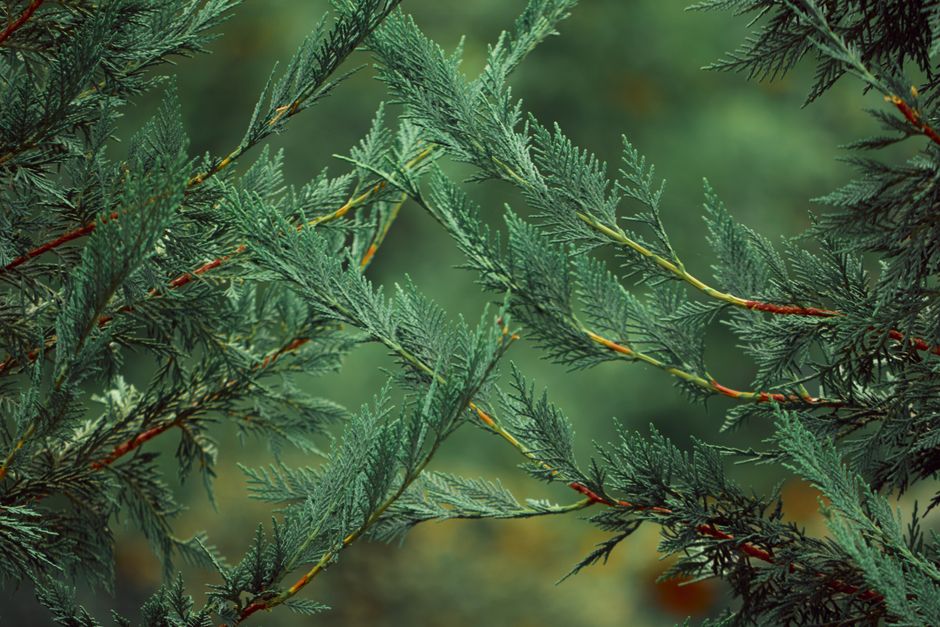
Cypress only regenerates from foliage that is still green. Cut past the green zone into bare brown stems and those branches will not push new growth. Ever. The brown patch stays brown. Permanently.
(This is also how cypress hedges get those ragged rectangular gaps that no amount of subsequent trimming can fix. Someone went too deep with a hedge trimmer, hit the dead zone, and now lives with it indefinitely.)
When trimming, work from the outside inward. Every branch you cut should still have a green tip on the portion you leave behind. If you can see bare brown stem at the intended cut point — back off. Move further out along the branch until you are back in green territory.
Make cuts just above a branch collar at roughly a 45° angle. The collar is the slight ridge where a branch meets the trunk or a larger limb. Cutting there promotes clean wound closure. Leaving long stubs invites disease and slow decay.
How much can you take off
Rule of thumb: 25% of the canopy per season, no more. This applies to most trees, but it is especially important with cypress because of the dead wood issue — you are operating with a narrower margin than you might expect.
Removing more than 25% in a single season stresses the tree. It can trigger dieback across the lower canopy, which is the opposite of what you are trying to achieve. And unlike a deciduous tree that bounces back by the following spring, cypress takes longer to recover.
If a tree has been left for several seasons and is significantly overgrown, spread the corrective work over two or three years. It is not a satisfying answer, but it is the honest one. Attempting to cut back several seasons of growth in a single weekend usually results in a progressively thinning, patchy hedge over the next two years.
For a hedge that has been properly maintained, the annual trim typically removes 6–12 inches from the sides and top. That is enough to keep the shape without stressing the plant.
Tools for the job
Sharp tools are not optional with cypress. Dull blades crush the stem tissue instead of cutting it, which creates entry points for fungal disease. With a species already prone to Seiridium canker — more on that below — clean cuts matter.
- Bypass pruning shears — for branches up to about half an inch diameter. Use bypass (two curved blades), not anvil (one blade against a flat plate). Anvil shears crush; bypass cuts.
- Loppers — for branches half an inch to one and a half inches. Long handles give reach without overstretching.
- Pruning saw — for anything larger. A hand pruning saw gives more control in tight canopy than a reciprocating saw.
- Hedge trimmer — for flat Leyland hedges, electric or battery. Not a chainsaw held sideways. (That image alone should give anyone pause.)
One specific note for Leyland cypress: the sap is a skin and eye irritant for many people. Wear gloves and eye protection. If you are prone to sensitivity, a long-sleeved shirt too. It is not toxic, but it catches people off-guard the first time.
Disinfect cutting tools between trees — particularly if you are moving between a potentially diseased Leyland and a healthy one. Isopropyl alcohol or a dilute bleach solution on the blades. Five seconds of effort that can prevent disease from spreading down a hedge row.

Leyland cypress vs. Italian cypress — different trees, different approach
These two species get lumped together in most guides. They behave differently enough to warrant separating them.
Italian cypress (Cupressus sempervirens) is the tall, narrow column from Tuscany. It grows more slowly than Leyland, holds its narrow form naturally, and needs relatively little intervention. Annual trimming usually means removing dead lower branches and any stray shoots that break the silhouette. It handles Surrey's wet winters reasonably well.
Leyland cypress (× Cupressocyparis leylandii) is a fast-growing hybrid — up to 3–4 feet per year in good conditions. That is why people plant it as a privacy hedge. That is also why it becomes a problem. A Leyland hedge left for three or four seasons can grow 12 feet taller than intended.
Leyland is not native to BC, and it shows. We see Leyland hedges struggle here regularly: disease pressure, root systems that handle our heavy wet soil poorly, and susceptibility to Seiridium canker, a fungal pathogen that causes dead brown patches across the canopy.
Seiridium canker looks identical to the dead-wood trimming mistake described above — the same permanent brown patch. The difference is it spreads. If you are seeing new brown patches appearing after a dry summer, not just in the shaded lower canopy (which is normal), that is worth a professional look. Infected branches need to come off with sterilised cuts before the disease moves further.
A few years ago I assessed a row of Leyland cypress in Langley that had been struggling for years — canker, poor growth, slow decline. I recommended replacing them with Sitka spruce and western red cedar. The homeowner did it, and those trees are thriving. Native species in BC's climate are adapted to what the weather actually does here. Less maintenance, better long-term results. It is not what most landscape designers will tell you. It is what fifteen years of watching trees either work or not has shown me.
If you have Leyland and want to keep it — regular maintenance and prompt attention to brown patches is the approach. If you are planning from scratch, BC's plant pest and invasive species guidance is worth reading before you plant something you will be managing for decades.
When not to do this yourself
For a single Leyland hedge under ten feet, not near any structure or power lines — yes, with the right tools and the 25% rule, you can manage the annual trim. That is a reasonable weekend job.
For anything beyond that, the calculation changes.
- The tree is over 15 feet tall. Any work that requires a ladder above the second rung is work where a single mistake has serious consequences. Ladder falls are the leading cause of injury in residential tree work. The savings on the trim bill do not offset the risk.
- The cypress is within fall distance of your house, power lines, or the neighbour's property. A professional assesses and rigs the work. An amateur makes a guess and hopes the direction is right.
- You are seeing brown patches that don't look like normal lower dieback. If it could be Seiridium canker, trimming without identifying it first spreads the fungus. Get an assessment before cutting.
- You are not sure where the dead zone starts. If the boundary between green and brown is unclear, stop. Permanent damage from cutting too deep is worse than leaving the tree for another season.
I will say this directly: if the job involves a chainsaw on a ladder, that is the point where no amount of YouTube preparation makes it a sensible DIY project. We see the results of that call fairly regularly. None of those stories end with "and then I saved a lot of money."
For a full picture of what professional tree pruning in Langley involves — what we assess, how we work near structures, and what cleanup looks like — that page covers it. For anything involving significant height or disease, a tree risk assessment first is worth the $150.
What a professional cypress trim costs
Pricing depends on height, access, and whether it is a single specimen tree or a full hedge run. These are all-in rates — labour, equipment, and green waste removal.
| Scope | Typical range (CAD) |
|---|---|
| Single cypress specimen, light annual tidy | $300–$500 |
| Single cypress, significant shaping or reduction | $500–$800 |
| Leyland hedge run (10–20 m), annual maintenance | $400–$700 |
| Leyland hedge, corrective reduction over 2 seasons | $700–$1,200 |
| Disease assessment + infected wood removal | $300–$600 |
If a second visit is needed — corrective work spread across two seasons — the second visit is typically less than the first, since the major structural work is done. We do not charge for re-assessment between visits.
The ISA's guide to hiring an arborist has a useful checklist of what to ask before anyone starts cutting. Worth reading before you get quotes on any tree work.
If you want an honest assessment of whether your cypress is worth maintaining long-term or whether a native replacement is the better five-year decision — that is a conversation worth having before you book a trim. We will give you a straight answer even if it means less work for us.