
Your car parked under a tree for one afternoon and came back looking like it was exfoliating. Congratulations — you've been sapped. (The tree doesn't apologise. It never does.)
Here's the direct answer: tree sap damages car paint if you leave it long enough. A regular car wash won't remove it. The fix depends on how long the sap has been sitting — fresh is easy, hardened takes more work, and week-old fully-cured sap might need a professional detailer or paint correction.
Quick guide: For fresh sap (within a few days), isopropyl alcohol and a microfiber cloth will handle it. For hardened sap, a clay bar or dedicated sap remover is the right tool. For anything that's been there more than two or three weeks — especially if the surface feels rough after cleaning — you may need a polish before waxing. Details on each method below.
Nine out of ten calls we get about sap are really about the tree above the car, not the car itself. I'll get to that part.
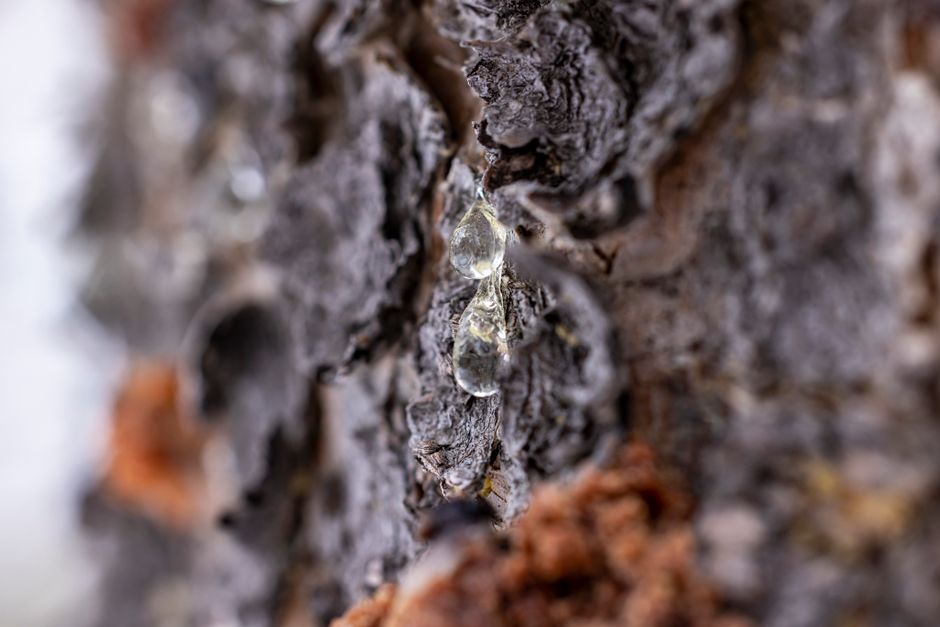
Why tree sap damages car paint
Sap is a mix of sugars, water, terpenes, and organic compounds. On contact with air, it starts to polymerise — harden and cross-link into a substance that bonds firmly to whatever it's sitting on. UV light speeds this up considerably.
The problem isn't the sap melting through paint. It's thermal movement. As the sap cures and hardens, it contracts and expands with temperature changes at a different rate than the clearcoat beneath it. That differential stress is what causes etching — micro-fractures in the clearcoat that leave a permanent crater where the sap sat.
In Surrey's climate — wet springs, warm dry summers with plenty of UV — the window from "easy to clean" to "starting to etch" is roughly 2–4 weeks in summer, longer in winter. That's your working window. Outside it, you're looking at paint correction rather than just cleaning.
The National Research Council of Canada notes that UV-induced degradation of clearcoat is one of the primary causes of paint failure on vehicles. Sap accelerates this process in localised spots.
Surrey's worst sap-producing trees
If you're parking under any of these regularly, this won't be the last time you're reading something like this.
Western red cedar is the stickiest offender in the Lower Mainland. The resin is thick, amber-coloured, and bonds to surfaces quickly. If your driveway is under a cedar, the problem is year-round — and particularly bad after pruning, when the tree produces extra resin in response to cuts.
Douglas fir exudes resin at wound sites. A tree that's had branches damaged by wind, or that's been pruned recently, will be actively weeping for weeks.
Bigleaf maple — the big, beautiful ones that are everywhere in Surrey — produces sap heavily in late winter and early spring. From late spring onward, they tend to host large aphid colonies. The sticky film on your car in summer isn't always sap; sometimes it's honeydew from aphids in the canopy above. Different substance, same problem, same fix.
Ornamental cherry (the pink-flowering ones that line half the streets in Surrey) exudes gummy sap from bark wounds and pruning cuts. If your street was recently pruned, expect drips.
Pine species — various — produce resin steadily, with peaks when the buds open in spring and again after any mechanical damage. Pine resin is particularly tenacious once fully cured.
I reckon if you can identify the tree above your parking spot, that's worth knowing. It tells you what you're dealing with and how fast to act.

Removing fresh sap safely
Fresh sap — caught within a day or two before UV curing has set in — is the straightforward case. You have a few options depending on what's accessible.
Warm water and car shampoo. A bucket of warm (not boiling) water with car wash soap, applied with a clean microfiber cloth in gentle circles. This works well on sap that's still soft and sticky. It won't touch hardened sap, but for same-day or next-day treatment, it's the lowest-risk method.
Isopropyl alcohol (70% or higher). This is the go-to. Dampen a microfiber cloth — not dripping, just saturated — and lay it over the sap for 30–60 seconds. Then lift the cloth. Don't rub at this stage. The alcohol needs time to penetrate and soften the sap before you try to move it. Wipe away what remains, then re-apply if needed.
The rule of thumb: lift, don't scrub. Rubbing spreads the sap and can cause micro-scratches even with microfiber. Saturate, dwell, lift. Repeat as needed.
Hand sanitizer. Same active ingredient as isopropyl alcohol. Works well on small spots, and it's what you'll have available if you catch the sap in a parking lot before it has a chance to cure. Apply, wait 30 seconds, wipe. Not a long-term solution, but effective in a pinch.
Always follow sap removal with a wax or paint sealant. The removal process strips the protective coating in that area. Without it, the next rain and UV exposure will start the etching process faster.
Dealing with hardened, dried sap
Hardened sap — firm, amber-coloured, doesn't yield to gentle pressure — needs a more deliberate approach. Isopropyl alcohol still works, but it'll take multiple applications and more dwell time.
Clay bar decontamination is the most clearcoat-safe method for moderately to heavily cured sap. Lubricate the panel with a clay bar lubricant spray — or a diluted car shampoo solution — and work the clay bar in straight lines across the surface. The clay physically lifts the sap and other bonded contaminants without any chemical attack on the clearcoat. It also removes anything else that's bonded to the paint: industrial fallout, brake dust, embedded grit.
Detailers use clay bars as a first step before polishing precisely because it's the least aggressive decontamination method. It works on glass too, if sap has reached your windscreen.
Dedicated sap removers. Products like Stoner Tarminator or Koch-Chemie Eulex are formulated to penetrate tree sap without attacking clearcoat. Apply, leave for the time specified on the label, wipe off. For badly cured sap, they're faster than repeated alcohol applications. The International Society of Arboriculture categorises pine and cedar resin as among the most adhesive organic compounds that regularly contact vehicle surfaces — dedicated removers are formulated with that in mind.
WD-40. It works as a sap softener. (Yes, WD-40 is useful for something other than squeaky hinges.) The problem is the oily residue it leaves behind — you need to wash the panel thoroughly with car shampoo afterward, otherwise the wax won't bond properly. Last resort, not first choice.
Plastic razor blade for very stubborn, rock-solid deposits. Shallow angle, always with a lubricant underneath — never dry. You're skimming, not scraping. After this, the panel will almost certainly need a machine polish to correct any micro-scratches before you wax.
Mistakes that damage paint
The sap removal horror stories I hear are almost always about what someone used, not what they left on too long.
Acetone (nail polish remover). Too aggressive for clearcoat. It strips the clearcoat in seconds, not minutes. Don't use it regardless of what you read elsewhere. (The temptation to use whatever's under the sink is real. The bathroom cabinet and the car garage are not interchangeable product libraries.)
Metal tools. Coins, keys, metal scrapers — they scratch clearcoat permanently. If you want to use a blade, it has to be plastic, held at a very shallow angle, and always lubricated.
Dry rubbing. Any sap removal attempt without a lubricant is a scratch in progress. Microfiber on dry sap creates friction. Always pre-wet the area.
Automatic car washes. The rotating brushes will spread the sap across a wider area and add swirl marks. The chemistry in most drive-through washes isn't designed to dissolve tree sap. You'll drive out with more surface area affected and more scratches.
Waiting to see if it falls off. It won't. Sap becomes more bonded over time, not less. Every week of inaction is a harder removal job.
Protecting your paint after removal
Whatever method you used, the clearcoat in that area needs protection restored immediately. Sap removal — even the gentle methods — strips off the wax or sealant layer.
A carnauba wax or paint sealant applied within 24 hours of removal will do the job for most homeowners. For spray-on convenience, a SiO2-based quick detailer is faster and provides good short-term protection.
If you're dealing with this every spring because a tree is directly above your parking spot, the longer conversation is about ceramic coating. A professionally applied ceramic coating creates a harder surface layer that sap can't bond to as readily. Cost ranges from $500–$1,500 depending on the size of the vehicle and how many layers are applied. It won't prevent sap from landing — nothing does — but it makes removal a 10-minute job rather than a 2-hour one.
That said, if you've got a cedar or pine dripping directly onto your car every week, the coating is treating the symptom. The source is the problem. More on that in the next section.

When to call an arborist (and when not to)
Honest answer first: you don't need an arborist to clean sap off your car. That's a detailing problem. Don't call us for that.
But if you're spending an hour on this every spring, and a cedar or pine is sitting directly above your parking spot with one or two branches overhanging at 15–20 feet — that's a tree problem with a tree solution. Crown reduction on a branch dripping onto a driveway runs $300–$600 in Surrey, depending on the branch size and access. Compare that to a paint correction job ($200–$500 per panel), and the math isn't complicated.
We handle driveway overhang reductions regularly as part of our crown thinning and pruning service in Surrey. One visit, one or two branches reduced or removed, problem largely solved. The tree stays healthy. Your clearcoat stays intact.
Call us if:
- The overhanging branch is over 15 feet up
- The branch is near power lines or a roofline
- The tree is showing signs of disease, instability, or structural damage (worth a full tree health assessment while we're there)
- You want the whole canopy assessed and shaped, not just one branch
Don't call us if:
- You just need to clean the car — a clay bar and an afternoon handles that
- The branch is small, well under 10 feet, and accessible from the ground with a pole saw
- You're renting and don't have authority over the tree (talk to your landlord first)
I'd rather talk someone out of a call-out fee than take a job that isn't worth the trip. That said, if the tree is over 20 feet or anywhere near a structure or power line, don't attempt it yourself — the cost of getting it wrong is not the branch you were trying to remove. WorkSafe BC's guidance on tree work hazards is worth a quick read before anyone picks up a saw.
Give us a call if you want a straight answer on whether trimming makes sense. No charge to ask.